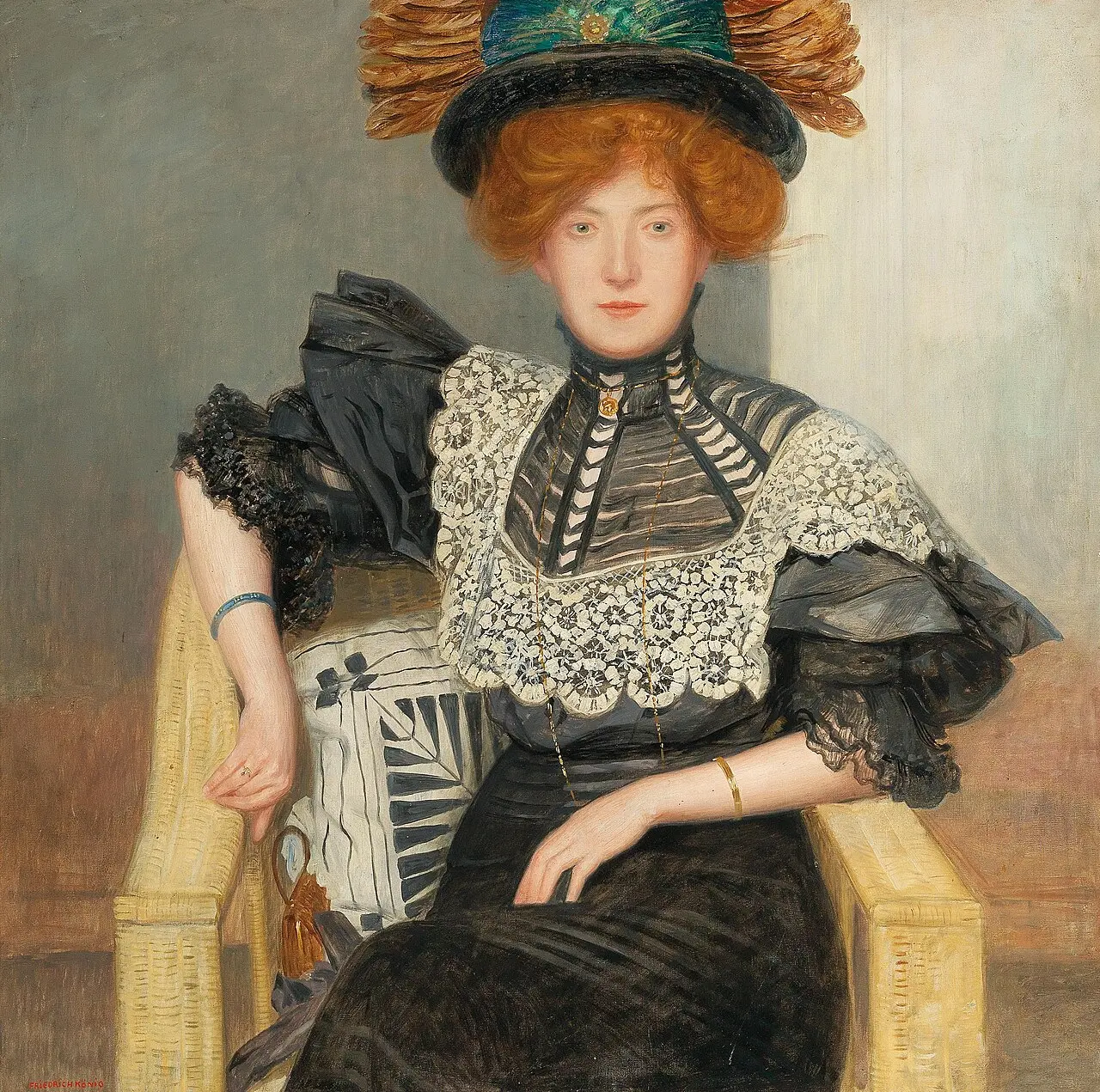
Vienna Secession: Friedrich König:
Portrait of a Lady with Lace-Trimmed Blouse and a Hat with Feathers (Damenbildnis mit Spitzenbluse und Federhut), ca. 1900-1910
Oil on canvas
100 x 100 cm
Auctioned at Dorotheum in 2018 for EUR 7,500
Anyone familiar with Gustav Klimt’s portraits will immediately recognize the world this woman inhabits. Friedrich König was not Klimt, yet this elegant sitter with her elaborate lace collar, feathered hat and confident presence belongs to the same Vienna where wealth, fashion and culture went hand in hand. Her name is unknown, yet her appearance suggests a place among the city’s affluent elite, the patrons whose support helped shape the artistic climate of fin-de-siècle Austria.
The Textures of the Chair and Lace
The painting draws attention to the woman’s clothing, her wicker chair and the carefully chosen details that surround her. Friedrich König (1857-1941) selected a canvas that measures exactly one hundred by one hundred centimeters. The square format gives the portrait an unusual sense of balance and presence. The woman sits in a wicker armchair. This type of furniture became popular through the work of the Wiener Werkstätte designers.
König painted the dress and lace collar with great care. The heavy dark silk of the dress fills the lower part of the picture. This dark fabric creates a strong contrast with the white lace collar above it. The artist painted every thread of the lace pattern. The lace is more than decoration. It is also a subtle display of status. A large hat with brown feathers frames her striking red hair against the muted background. Although surrounded by the lace collar, feathered hat and elegant dress, it is the directness of her gaze that gives the portrait its presence.
The Second Portrait from Dorotheum
Records from the Dorotheum auction house in May 2018 show that König painted two remarkably similar portraits that appeared in the same sale. Both share the same square format and the same wicker chair. Seen together, they feel almost like variations on a theme.

The identity of the sitter remains unknown, yet the similarities are striking. The same red hair, the same features and the same wicker chair strongly suggest that König may have portrayed the same woman more than once. In one painting she meets the viewer’s gaze directly beneath an imposing feathered hat. In the other she turns away, dressed in lighter fabrics and long gloves beneath a dramatic blue-green plume.
If the two works do depict the same sitter, they reveal how dress, colour and pose could completely transform her appearance while preserving her social status and elegance.
A Portrait of Vienna’s Elite
König was an important figure in the history of Austrian modernism. He left the conservative Künstlerhaus in 1897 to help establish the Vienna Secession and later worked on the editorial committee of Ver Sacrum, where he published graphic works.
Like many artists of his generation, König needed patrons. Portrait commissions from wealthy clients provided a living and allowed artists to pursue more ambitious projects alongside them.
Readers interested in other aspects of König’s work may also enjoy his mythological painting Three Nymphs and a Fawn (1900) and the later Portrait of a Lady (ca. 1912-1915), both featured previously on this site.
König concentrated on the clothing, interiors and manners of Viennese high society, recording how a social class wished to present itself while helping shape the cultural life of the city.
Together, these two portraits bring that world back to life. König may not have pursued the decorative brilliance of Klimt, but they breathe the same atmosphere of turn-of-the-century Vienna, where fashion, status and modern culture were closely intertwined.
Leave a Reply