Vienna Secession: Wilhelm Bernatzik:
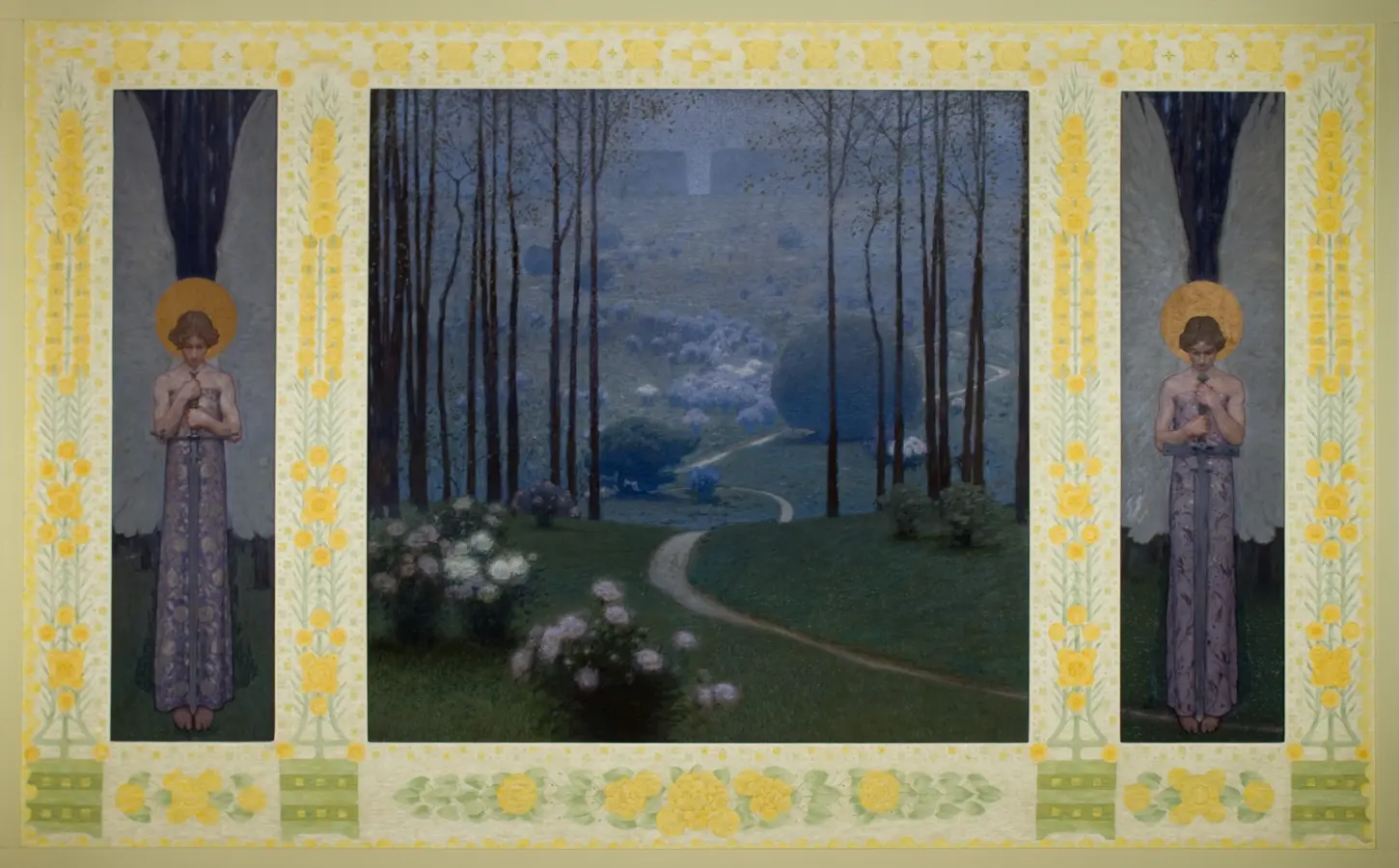
Entrance to Paradise (Eingang zum Paradies), ca. 1903–1906
Oil on canvas
Dimensions unknown (monumental triptych)
©Museum Wiesbaden, Wiesbaden, Germany
The Vienna Secession was not only about portraits, symbolism, or decorative design. Artists such as Wilhelm Bernatzik also reimagined the landscape, transforming it into something more personal, poetic, and mysterious. Wilhelm Bernatzik was a founding member and even served as the group’s president between 1902 and 1903. Although he is far less familiar today than Gustav Klimt, his large three-panel painting Entrance to Paradise shows exactly what the movement stood for. It perfectly combines a dreamlike atmosphere with the decorative language that became one of the hallmarks of the Vienna Secession.
The Look of the Painting
Bernatzik chose a triptych format, which means the painting is divided into three separate panels. This setup creates a clear path for the eye to follow. On the two narrow side panels, he painted tall, quiet women with gold halos around their heads. They stand like silent figures at a gateway, framing the scene and drawing attention toward the path beyond.
In the large middle panel, a winding trail draws the viewer straight into the woods. The path passes dense flowering bushes and gradually disappears into a bright glow in the distance. Rather than smoothing everything into a decorative pattern, Bernatzik used thick paint to give the leaves and flowers a tangible texture. The path acts as a guide, leading the viewer away from the darker foreground and toward the light beyond.
Dates and the Missing Dimensions
There is a slight confusion about the exact year of the painting. Museum Wiesbaden lists the work as 1903. This date matches the period immediately following Bernatzik’s presidency of the Secession. He later joined Gustav Klimt and the progressive artists who left the group in 1905. Other art archives use the date 1906. This was the year Bernatzik died and the year in which the painting entered the historical record.
Interestingly, the exact physical dimensions of this monumental work remain unlisted in public museum databases. Based on comparable Secession-era triptychs and the way the work is displayed in Museum Wiesbaden, the painting may stand roughly 150 to 180 centimeters high and extend some 220 to 260 centimeters in width, although no official measurements have been published.
The Impact of the Frame
Seeing the artwork with or without its frame changes the experience entirely.

Without the frame, the three canvases feel like one continuous landscape. The eye moves naturally from the side figures toward the central path and into the distance.
The original frame displayed in Museum Wiesbaden creates a different effect. Its decorative structure introduces strong divisions between the panels, turning the composition into three distinct visual spaces. At the same time, the floral ornamentation connects the painting to the broader ideals of the Vienna Secession, where architecture, decoration, and painting were often conceived as a unified whole.
The frame separates the standing women from the central path, transforming the frame itself into a symbolic gateway that perfectly complements the painting’s title. Rather than functioning as a simple border, it becomes part of the experience. Standing before the work, it is easy to see why Bernatzik chose this format. The viewer is not simply looking at a landscape but is being invited to move through it.
Whether the painting ultimately dates to 1903 or 1906, Entrance to Paradise belongs to the final years of Bernatzik’s career. More than a century later, its appeal lies not in providing answers but in leaving room for imagination. Who are the haloed women? What lies beyond the light at the end of the path? Bernatzik never tells us. Instead, he leaves the gate open and lets every viewer complete the journey in their own way.
Leave a Reply