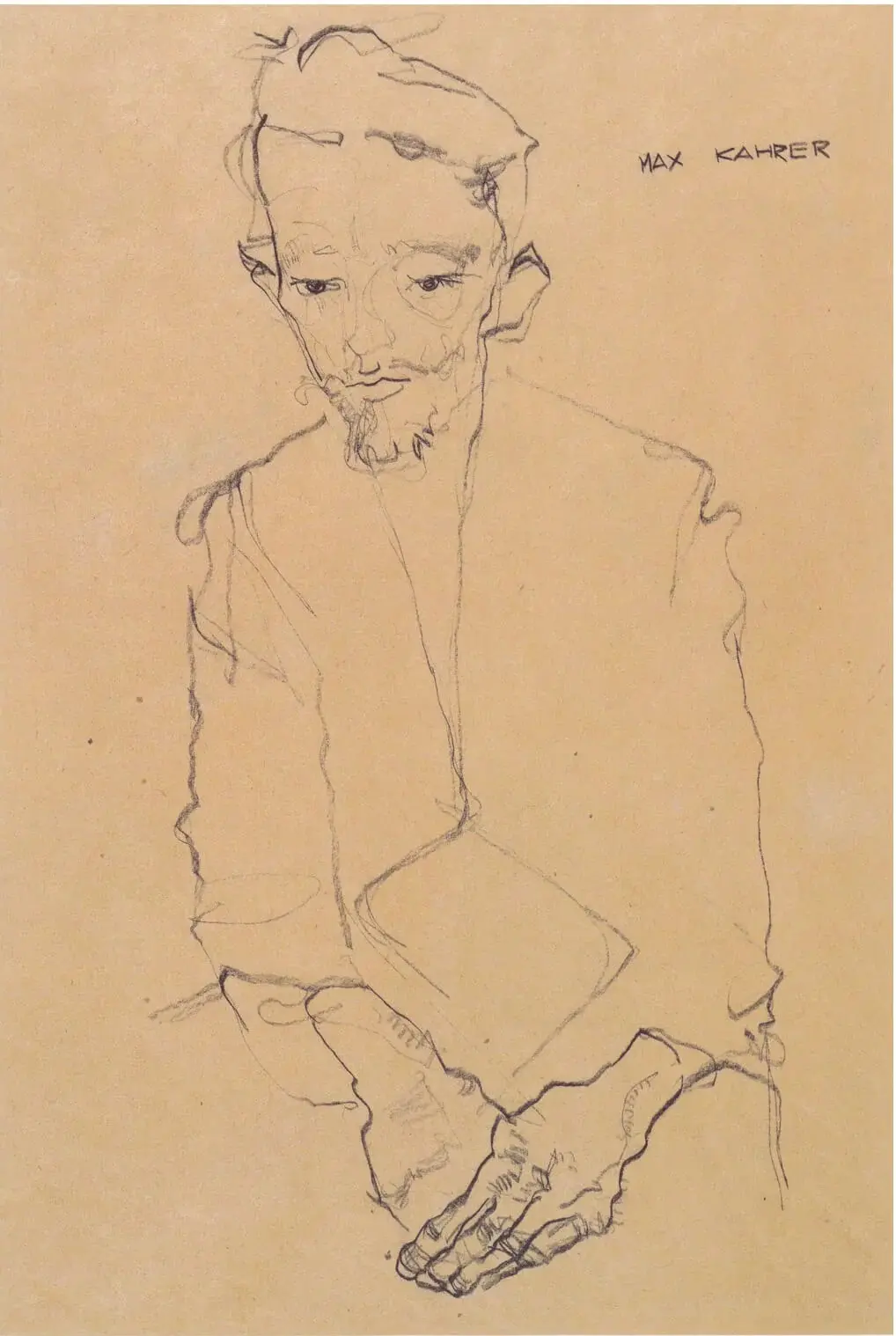
Egon Schiele:
Max Kahrer, 1910
Drawing (black chalk on brown packing paper)
44 x 31.7 cm
©Albertina Museum, Vienna
(Kallir d623)
In 1910, Egon Schiele increasingly turned his attention to the people around him. Friends, fellow artists, patrons and family members all became subjects for a growing number of rapid portrait studies. Among them was Max Kahrer, one of the first people to recognize Schiele’s talent and help the young artist gain opportunities beyond the Academy. Rather than creating a formal likeness, Schiele captured someone he knew well, reducing the portrait to a few decisive lines, a weathered face and a pair of strikingly large hands.
The Klosterneuburg Connection
When Schiele met Max Kahrer, he encountered someone already established within the artistic community. Born in Temesvar in 1878, Kahrer studied in Vienna and Munich before settling in Klosterneuburg, where he became known as a painter, teacher and organizer of local artistic life. During his years as a drawing teacher, he recognized Schiele’s remarkable draftsmanship and became an early supporter.
At a decisive moment in Schiele’s development, Kahrer helped open doors that the Academy could not. He facilitated the young artist’s participation in the 1908 exhibition of the Verband heimischer Künstler in Klosterneuburg, providing valuable public exposure. By the time Schiele drew this portrait in 1910, the relationship had evolved from teacher and student into one between fellow artists.
Schiele portrayed Kahrer on several occasions, suggesting a relationship that extended beyond a single sitting. Readers interested in comparing different interpretations of the artist may also enjoy our post on Max Kahrer in Profile Facing Left, 1910, which shows how Schiele approached the same sitter from a very different angle.
Brown Paper and Direct Observation
Like many works from this period, the drawing was executed on coarse brown packing paper rather than expensive academic stock. Schiele embraced the material’s rough texture, allowing the surface itself to become part of the image. Large areas remain untouched, while a few dark chalk lines do most of the work.
The first thing that stands out is Kahrer’s hands. Schiele gives them almost as much visual weight as the face itself. Using only a handful of strokes, he defines the essential features of the sitter while avoiding unnecessary detail. The result feels unpolished, as if the artist were trying to capture an impression before it disappeared.
The dark coat forms a compact shape that anchors the figure near the bottom of the sheet. Above it, Kahrer’s head and hands emerge from the brown paper with remarkable clarity. There is little distraction and almost no background. Everything directs attention back to the sitter. The drawing demonstrates just how much Schiele could express with surprisingly little.
Multiple Views of the Same Sitter
Schiele rarely stopped after a single drawing. When a sitter interested him, he often produced several versions in quick succession, experimenting with different viewpoints and poses. Kahrer was no exception. Creating multiple versions allowed Schiele to explore different aspects of the same person. Rather than searching for a single definitive image, he approached portraiture as a process of observation. Each drawing captures Kahrer slightly differently, revealing both the character of the sitter and Schiele’s growing confidence as an artist.
This drawing later entered the Albertina through the estate of Heinrich Benesch, one of Schiele’s most loyal supporters. Thanks to collectors and friends such as Benesch, many of Schiele’s early drawings survived and eventually found their way into public collections. More than a century after it was drawn, this portrait still offers a glimpse into the circle of artists, supporters and friends who helped shape Schiele’s formative years.
Leave a Reply