Egon Schiele:
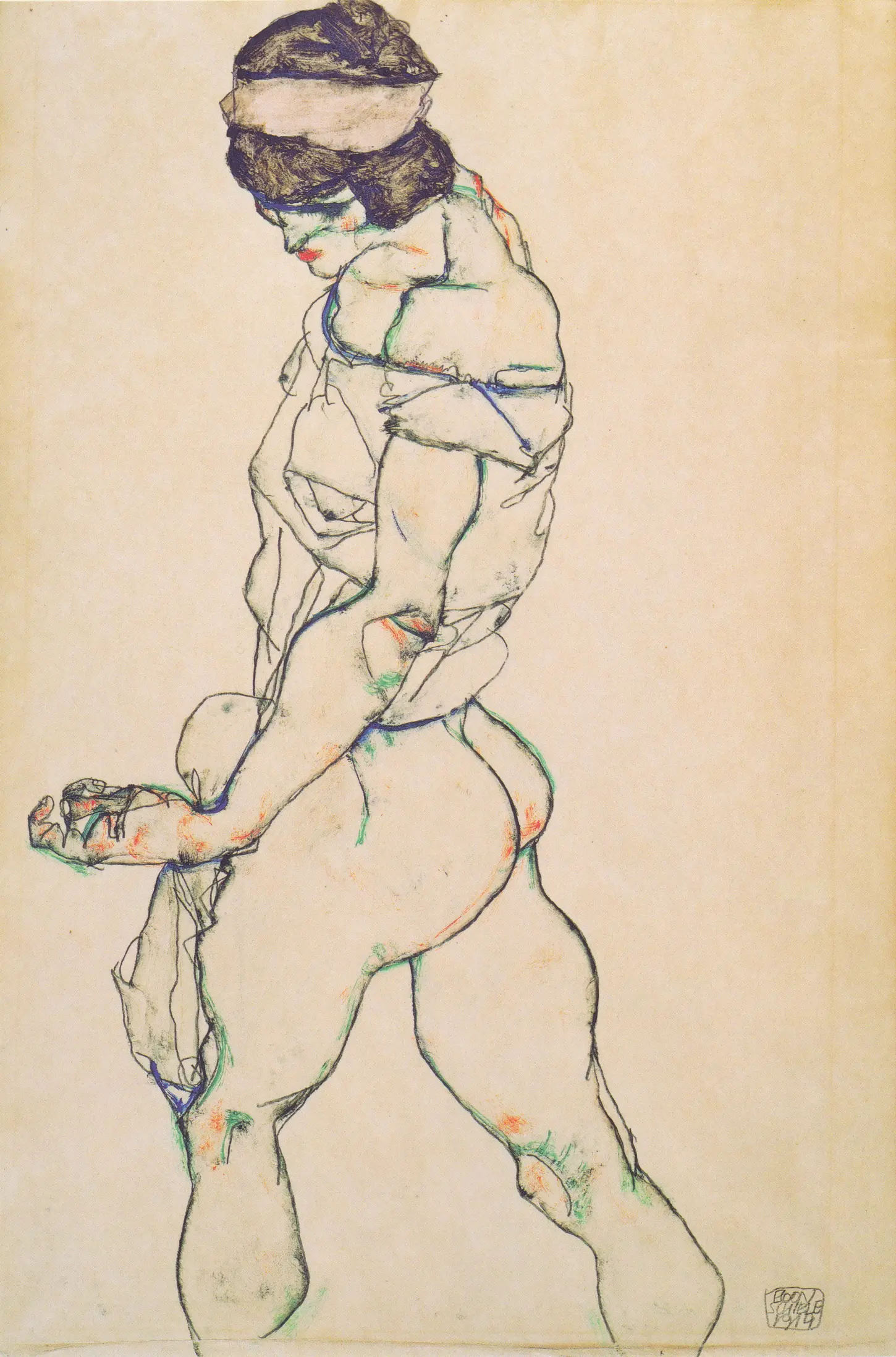
Female Nude Striding Left (Nach links schreitender Frauenakt), 1914
Gouache and pencil on paper
48.4 × 32 cm
©Albertina, Vienna
(Kallir d1492)
Egon Schiele draws this woman partly undressed as she takes a sharp step forward. He keeps her upper body wrapped in clothes while exposing her bare hips and legs in a direct, unvarnished way. By dropping everything else from the background, he forces you to look straight at her body, without making it any more romantic, warmer, or more beautiful than it really is.
Shocking High Society
This drawing dropped a bomb on traditional ideas about beauty in its time. In the polite art circles of Vienna, people expected life studies to be balanced and soft. Schiele chose a much harder path. Instead of presenting a graceful pose, he cuts the contours with quick, jagged strokes that emphasize raw physical bone and muscle. In a society obsessed with decorative facades and proper appearances, this unvarnished look at a body was a direct provocation. Collectors and critics either loved it for its absolute honesty or hated it for its harshness.
Schiele produced these drawings at an enormous speed, working in a rapid tempo that defined his daily studio practice. During 1914, this fast pace pushed his style toward increasingly angular nude drawings that almost felt cubist. He skipped the sharp pencil points here, rubbing a soft graphite stick flat against the paper to drag out wide, grainy shadows along her hips and joints. This action strips away the typical studio look and turns her walking stance into something rough and moving. It is a powerful example of how in his drawings Schiele intentionally chose friction over classical harmony.
The Restless Months of 1914
This sheet comes from 1914, a volatile year where the tension of a looming war was heavily felt in the air. It captures a fragile, final moment right before the outbreak of that conflict changed the European landscape and human reality forever. On this site, this image connects directly with a sequence of intense experiments from those same creative months. It carries the same heavy graphic energy as the dark lines in self-portrait, 1914 and the close anatomical focus found in embrace, 1914.
Instead of decorating the skin with mosaic patterns like Gustav Klimt, Schiele used brief patches of green and orange gouache to show uneven flesh tones. He left the rest of the sheet blank, letting the natural grain of the paper contrast with the dark outlines. When you look at this drawing more than a century later, you still don’t know whether to find it beautiful or deeply ugly. That exact doubt is precisely what Schiele wanted to evoke.
Leave a Reply