Egon Schiele:
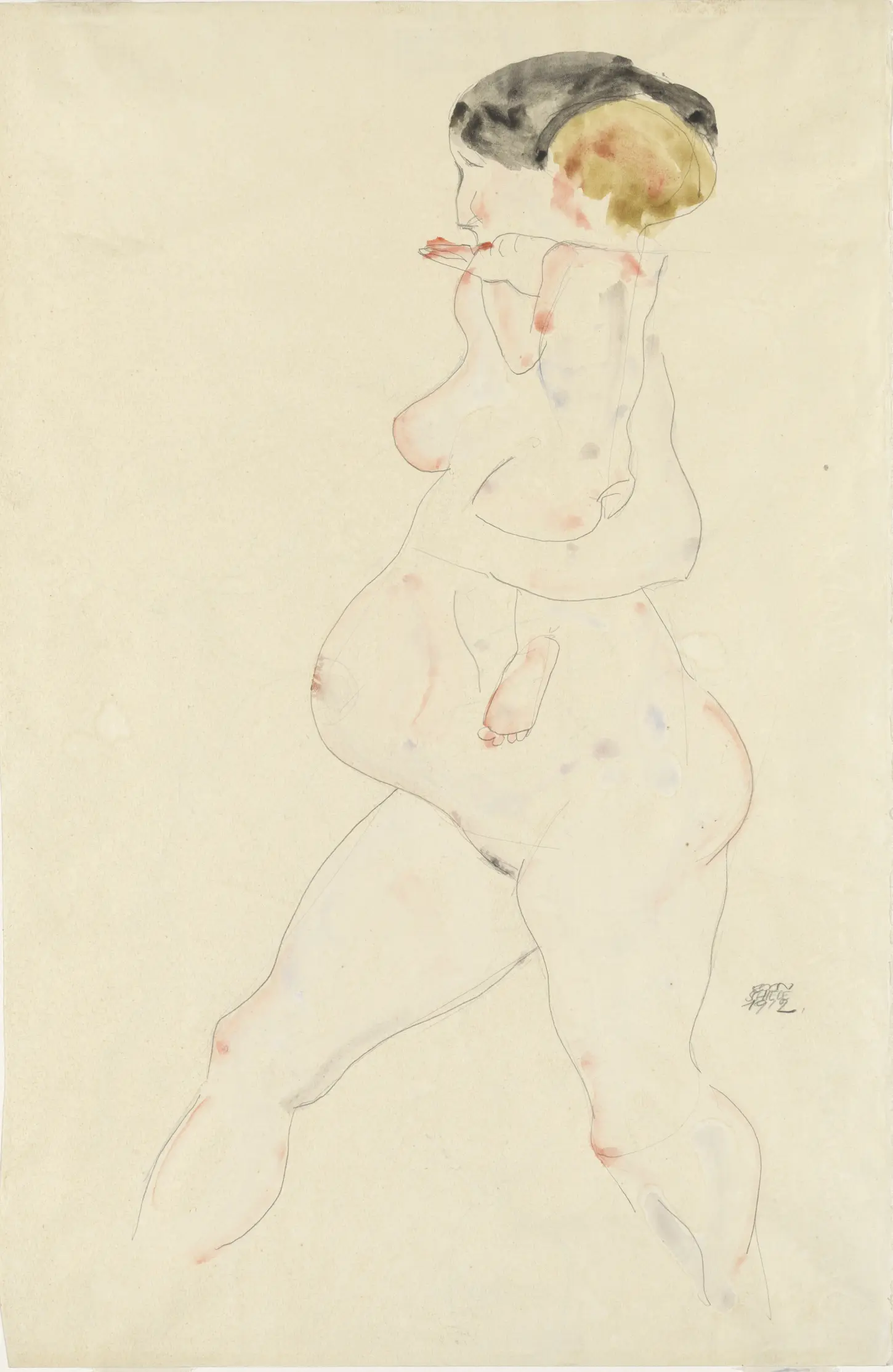
Pregnant Woman with a Child on her Arm (Schwangere Frau mit Kind auf dem Arm), 1912
Watercolor and pencil on paper
48.3 x 31.8 cm
©Wien Museum, Vienna
(Kallir d1081)
In the spring of 1912, Egon Schiele experienced a trauma that permanently altered the emotional weight of his artwork. The local authorities in the village of Neulengbach arrested the artist, branding his raw drawings of the human body as immoral and locking him in a prison cell for twenty-four days. This brief period of captivity left deep psychological scars, forcing a shift in his style toward sharp lines and fragile figures that captured the pure struggle of existence. This watercolor stands as a powerful record of that transition, turning a traditional theme of motherhood into a haunting image of survival.
The scars of Neulengbach
Before his imprisonment, Schiele often painted his figures as if they were floating freely in an empty space, focused primarily on decorative line play. The experience of the prison cell brought his vision back to earth with an painful focus on human vulnerability. During his trial, the judge even burned one of his drawings over a candle flame, a symbolic act of hostility that had deeply shaken the young artist. When he returned to his studio, his approach to the human form had lost its early elegance.
This watercolor completely rejects the warm, joyful imagery usually connected to pregnancy and motherhood. Instead of a celebration of new life, Schiele presents a gaunt woman with hollow eyes and a tight, defensive posture. Her thin face looks worn by life, and the small child clinging to her arm shares that same anxious, lost expression. The empty paper background leaves the mother and child completely alone, highlighting their isolation.
From fragile lines to expressionist truth
The strength of the drawing comes from the nervous quality of the pencil work that defines the year 1912. Schiele no longer used smooth, sweeping lines to contour the body. He dragged across the paper in short, angular bursts, creating jagged edges around the woman’s belly and shoulders that look almost like physical wounds. The pale watercolor washes applied to the skin do not add warmth, but rather heighten the delicate, fragile nature of the two figures.
This specific breakthrough in honesty laid the technical foundation for his subsequent masterworks. The desperate energy found in this prison-year study directly carried over into his next creative phase, visible in the tense poses of his 1913 works like Standing Girl in Blue Dress and Green Stockings, Back View. This intimate work remains a striking record of survival that still connects with viewers today.
Leave a Reply