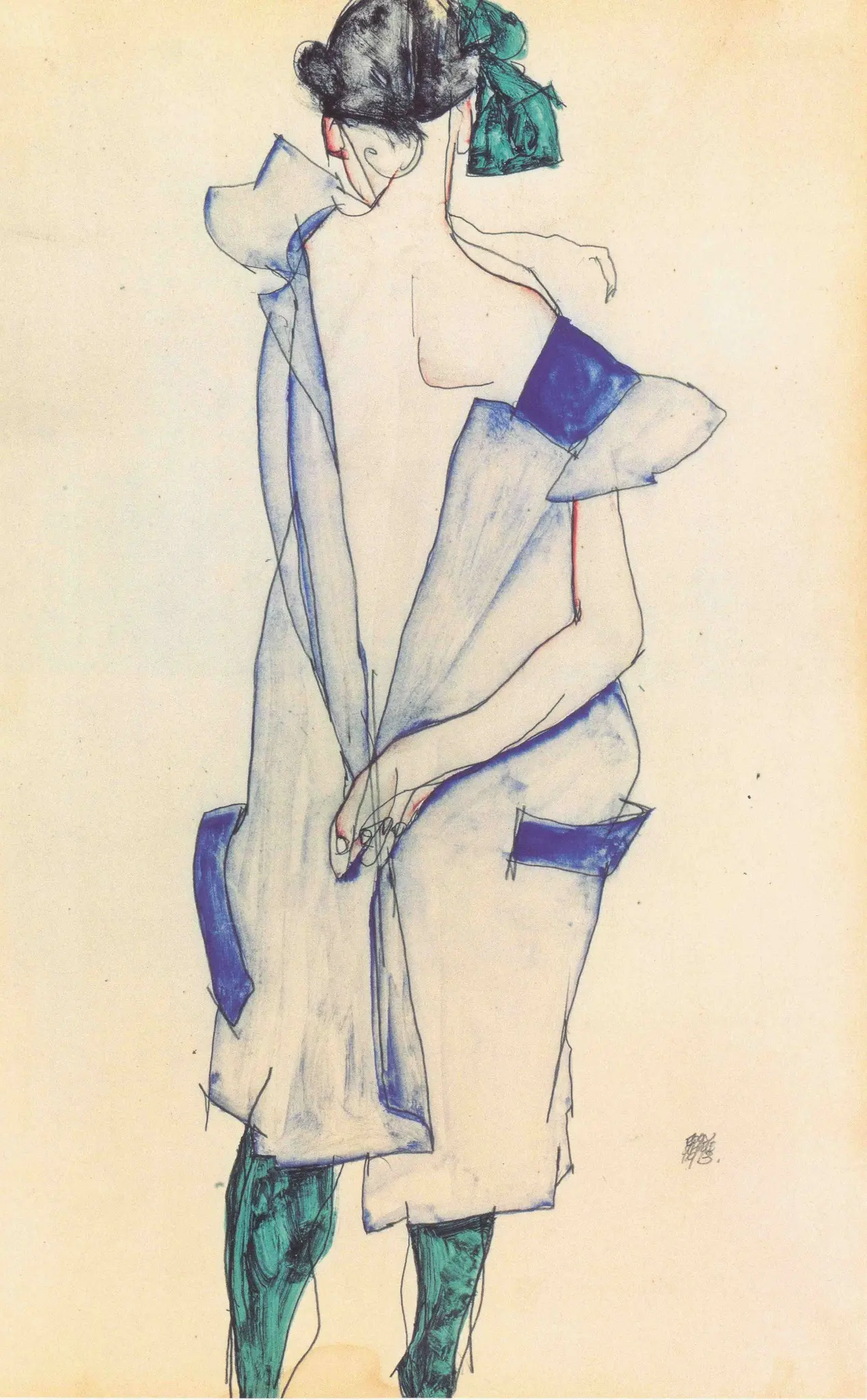
Egon Schiele:
Standing Girl in Blue Dress and Green Stockings, Back View (Stehendes Mädchen in blauem Kleid und grünen Strümpfen, Rückansicht), 1913
Watercolor and pencil on paper
47 x 31 cm
Private collection
(Kallir d1271)
This drawing turns a standing woman into a graphic study of raw skin against heavy fabric. Egon Schiele uses this rear perspective to remove facial expression, relying entirely on her posture to communicate tension. The work belongs to a series of studies focusing on women, partly nude, in draped robes, using the same model featured in Standing Girl, Head Resting on Hand, 1913.
From the cell to the Hietzing studio
Schiele created this drawing during a frantic burst of work following his traumatic 1912 imprisonment in Neulengbach. The arrest on false charges of public immorality left him deeply shaken, but his freedom triggered an intense creative output. He moved into a large, quiet studio on Hietzinger Hauptstraße in Vienna, a space he decorated with dark walls and minimalist furniture to focus entirely on his subjects.
During this 1913 transition, his attention focused on how loose clothing could both hide and expose the body. He used an anonymous model for these sessions, experimenting with specific, draped robes. In this study, the blue garment acts almost like a shell, featuring wide cuffs and a long, sharp opening that frames her bare spine.
Sharp lines and unblended watercolor
Schiele captured the woman’s form with a fast, uninterrupted pencil line. He used his distinct technique of keeping his eyes locked onto the subject, rarely glancing down at the paper while his hand moved. This tense approach created the sharp, geometric angles that define her shoulder blades and the folds of her robe.
The watercolor fields bypass traditional shading. Schiele applied the cobalt blue and emerald green in quick, wet layers, leaving the edges stark and unblended. The deep tones spills outside his pencil outlines, existing as independent color shapes on the cream paper. This handling of watercolor marks his entry into expressionism. Everything in the drawing serves to frame the woman in her robe, turning a simple back view into a powerful study of fabric and bare skin.
Leave a Reply