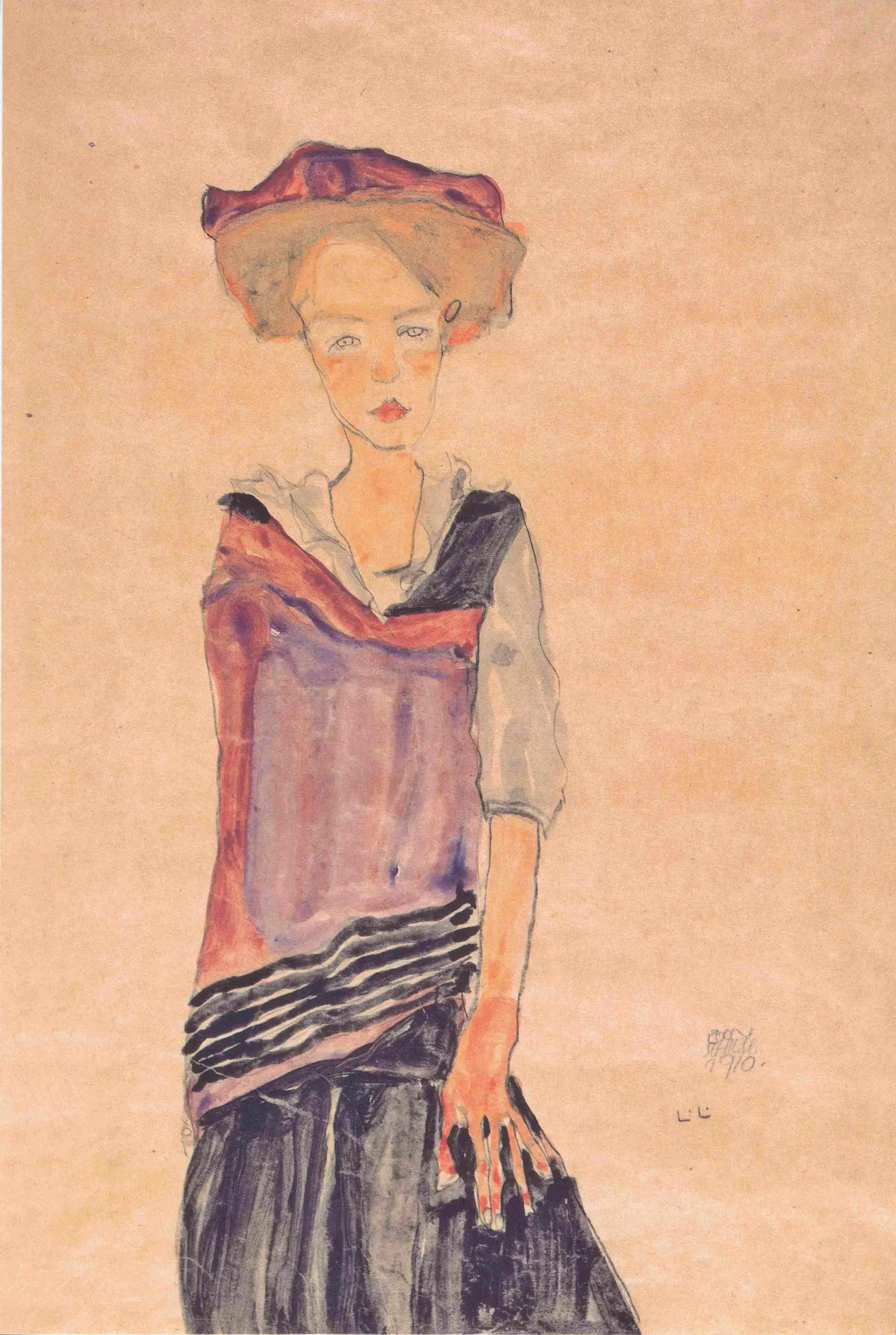
Egon Schiele:
Standing Girl (Stehendes Mädchen), 1910
Watercolor and crayon on paper
43.1 x 29.2 cm
©Albertina, Vienna
(Kallir d487)
In 1910, Egon Schiele altered his approach to portraiture by stepping away from academic conventions. He focused on the isolated human figure, leaving the paper surrounding his subjects entirely blank. This specific sheet illustrates his shift toward this representation during his breakthrough year in Vienna.
Unmasking the Subject
The identity of the model remains a subject of ongoing discussion. In her catalogue raisonné, Jane Kallir places this drawing within a sequence of works that frequently featured the artist’s younger sister, Girl’s Head (Gertrude Schiele). However, Kallir also records an unverified alternative theory suggesting the subject could be Poldi Lodzinsky. Lodzinsky was the daughter of a local driver from Krumau, the town where Schiele frequently worked. She was slightly younger than Gerti but shared similar physical traits, leaving the exact attribution impossible to verify with definitive historical documentation.
Breaking the Academic Mold
Schiele used this phase of his career to challenge traditional Viennese aesthetics. He rejected the balanced, classical postures taught at the Academy, favoring rigid poses instead. The physical form in this drawing is constructed from jagged charcoal outlines that emphasize skeletal landmarks. This urge to capture real, unfiltered human experiences directly from life also drove him to sketch raw everyday scenes, such as his contemporary study Mother with Child. The drawing displays a sharp departure from the decorative patterns favored by his former mentor, Gustav Klimt.
The Use of Luminous Boundaries
The paper acts as an active element within the composition. Schiele completely isolated the female silhouette, refusing to ground her with floorboards. To heighten this sense of detachment, he applied a thick border of white gouache directly along the outer contours of her body. This outline functions as a zone that separates the skin from the paper. The application of watercolor washes is highly localized, ensuring that large areas of the composition remain completely bare.
Leave a Reply