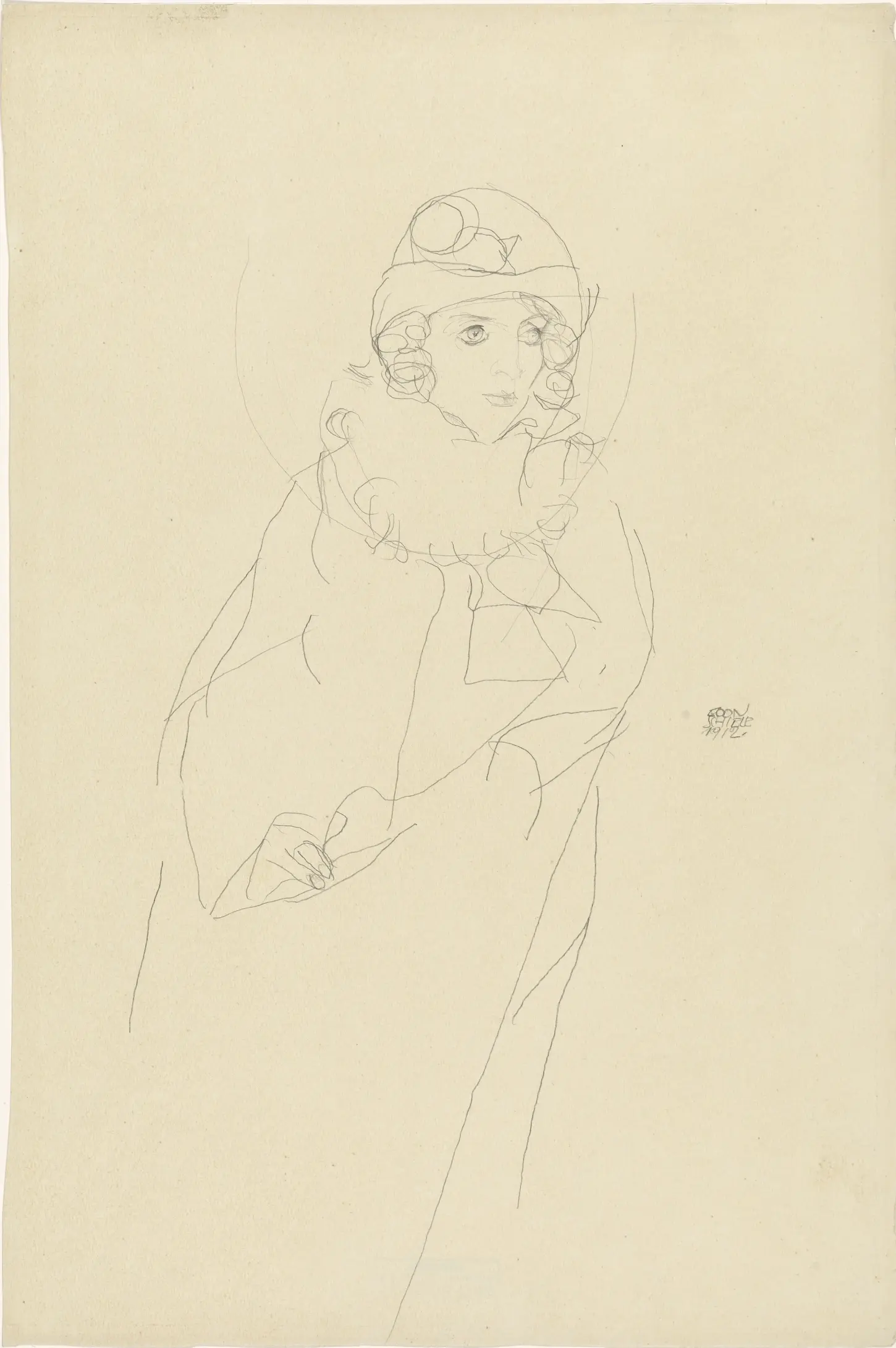
Egon Schiele:
Woman in a Fur Coat (Frau im Pelz), 1912
Pencil on paper
47.7 x 31.1 cm
©Wien Museum, Vienna
(Kallir d1132)
the look earlier today at Anton Faistauer’s oil painting introduced Ida Roessler, the wife of the influential Viennese art critic Arthur Roessler. As a writer and promoter, Arthur Roessler was the main driving force behind the young artists who challenged the traditional art world. This 1912 pencil drawing by Egon Schiele shows Ida from the same inner circle, focusing the entire composition on her gaze.
The Roessler Circle and Schiele’s Choice
This drawing comes directly from Schiele’s work with his early supporters. Arthur Roessler and Ida Roessler provided studio space and managed sales for the young artists who left the academy. This connection gave Schiele the freedom to draw Ida without the restrictions of a formal commission. He rejected the traditional need for a polite family picture, focusing instead on a direct study that led to his final painting, Portrait of Ida Roessler from 1912.

Archival records from the Wien Museum add an important layer to her identity, listing Ida as a translator. She operated as an educated, intellectual force within the Viennese avant-garde rather than a passive observer. The clothing in Henry Traut’s photograph shows her actual style during these years. The Roesslers used modern fashion to signal their position as progressive city dwellers. Schiele studied how the heavy winter coat altered the lines of Ida’s body, documenting the look of the circle that funded the Neukunstgruppe exhibitions at Salon Pisko.
Fur, Form, and Creative Contrast
The pencil lines create a clear contrast on the paper. Schiele built the coat with quick, jagged strokes that fill the lower half of the drawing. Directly above this mass, Ida’s face emerges with very few lines. Schiele left the surrounding paper bare, drawing the eye directly to her features and her steady gaze.
The composition shows how Schiele relied on a close personal shorthand with Ida. Traut’s camera recorded her official social appearance, but Schiele used his graphite lead to strip away bourgeois convention. He used the texture of the heavy fur to isolate her head, making her expression the central anchor of the entire sheet.
This work offers a clear alternative to the oil painting published on this site earlier today. While the later Ida Roessler (1914) by Anton Faistauer relies on painterly weight and thick layers of pigment, Schiele uses the speed of a graphite line. He handles Ida with a separate method, proving that paper and pencil could establish a modern presence without the density of canvas.
Leave a Reply