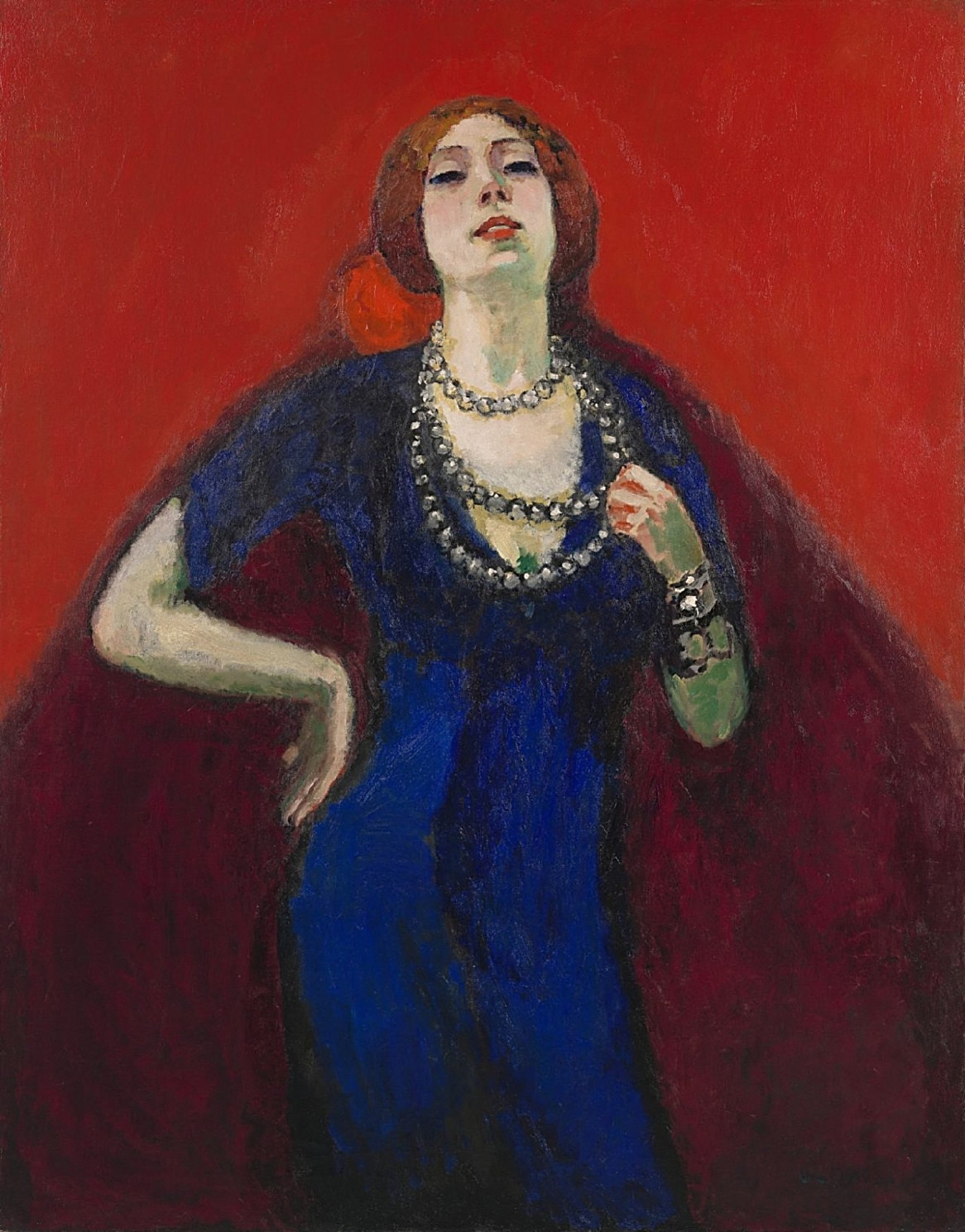
Dutch Modernism: Kees van Dongen
The Blue Dress (La robe bleue), 1911
Oil on canvas
146.2 x 114.4 cm
©Van Gogh Museum, Amsterdam
The arrival of Dutch artists in Paris at the turn of the century changed modern portraiture. Kees van Dongen became a key figure within the French avant-garde by challenging traditional ideas about color and form. This canvas marks a major moment in his career where his personal life and a new style of painting came together.
Guus Preitinger and the Realities of a Bohemian Marriage
The woman posing in this large portrait is Augusta “Guus” Preitinger. She was a Dutch painter who met Van Dongen during their student years at the academy in Rotterdam. The couple moved to Paris together and married in 1901, joining the local bohemian art community.
Their partnership directly shaped Van Dongen’s painting style during his Fauvist years. Preitinger acted as his main model while they navigated the financial struggles of their early time in Paris. This relationship ended a decade after he finished this canvas. The couple divorced in 1921 after the artist started a relationship with fashion director Jasmy Jacob, a change that altered his social circle and his future portrait work.
Electric Light and Green Shadows: The Fauvist Technique
Van Dongen broke away from traditional art rules by using pure, unblended colors to paint the human body. The skin tones on the neck, arms, and face show visible green lines instead of the usual grey or brown shadows. This choice creates a sharp lighting effect, similar to the glare of an electric lamp.
The layout of the painting relies on contrast to make the figure stand out. A blue dress forms the center of the image, placed directly against a flat red background. A dark shadow falls behind the right side of her body to balance her asymmetrical pose. The low neckline serves a practical purpose in the composition, making the torso appear longer to emphasize the upward tilt of her head.
From Satirical Satire to the European Avant-Garde
The style of the painting comes from Van Dongen’s early connection to Parisian political movements. After arriving in the capital around 1899, he drew illustrations for anarchist magazines like L’Assiette au Beurre. This commercial work taught him to focus on direct and simple images.
He was the only major non-French artist in the Fauvist group at the 1905 Salon d’Automne, and his work kept a unique perspective. While other artists focused on landscapes, he applied the bright color theories of Les Fauves to the human form. This approach to portraiture shares distinct parallels with concurrent developments in Central Europe. While artists of the Vienna Secession utilized expressive, jagged lines to examine human psychology, Van Dongen achieved a similar modern intensity through flat blocks of complementary color. The large scale of the canvas shows that he wanted to present his family subjects with the importance usually given to historical portraits.
Leave a Reply