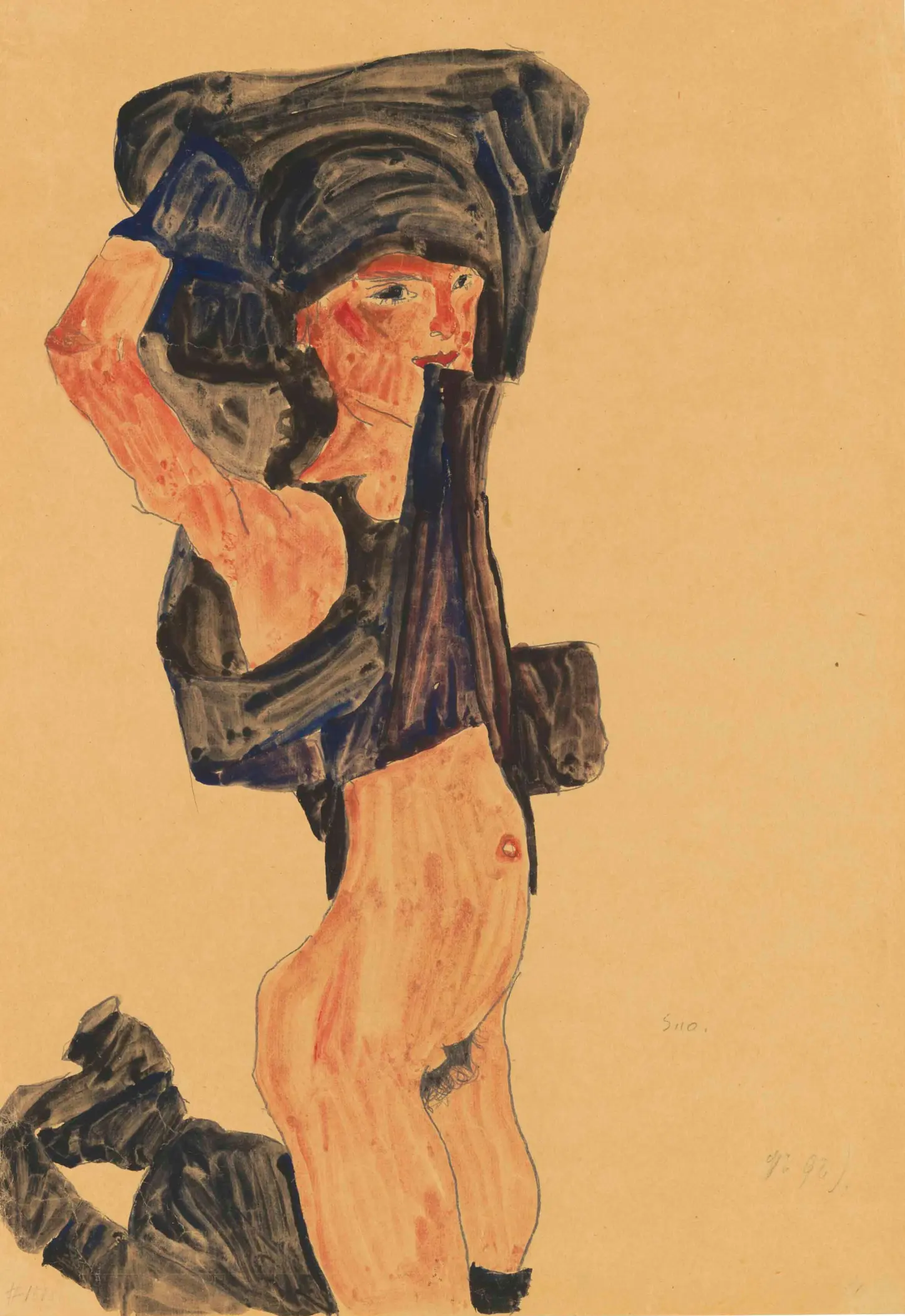
Egon Schiele:
Kneeling Girl, Pulling up her Skirt over her Head (Kniendes Mädchen, sich den Rock über den Kopf ziehend), 1910
Gouache, watercolour and pencil on paper
45 x 31.1 cm
Auctioned at Christie’s in 2018 for £1,568,750
(Kallir d561
In 1909, Egon Schiele left the Vienna Academy of Fine Arts to find his own artistic path. That move paid off quickly. By 1910, he had created Kneeling Girl, Pulling up her Skirt over her Head (Kniendes Mädchen, sich den Rock über den Kopf ziehend)—a raw drawing that proved he was no longer just copying his mentor, Gustav Klimt. Bought straight from the artist’s studio by an early collector, this work marks the moment Schiele decided that the human figure would become the heart of his career.
Sharp Outlines and Autumn Colors
You can see a massive surge of confidence in the way Schiele handled his brush here. On a sheet of paper he mixed fluid watercolours with thick patches of gouache. Around the middle of 1910, he abandoned the bright, neon colours he used before. Instead, he embraced a moody palette of earthy browns, deep blues, and dark shades that made the pale skin of his models stand out. With single, unbroken pencil lines, he captured the thin, angular frame of the model with absolute precision.
A Direct Stare and Modern Unease
The young woman in this drawing tells a real story about life in working-class Vienna. Schiele did not use expensive, professional studio models. Instead, he recruited young people from the city’s poorest neighborhoods. They were glad to earn some pocket money, posing for significantly smaller amounts than professional models.
For many modern viewers, looking at this artwork today causes a deep sense of unease. The model is clearly a young adolescent, and the power dynamic between a twenty-year-old rising artist and a girl from the slums can feel uncomfortable. But Schiele gives this situation a specific twist. Instead of portraying her as a passive subject, he shows her with an air of complete nonchalance. The pose she strikes is defiant: she looks directly into the eyes of the viewer, using her teeth to hold up the hem of her heavy dress to expose her body.
Smashing the Hypocrisy of Vienna
This provocative stance was a direct attack on the conservative bourgeois morality of Imperial Vienna. Society at the time was built on a dual reality: a strict, polite public exterior that hid a dark world of poverty and taboo. Schiele despised this hypocrisy. By bringing these young, uninhibited models into his studio, he forced the public to look at the realities of human nature and desire that the upper classes tried to ignore. He was actively fighting the rigid social rules of his environment.
The Shadow of Neulengbach
However, this rebellion came with a heavy price. The outside world looked at Schiele’s radical studio with growing hostility. This focus on very young models reached a devastating turning point in April 1912. Schiele was arrested in the small town of Neulengbach and spent twenty-four days in a prison cell under accusations regarding the corruption of a minor.
The shock and the social consequences of this arrest changed Schiele’s life and art permanently. The experience shook him to his core, drawing a hard line through his career. After the Neulengbach crisis, Schiele stopped using adolescent models altogether. He turned away from the dangerous edges of his early breakthrough years, choosing instead to focus on adult models like Wally Neuzil and his later wife, Edith Harms. Works like Kneeling Girl, Pulling up her Skirt over her Head therefore capture a fleeting window in his career—a fierce period of artistic freedom before the reality of law and society forced him to change course.
From Studio to Private Hands
First bought directly from Schiele by the collector Frank S. Hermann, the drawing passed through several collections over the decades, including those of Serge Sabarsky and Charles Tabachnick. In 2018, it re-emerged at Christie’s in London, crossing the million-pound mark before disappearing once again into a private collection.
Leave a Reply