The Finnish Connection: Elga Sesemann
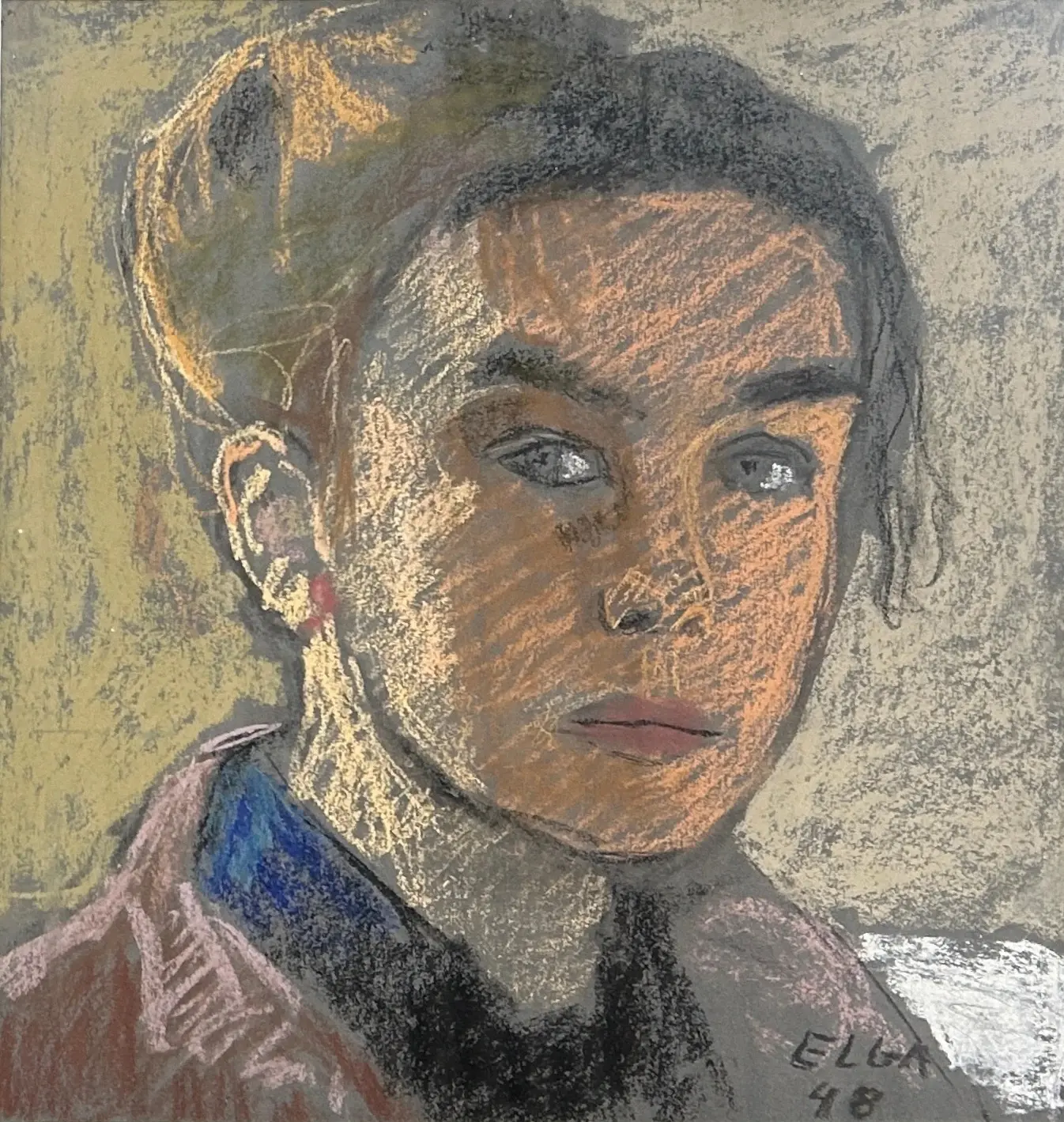
Self-Portrait (Självporträtt), 1948
Pastel on paper
40 × 32 cm
Private Collection
Elga Sesemann (1922–2007) was only twenty-three years old when her first solo exhibition in Helsinki in 1945 immediately drew the attention of critics and the art audience. Rather than relying on traditional academic guidelines, she engineered a raw, highly individual expressionism driven by intense personal feeling. Her career remained active and constantly evolving until the mid-1990s, but it is her work from the immediate post-war decade that remains her most psychologically charged.
The Shadow of Viipuri
To understand the profound melancholia and isolation in Sesemann’s portraits, one must look at the tragic geopolitical reality of her youth. She was born in 1922 in Viipuri (Vyborg), which was at that time the second-largest city in Finland. Her upbringing was cosmopolitan; her family was of German origin, and she grew up speaking German with her mother and Russian with her father, learning Finnish and Swedish at school.
This multicultural world shattered abruptly with the outbreak of the Winter War in 1939. The Soviet invasion forced the immediate evacuation of Viipuri’s entire Finnish population. For Sesemann, the war meant losing her home, her stability, and ultimately her birthplace. Viipuri was permanently ceded to the Soviet Union, leaving an entire generation of displaced Finns grappling with deep rootlessness and historical trauma.
The 1940s Self-Portrait Series
Following her evacuation to Helsinki, Sesemann entered an incredibly intense creative phase. Between 1943 and 1950, she painted dozens of self-portraits, forming a diary-like series in which she endlessly explored her own gaze, her identity, and the mystery of existence. The 1940s became her true breakthrough decade.
Because art supplies were scarce due to post-war shortages, Sesemann frequently turned to paper, cardboard, and pastels instead of canvas. She used heavy pastel sticks to gouge and block out her features, building a highly texturized, dense surface. Her eyes in these works often carry a vacant, soulful look, partially faded or masked by her thick strokes. This 1948 self-portrait acts as a direct visual diary of that displacement, capturing the collective grief and loneliness of a fractured post-war generation.
Connections to Schjerfbeck and Munch
Sesemann’s modernism did not develop in a vacuum, though she fiercely guarded her autonomy. When her work first debuted in the 1940s, contemporary critics immediately drew close comparisons to two major Nordic masters: Edvard Munch and Helene Schjerfbeck.
The connection to Schjerfbeck (1862–1946) is particularly profound. Although they belonged to different generations—Schjerfbeck was already an elderly woman working in isolation during Sesemann’s youth—both women shared a radical, non-academic approach to the human face. Like Schjerfbeck, who spent her final years scraping layers of paint away to create raw, spectral self-portraits, Sesemann used a palette knife and pastels on this 40-by-32-centimeter sheet to strip away traditional beauty in favor of psychological truth.
There were also immediate personal and professional connections within her direct environment. In 1948, the exact year this portrait was executed, Sesemann and her husband, the fellow painter Seppo Näätänen, left the capital to seek creative refuge in the rural isolation of Ruovesi. Alongside avant-garde contemporaries like Ellen Thesleff and Sigrid Schauman, Schjerfbeck and Sesemann are now celebrated by institutions like the Ateneum Art Museum as part of a pioneering circle of modern women who redefined Finnish expressionism through a shared sense of moody anonymity and structural defiance.
Leave a Reply