The Finnish Connection: Helene Schjerfbeck
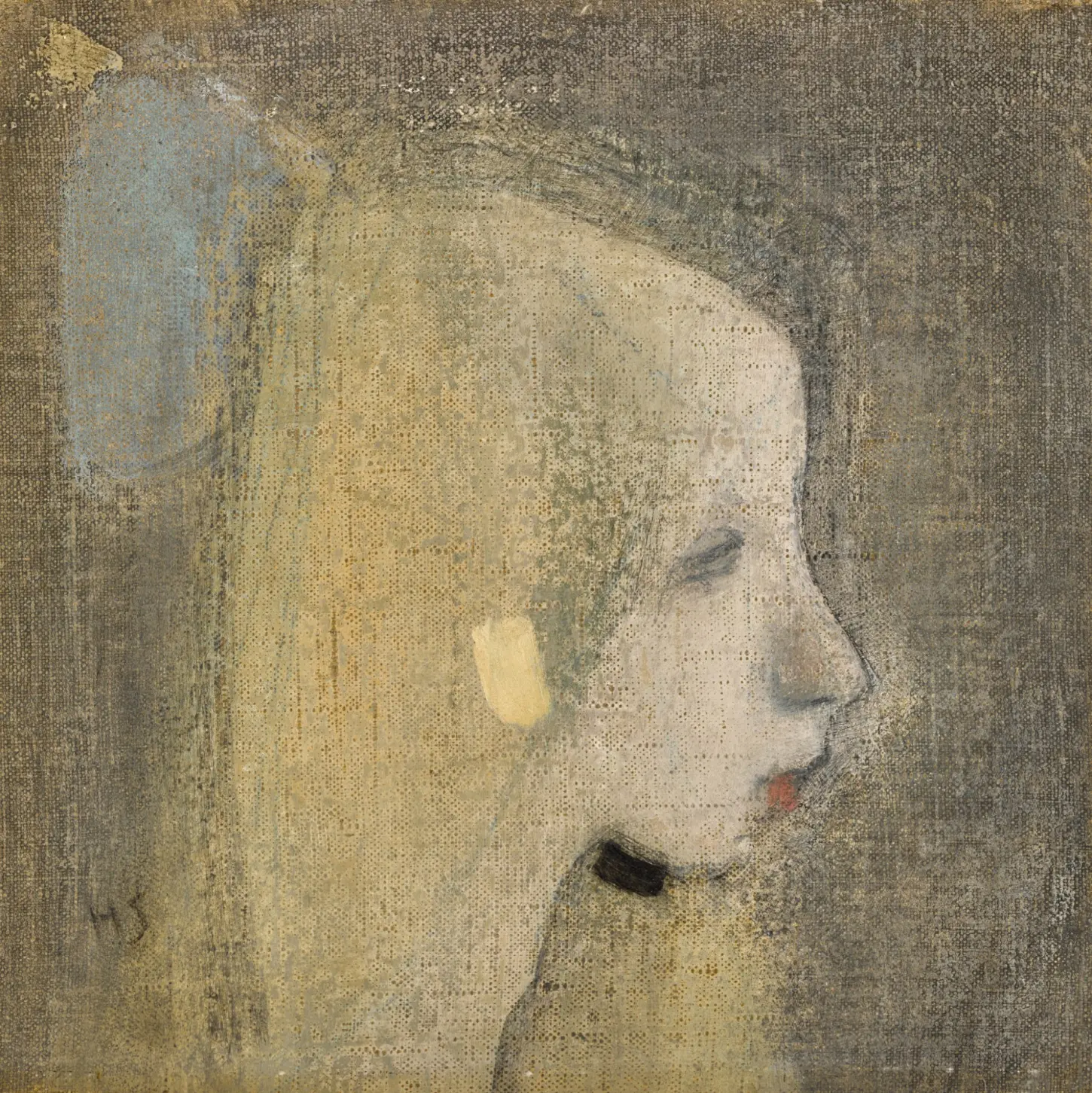
Blonde Girl (Girl with Blue Bow) (Blonda flickan / Flicka med blå rosett), circa 1923
Oil on canvas
33 × 33 cm
Private Collection
Helene Schjerfbeck’s art underwent a profound stylistic evolution during the early 1920s. She abandoned her early French-trained naturalist realism to engineer a highly stylized, radically reductive language of pure form and texture.
The Hyvinkää Retreat
By the time Schjerfbeck conceived this canvas around 1923, she had spent years living in relative physical isolation in Hyvinkää, away from the bustling artistic center of Helsinki. A severe childhood hip injury had left her physically fragile and structurally detached from mainstream academic circles. This domestic confinement deepened the intensely introspective and psychological nature of her method. The year 1923 also brought personal upheaval with the passing of her mother, prompting Schjerfbeck to relocate to Ekenäs and sink even deeper into an austere visual worldview.
Saara Annuli Huhtala
The model for this profile was Saara Annuli Huhtala, a young local girl from Hyvinkää whose family faced severe hardships. Her father, a railway worker, was killed during the Finnish Civil War, leaving her mother to raise eight children alone. Schjerfbeck provided financial support to the family by hiring Annuli to pose in her studio. To earn extra pocket money, Annuli also performed dances at the local cinema. A surviving archival photograph from 1921 shows her on stage wearing a large blue bow, an image that likely stayed with the artist and inspired this composition two years later.
Stripping Down the Form
Schjerfbeck used this square canvas to explore the strict architectural boundaries of the human profile rather than delivering a literal portrait of a specific sitter. She turned the girl completely to the side, facing right, exposing a sharp outline defined by soft, pale flesh tones and a vivid red accent on the lip. The angelic profile recalls the Renaissance faces of Fra Filippo Lippi, yet Annuli’s expression remains withdrawn and resigned—a quiet melancholy that echoes Edgar Degas’s famous sculpture The Little Fourteen-Year-Old Dancer, a work Schjerfbeck knew well.
The painter flattened the form by scraping the layers of oil paint with a palette knife until the background and the cascade of blonde hair almost merged into a single chalky, translucent plane. She punctuated this muted scheme with deliberate, abstract accents: the soft blue hair bow, a bright yellow patch near the ear, a touch of gold leaf at the top edge, and a single, heavy black block on the neck that grounds the floating silhouette.
Traces in the Archives
For decades, this small canvas remained quietly tucked away in a private Swedish collection, entirely out of the public eye. It was never truly lost to history, though. In 1953, Einar Reuter—Schjerfbeck’s close friend and biographer—documented the painting. The Stockholm gallery Åmells eventually handled the piece before its current owner acquired it in 2004. The fact that a painting this thin and heavily scraped survived so well shows how deeply Nordic collectors understood her vision. They recognized that these raw, chalky surfaces were exactly where her modernism came alive.

Leave a Reply