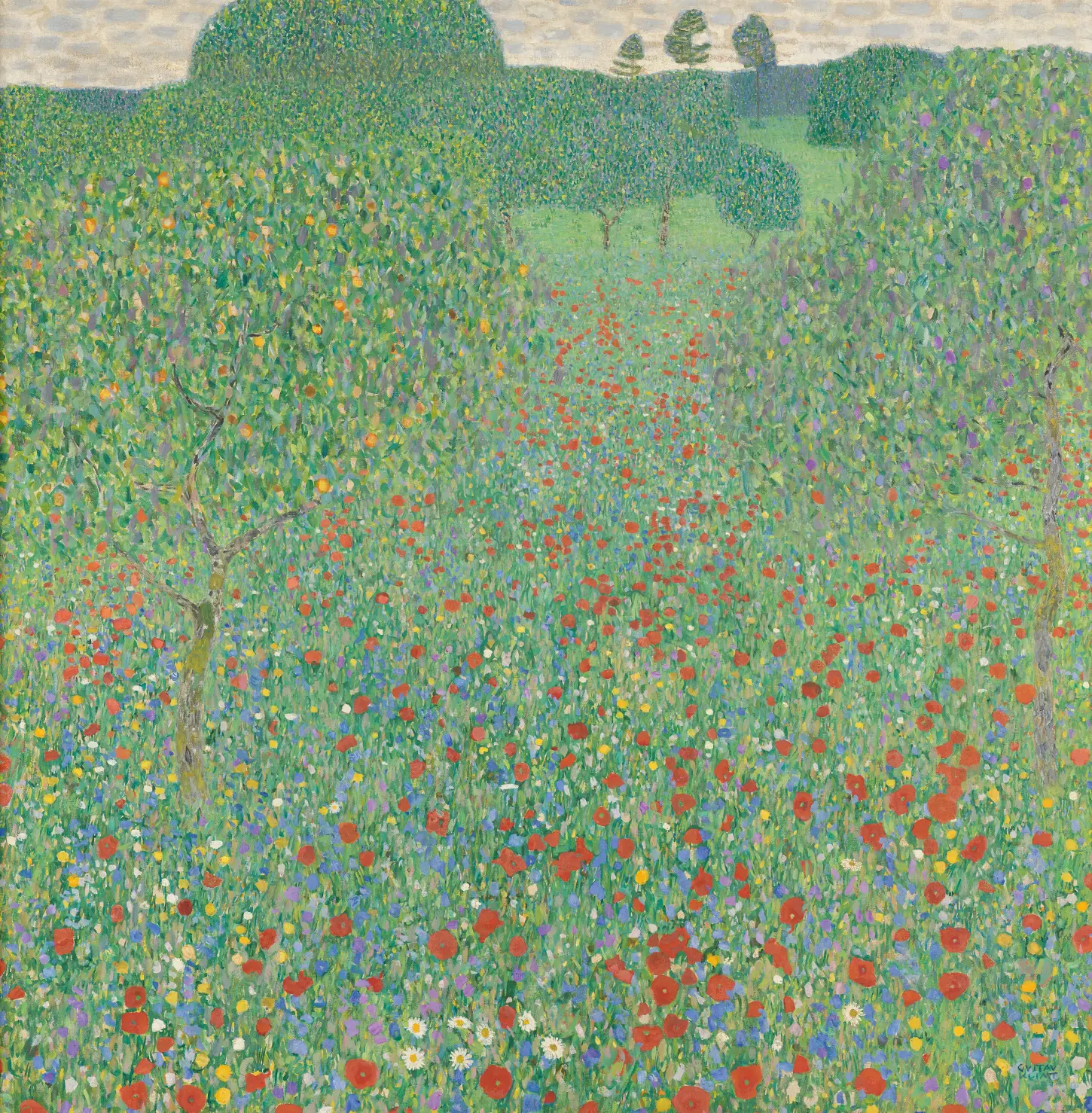
Gustav Klimt:
Poppy Field (Mohnwiese/Blühender Mohn), 1907
Oil on canvas
110 × 110 cm
©Österreichische Galerie Belvedere, Vienna
(Natter 172)
Gustav Klimt painted Poppy Field during his summer stay in Litzlberg on the Attersee in 1907. The artwork utilizes his established 110 by 110 centimeter square format. A magnificent poppy-filled meadow occupies almost the entire lower half of the pictorial surface. Unlike his other enclosed fields, this composition opens up in the upper section to reveal a dense orchard of green fruit trees and bushes. While the poppies and daisies in the immediate foreground are rendered with clear, individual forms, the motifs systematically dissolve into loose specks of pure color as the eye moves toward the high background. A very narrow strip of pale, patterned sky remains visible at the absolute top edge, breaking the tapestry-like density.
The spatial treatment reflects Klimt’s active study of contemporary photography, a medium he tracked closely between 1897 and 1916. The sudden, tilted angle and wide, square crop mirror the technical breakthroughs in camera viewfinders from this period. To construct this landscape, Klimt blended photographic frames with French Post-Impressionist pointillism. The Vienna Secession had introduced these international ideas through a major 1903 exhibition that placed avant-garde paintings by Georges Seurat and Vincent van Gogh alongside East Asian woodblock prints. Klimt adapted these flat, decorative principles to structure his field, balancing botanical texture with an abstracted mosaic overlay.
The canvas debuted publicly under the title Poppies in Bloom (Blühender Mohn) at the groundbreaking 1908 Kunstschau in Vienna. Organized by the Klimt-Gruppe following their split from the official Secession, the exhibition dedicated a specific room to Klimt’s recent output, establishing his contemporary reputation as a master landscape painter. The historical trajectory of the canvas remains deeply tied to the Jewish Zuckerkandl family, who lost their entire collection under Nazi confiscation in 1938. Following the Second World War, the painting was officially restituted to Fritz Zuckerkandl. However, the Austrian federal agency for historical monuments refused to issue an export permit, preventing the family from taking the artwork to the United States. Due to these legal restrictions, Zuckerkandl sold the painting to the Viennese collector Rudolf Leopold. In 1957, Leopold presented the canvas to the Österreichische Galerie Belvedere in a direct exchange for two paintings by Egon Schiele. A subsequent restitution review in 2010 confirmed the museum’s legal title under current frameworks, though the post-war export ban remains a subject of modern provenance debate. This administrative and material history positions the canvas as a key document for analyzing the rigid domestic trade controls that shaped Austria’s major public collections during the mid-twentieth century.

Leave a Reply