Egon Schiele:
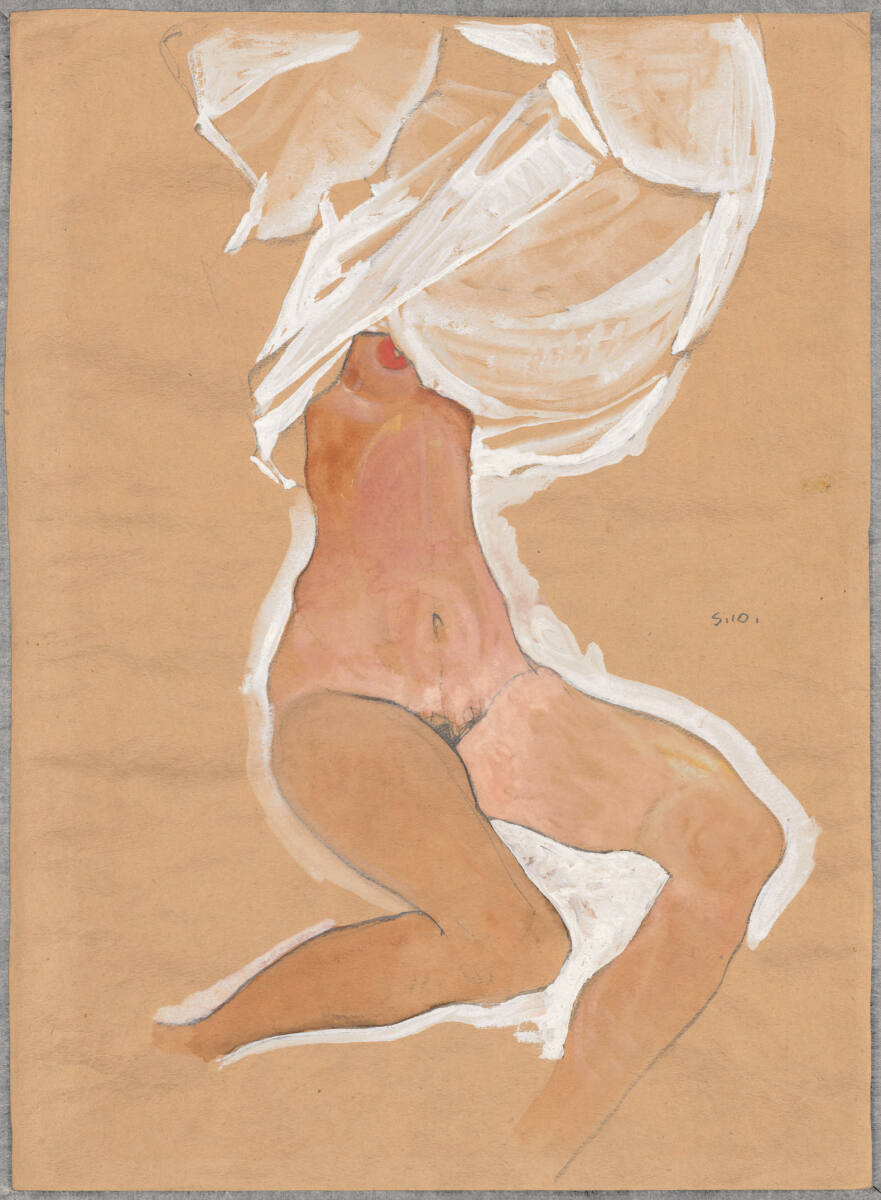
Seated Girl Nude with Shirt over her Head (Sitzender Mädchenakt mit Hemd über dem Kopf), 1910
Pencil, watercolor, and opaque white gouache on packing paper
44.7 × 32.7 cm
©Albertina, Vienna
(Kallir d560)
Egon Schiele completed this radical study of a female nude in Vienna during 1910. The year marked a defining break from the ornamental style of his mentor, Gustav Klimt. Instead of classical elegance, Schiele used this sheet to explore a heavily abstracted anatomical form.
The 1910 Expressionist Pivot
The year 1910 stands as Schiele’s absolute breakthrough period, the exact moment he established his formal independence. At just twenty years old, he began a relentless studio campaign centered almost exclusively on the human body. He stepped away from Klimt’s decorative surfaces, producing an unprecedented volume of raw nudes.
During these feverish months, drawing ceased to be an academic exercise in replication. Schiele stripped away domestic backdrops and interior environments, isolating his figures within a vacuum of blank space. His models were no longer passive muses. They performed complex, contorted choreographies that pushed the limits of anatomy. This particular sheet captures that precise transition, where the physical form becomes a site for pure graphic experimentation.
Staging the Studio Session
The sheet was executed on cheap, rough brown packing paper. Archival records from the Albertina reveal that this drawing was part of a highly systematic studio session. Schiele produced a series of ten consecutive sheets tracking a single model as she slowly turned in front of him. Five drawings recorded her from the front, and five from behind, a sequence that includes related museum works.
While the other sheets follow a more predictable sequence, this specific drawing stands apart from the group. Schiele completely stripped away the limbs, leaving the torso to stand like a column. The right breast features a dark, saturated red nipple that breaks the muted tones of the skin. Over this heavy frame, the shirt hangs down without the structural support of arms or hands, resembling a sheer curtain.
The Aura and the Occult
The unusual handling of white gouache on the brown paper links directly to Schiele’s interest in contemporary spiritualism. Through his friends in the Neukunstgruppe, he became familiar with the theosophical writings of Rudolf Steiner. This intellectual circle spent hours discussing occult ideas, specifically focusing on the duplication of the human ego and the concepts of spiritual light emanating from the flesh.
Schiele used opaque white paint to materialize this philosophy. The white highlights function as a literal aura surrounding the limbs, meant to visualize the light that, in his own words, “streams from the bodies and symbolizes the double nature of man”. Rather than just illuminating the subject from an outside source, the paint represents an inner radiation escaping the skin.
Mid-Century Acquisition
The provenance of this sheet traces back to mid-century Viennese private collections. The drawing was long held by Grete Jancsy, a collector living in postwar Vienna. In 1950, the Albertina museum officially purchased the paper from her estate, adding it to their growing collection of early Austrian Expressionism.
By hiding the face and replacing it with a draped white cloth, Schiele completely removes the identity of his model. It makes one ponder whether this anonymity was a deliberate attempt to turn a physical studio model into a universal, spiritual symbol. By choosing cheap packing paper for such a calculated, esoteric study, he forces us to think about how the choice of everyday materials can anchor abstract spiritual ideas into a raw reality.

Leave a Reply