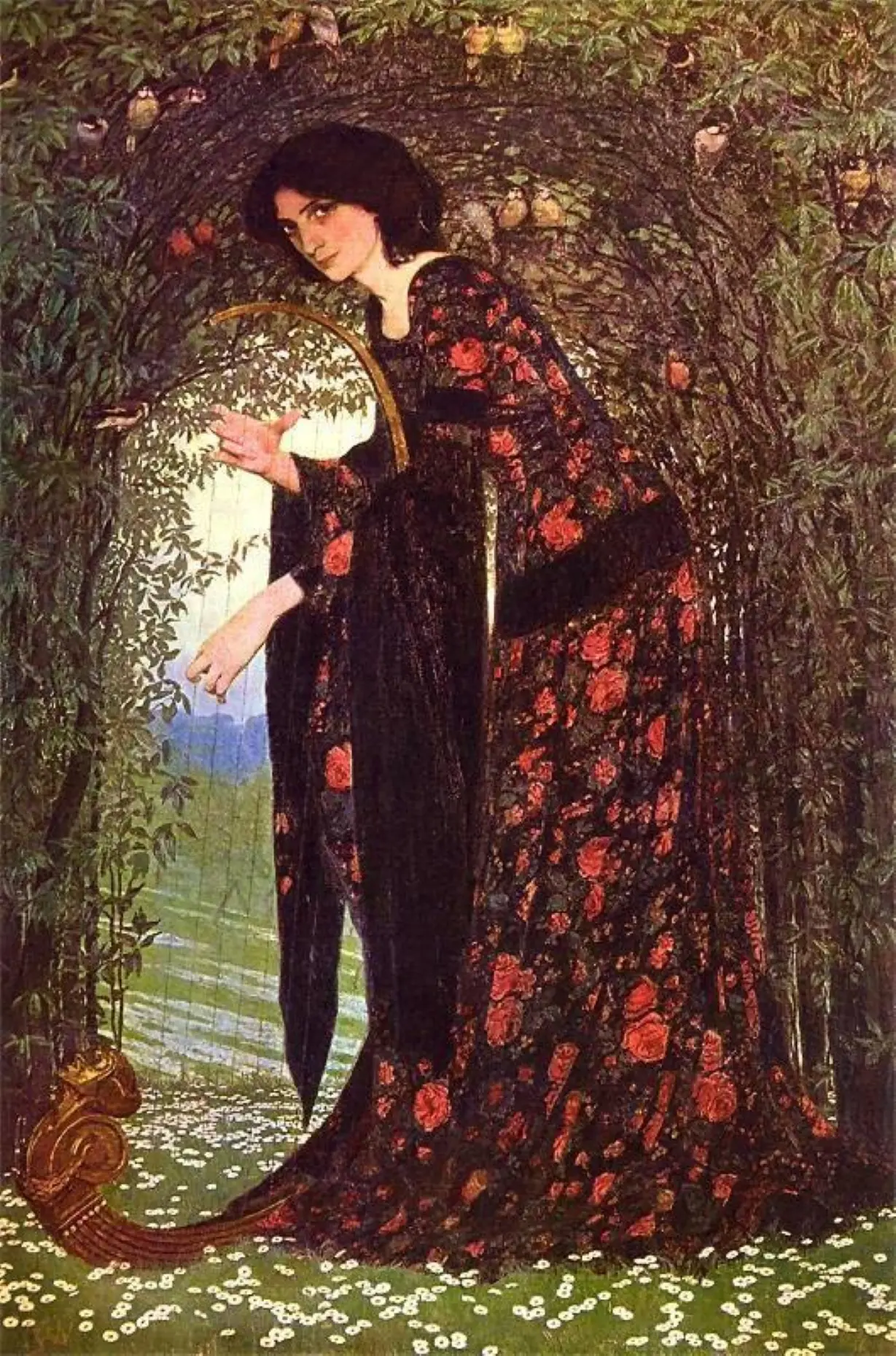
Młoda Polska: Edward Okuń
Concert, 1912
Oil on canvas
50 x 40 cm
Presumed lost/destroyed/Whereabouts unknown c. 1944
One of Okuń’s notable works is Concert (1912), a painting that remains lost to this day. The artwork is an example of Polish Symbolism, showcasing a strong dialogue with the Vienna Secession, Art Nouveau, and the Pre-Raphaelites. Okuń paid meticulous attention to detail in both the central figure and the surrounding environment, employing decorative elements and highly stylized forms. Its decorative patterns and flowing lines closely resemble the style of Gustav Klimt and the Central European Secession.
Wartime Disappearance
The loss of Concert is directly tied to the devastation of Warsaw during World War II. Okuń spent the war years in the Polish capital, where a significant portion of his life’s work was stored in his studio. Following the 1944 Warsaw Uprising, occupying German forces systematically destroyed and burned the city block by block.
Okuń’s studio was completely ruined during this period, and his collection was scattered or destroyed. Concert, along with another major musical composition titled Mazurek Chopina (Chopin’s Mazurka), vanished during the chaos. Because of the widespread destruction, art historians categorize the painting as presumed destroyed, though the exact fate of individual pieces from his studio remains unconfirmed.
Visual Record
Today, our knowledge of Concert relies entirely on archival materials, early gallery prints, and vintage black-and-white photographs published in art journals before 1939. These historical records confirm the painting’s tight Secessionist framing, depicting a female musician performing amidst dense, stylized foliage and intricate Art Nouveau patterns.
About Edward Okuń (1872–1945)
Edward Okuń was a prominent Polish Symbolist painter and graphic artist whose style and poetic vision left a lasting imprint on early 20th-century art. Born in 1872, he studied art in Warsaw before continuing his education in Munich and Paris. In 1897, Okuń studied with Simon Hollósy, the founder of the Nagybánya artists’ colony, an influential Hungarian painter group focused on open-air painting. During his time in Munich, he also became a prominent contributor to the famous Art Nouveau magazine Jugend.
For the next two decades, he lived in Rome and traveled extensively through Italy, immersing himself in classical and Renaissance art. Okuń became a key figure in the Polish art colony in Rome and co-founded the Masonic lodge “Polonia”. In 1921, he returned to Poland and settled in Warsaw, where he was appointed professor at the School of Fine Arts in 1925. He was also an active member of the Society of Polish Artists. Okuń remained in Warsaw during World War II; ollowing the destruction of the city, he relocated to Skierniewice, where he was killed by a stray bullet in January 1945, on the very day the city was liberated.

Leave a Reply