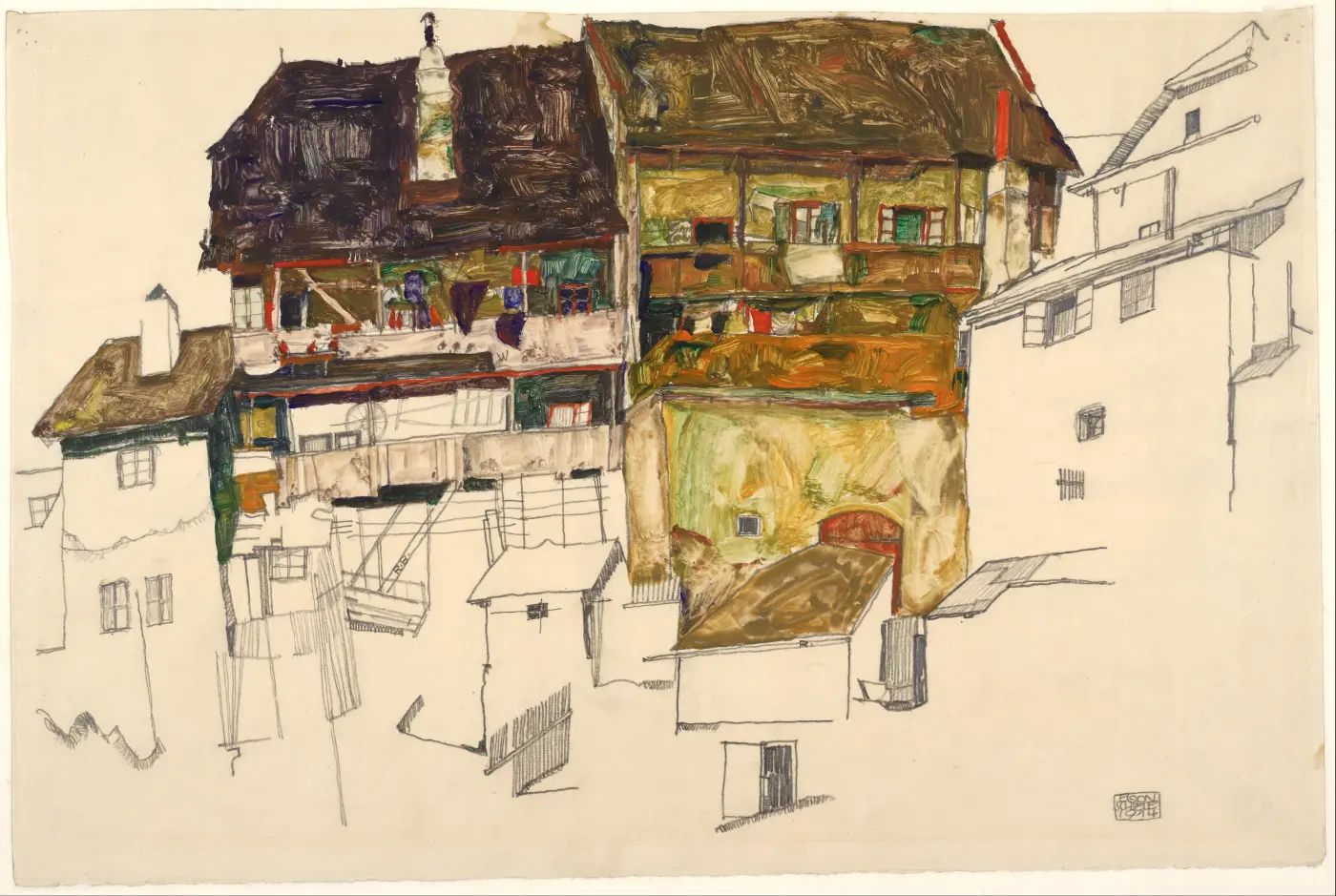
Egon Schiele:
Old Houses in Krumau (Alte Häuser in Krumau), 1914
Pencil, brush, and gouache on Japanese paper
32.5 x 48.5 cm
©Albertina Museum, Vienna
(Kallir d1691)
With a few sharp strokes and heavy patches of paint, Egon Schiele breaks apart the traditional landscape to reveal a town frozen in time. This 1914 masterpiece, now a highlight of the Albertina Museum, captures the steep suburban hills overlooking the Vltava (Moldau) River.
The Motif Across a Broader Canvas
This gouache does not stand alone; it is a critical piece of a much larger, obsessive project. Between 1910 and 1917, Schiele used the exact same hillside of the Flössberg suburb to build some of his most famous large-scale oil paintings. Works like Krumau on the Moldau and The Small Town series use the same crowded, interlocking houses. However, while his oil canvases fuse the architecture into heavy, solid blocks of color, this work on paper reveals the skeletal framework behind those larger masterpieces. It acts as a rare window into how Schiele sketched and visualized his entire painted world.
The Symbol of the Dead City
Krumau was the birthplace of Schiele’s mother, and he maintained a deep psychological bond with the town throughout his life. In his art, these old, weather-beaten buildings became stand-ins for existential themes. Rather than painting a lively, picturesque town, Schiele turned Krumau into a symbol of a “Dead City,” a concept popular among European Symbolist painters. Even though research proves he stayed remarkably true to the actual topography, the atmosphere feels completely frozen, decaying, and detached.
Breaking the Horizon
Schiele avoided traditional framing devices in this composition. He chose not to ground the view with a natural horizontal border, completely omitting the riverbank or the water of the Vltava below. Instead, the structured houses seem to float on the paper, fading out into raw, uncolored pencil outlines toward the bottom edges. By deliberately leaving parts of the buildings unfinished, he shifts the focus from realistic documentation to a stark graphic pattern.
Spatial Shock and Contrast
The architecture is constructed through a dynamic tension between flat color and blank paper. Heavy, dark gouache on the roofs stands directly next to bare pencil sketches of balconies and walls. A structure on the right cuts into the frame with a sharp, rapid perspective shift. Small, dark pockets of shadow in the windows and doorways serve as visual anchors, while everyday objects—like colorful laundry hanging on an upper balcony—clash with bare outlines of farm tools below.

Leave a Reply