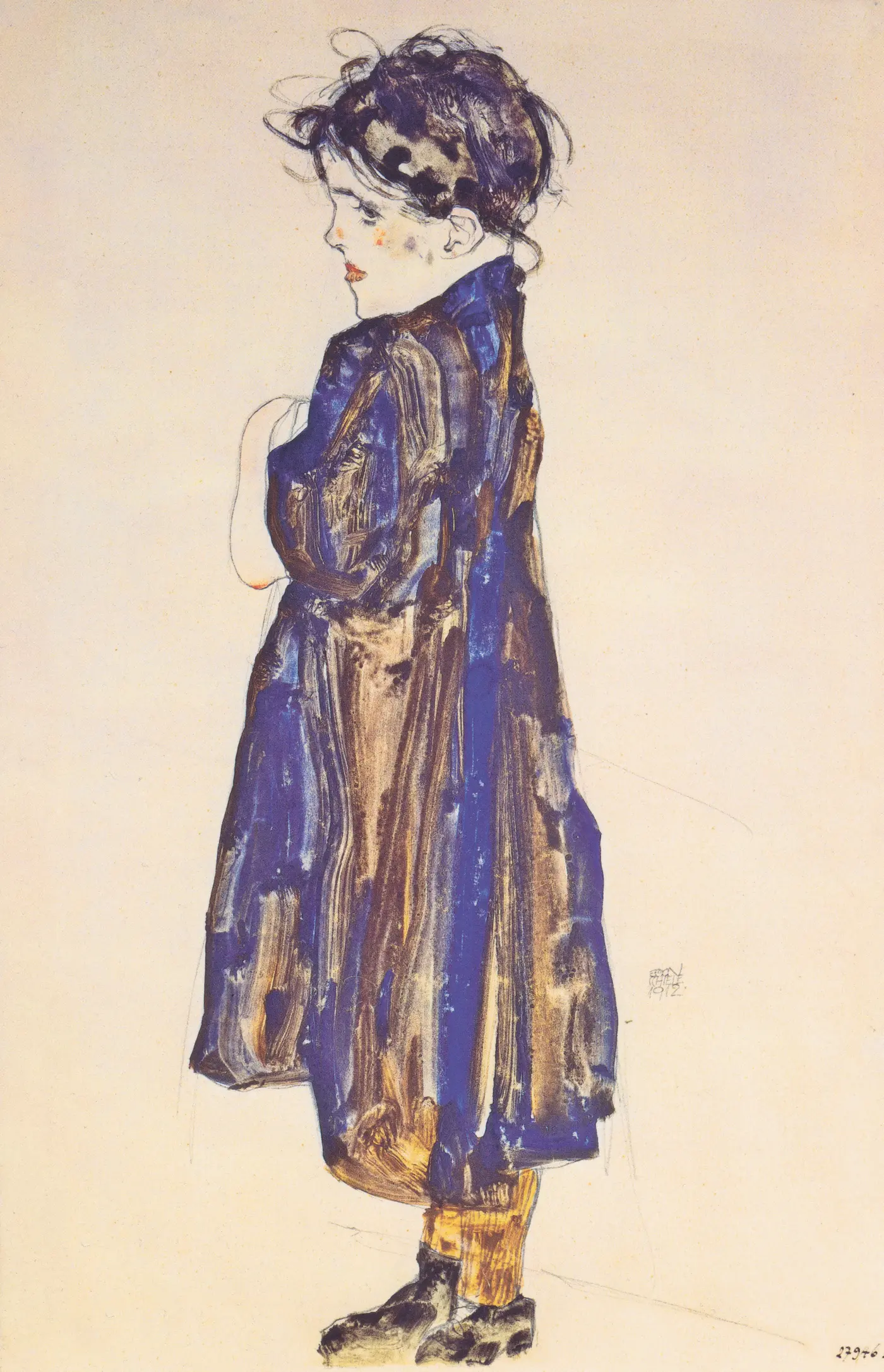
Egon Schiele:
Peasant Girl (Bauernmädchen) (1912)
Watercolor, bodycolor, and pencil on Strathmore Japan paper
47.5 x 31.7 cm
©Albertina, Vienna
(Kallir d995)
In 1912, Egon Schiele created one of his most touching portrait of youth: Bauernmädchen (Peasant Girl). Kept in the permanent collection of the Albertina, this artwork reveals a deeply vulnerable side of the Austrian master.
No Childhood Joy, Only Raw Reality
When looking at this young peasant girl, one does not see a joyful, smiling child. Instead, Schiele captured the reality of the working-class children in his immediate surroundings. The girl’s deep, melancholic gaze reflects a childhood that left very little room for innocence or carefree happiness.
It was difficult for Schiele to find regular models who wanted to pose for him, especially in the small towns outside Vienna. People from good families did not want their daughters inside an artist’s studio. Because of this, Schiele often asked children from the poorest neighborhoods to pose for him. He found them on the streets, playing in the suburbs, or skipping school. He often gave them a small amount of money or let them stay in his studio where it was warm. This is likely how this peasant girl ended up sitting for him, giving us a look into her daily life.
The Technique: Freedom in Watercolor
The year 1912 marked a significant shift in Schiele’s technical approach:
- Embracing transparency: Schiele moved away from thick, opaque gouache paints, letting watercolor dominate his work.
- Fluid lines: Instead of his signature frantic, slashing brushstrokes, the paint flows here in a controlled yet free manner.
- The materials: He mixed watercolor, bodycolor, and pencil on delicate Strathmore Japan paper to achieve this soft texture.
With just a few basic lines and soft washes of color, Schiele managed to show exactly what this girl was feeling.
Leave a Reply