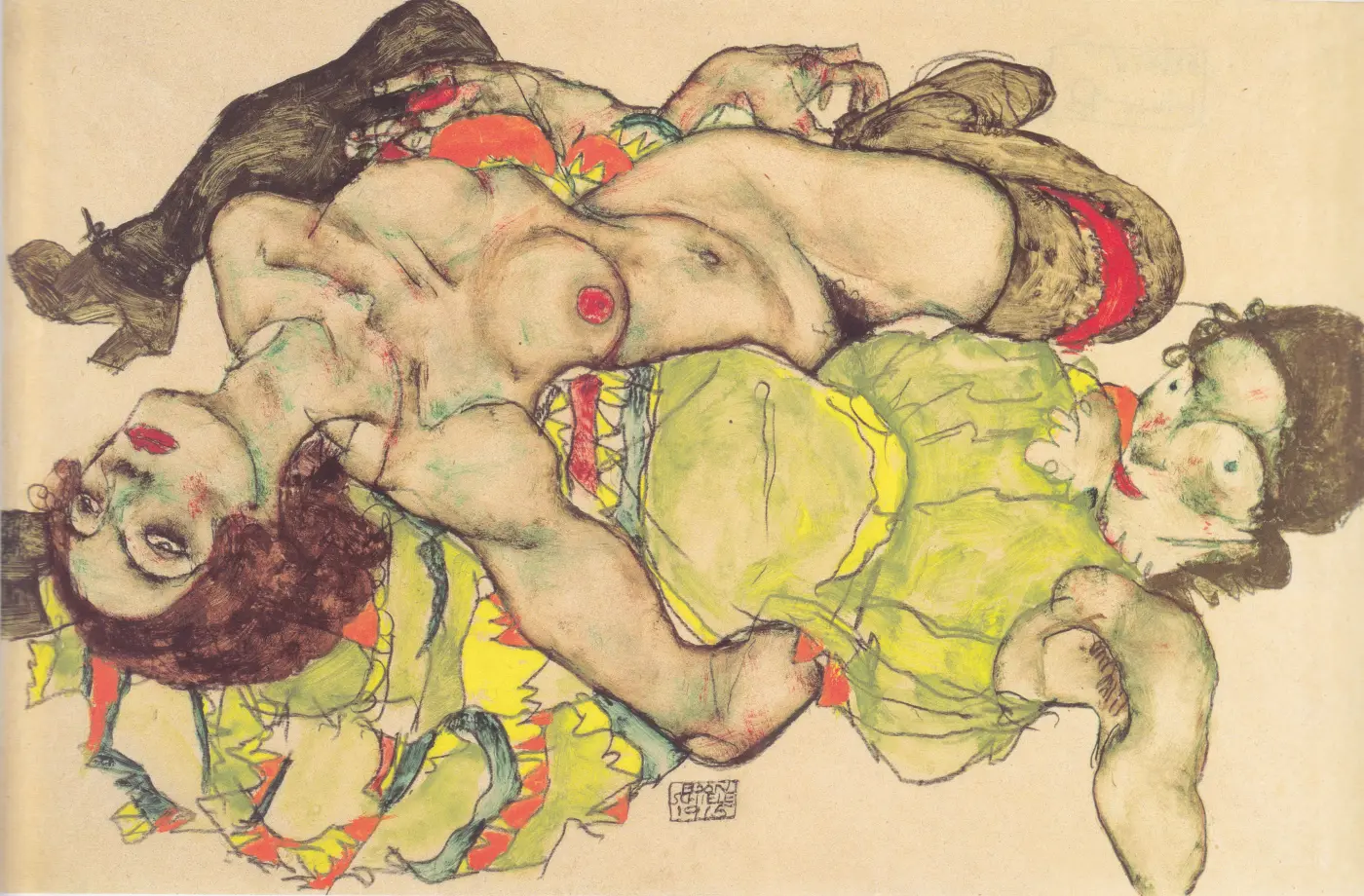
Egon Schiele:
Two Girls, Lying Entwined (Zwei Mädchen, in verschränkter Stellung liegend), 1915
Gouache and pencil on paper
32.5 × 49.5 cm
©Albertina, Vienna
(Kallir d1743)
The year 1915 was a chaotic turning point for Egon Schiele. Shortly after being declared fit for military service, he abruptly ended his long relationship with his famous model and muse, Wally Neuzil, to marry Edith Harms. Once stationed as a soldier in Vienna, he had much less time for his art, and his output of drawings dropped significantly. The few pieces he did finish in his studio show a heavy sense of wartime anxiety and look closely at his complicated personal life.
The Problem of the Title: Lovers or Fiction?
When you visit the Albertina museum, this work is displayed as Weibliches Liebespaar (Female Lovers). However, in the definitive catalogue raisonné, Jane Kallir uses a strictly descriptive title: Zwei Mädchen, in verschränkter Stellung liegend.
Schiele rarely titled his own drawings, leaving that to dealers and museums later on. In this case, calling the figures “lovers” feels not completely right. If this were a drawing of two real women, it would certainly be an intimate moment. But the drawing shows something else. It portrays a nude woman resting on top of possibly a clothed, life-sized doll. Because one of the women is most probably a doll, the museum’s romantic title does not really match what Schiele actually drew.
Stylistic Transition and Geometry
Schiele’s technique highlights this division between life and fiction. He prepared this composition using a preliminary pencil drawing, catalogued as Kallir d1742. While we won’t look at that specific study here yet, it reveals how Schiele used a hard graphite pencil to map out the sharp, almost cubist geometry of the two entangled shapes.
In this final version, Schiele used opaque watercolor to drive the contrast home. The flesh of the nude woman is rendered with warm, heavy washes that show physical fatigue. In contrast, the underlying figure reveals a transition from his own artistic past. The mask-like face and rigid features look exactly like Schiele’s highly stylized drawing style from late 1914. By placing his newer, more realistic style of 1915 on top of a geometric relic, the doll becomes a representation of changing form rather than a living partner.
An Alternative Look at Alienation
For readers following the history of the Vienna Secession, this drawing marks a clear shift. In Schiele’s earlier works, figures often touch in ways that show a deep connection. Here, it is completely different.
By using what is possibly a doll instead of a living partner, Schiele shows how people can feel completely disconnected from each other. The scene looks intimate because the figures are so close, but the actual feeling is one of deep isolation.
The Legacy of the Benesch Collection
The history of this drawing connects directly to an important part of Schiele’s career. In 1951, the Albertina museum acquired the piece from the estate of Heinrich Benesch.
Benesch, a railway official, was one of Schiele’s earliest and most dedicated collectors. He was among the few who recognized Schiele’s raw talent and supported him financially when the Viennese public still found his work scandalous. This piece proves that Schiele didn’t need fancy materials to create a powerful image; a pencil and a scrap of paper were enough.
Leave a Reply