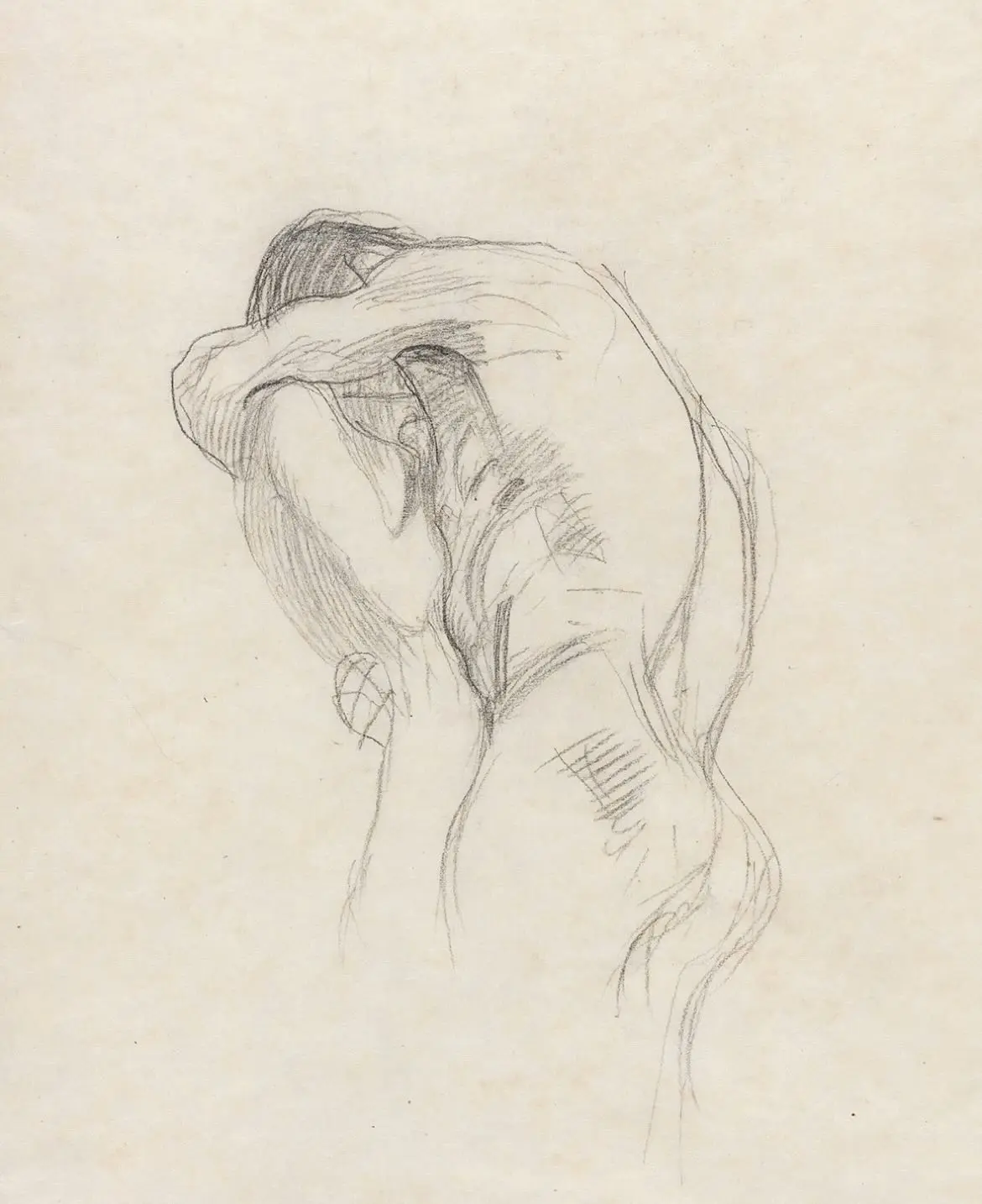
Gustav Klimt:
Embracing Couple (Sich umarmendes Paar), 1898/99
Black chalk on paper
45 × 31.7 cm
©Oesterreichische Nationalbank, Vienna (Permanent loan to Museum der Moderne Salzburg)
(Strobl s481)
Study for the Faculty Paintings
This 1898/99 drawing is a preparatory study for Philosophy, one of the three controversial Faculty Paintings commissioned for the Great Hall of the University of Vienna. Specifically, the sheet details the positioning for the embracing couple located above the figure of the old woman in the initial composition of the mural.

The Faculty Paintings provoked intense public and academic scandals in Vienna due to their departure from traditional allegory, opting instead for a symbolic presentation of human existence. In this study, Klimt focuses entirely on the formal arrangement of the figures, exploring how the human form could convey themes of love, fate, and cosmic suspension within his broader decorative program.
The Tragedy of Philosophy
The commission for Philosophy, alongside Medicine and Jurisprudence, turned into one of the greatest art scandals in Viennese history. When Klimt presented Philosophy at the 1900 Secession exhibition, eighty-seven professors rejected it, protesting against its dark, pessimistic, and erotic atmosphere. Instead of celebrating rational science, Klimt chose to depict humanity as a blind, drifting mass controlled by fate and cosmic forces.
The public backlash was so severe that Klimt eventually withdrew from the commission, repaid his advance with the help of private patrons, and reclaimed ownership of the canvases. The paintings remained in private Austrian collections until World War War II, when they were confiscated by the Nazi regime and moved to Schloss Immendorf for safekeeping. In May 1945, retreating German SS troops set fire to the castle. Philosophy, Medicine, and Jurisprudence were almost certainly destroyed in the blaze, leaving only a few black-and-white photographs, one color detail of Medicine, and preparatory sketches like this sheet as witnesses to their existence.
Technical Execution
The work is executed entirely in black chalk on paper. Klimt uses a delicate, repeating contour line to define the intertwined bodies of the couple, focusing heavily on the anatomical alignment of the embrace.
The texture of the chalk creates a soft tonal gradient across the skin and hair, establishing form through subtle shading rather than heavy outlines. By isolating the figures against the blank background of the sheet, Klimt removes any immediate narrative context, prioritizing the study of gesture and physical unity that would eventually be integrated into the dense, floating mass of figures in the final oil painting.

Leave a Reply