The Italian Connection: Amedeo Bocchi:
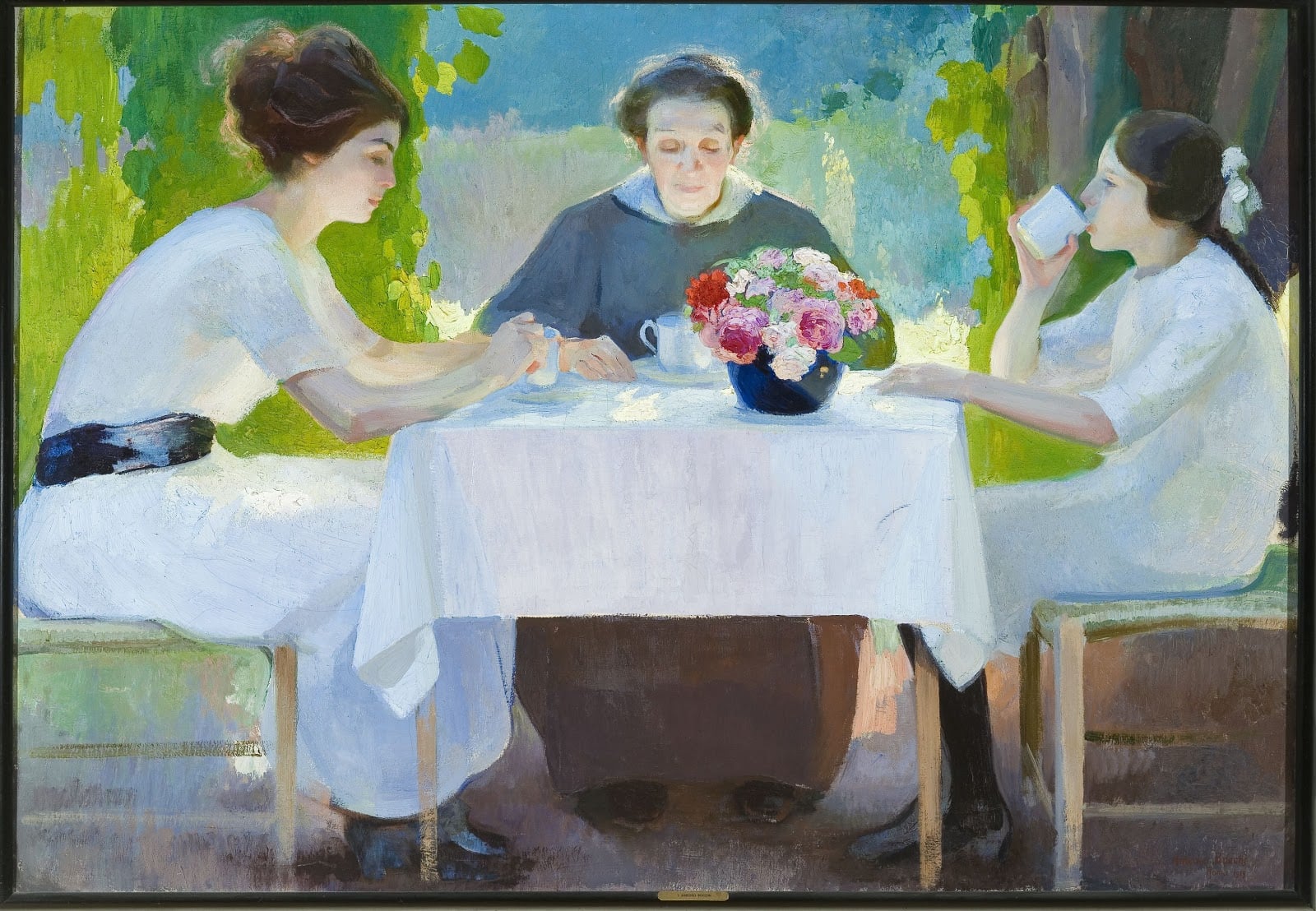
Morning Breakfast (La colazione del mattino), 1919
Oil on canvas
125 × 181 cm
©Galleria Ricci Oddi, Piacenza
Painted in 1919, La colazione del mattino depicts a seemingly idyllic moment, yet it carries a deep, intimate, and tragic weight. The canvas portrays three generations of women from the painter’s immediate family: his mother Clelia seated at the center, his second wife Niccolina on the left, and his daughter Bianca on the right. Bocchi structured the scene around a breakfast table in a garden, using the figures to create a direct compositional triangle. The work symbolises the three stages of a woman’s life: youth, adulthood, and old age.
The Italian Response to the Secession
Bocchi (1883–1976) worked within Roman artistic circles alongside artists like Costa, Sartorio, Balla, and Cambellotti. While not an official member of the Secessione Romana (1913–1917), his work closely aligned with its core goal: breaking away from rigid academic conventions to engage with international modernism.
His visit to the 1910 Venice Biennale, where he saw Gustav Klimt’s exhibition, became a major turning point. This influence shows in the structured color harmonies and decorative rhythms of La colazione del mattino. Instead of copying Klimt’s heavy ornamentation, Bocchi applied European Secessionist ideas directly to an Italian domestic scene, using color and pattern to build the space.
Divisionist Light and Structure
The composition relies on Divisionist techniques to handle the sharp contrast between the white dresses and the dark green foliage of the garden. Bocchi used controlled shifts of color to make the morning sunlight vibrate across the tablecloth.
Despite the bright, sun-drenched palette and the idyllic garden setting, the women project a deep seriousness and melancholy. They do not communicate with one another; the physical space between them reflects a psychological distance. The white passages function as structural anchors, stabilizing the figures within the surroundings while reinforcing a formal distance based on placement and light rather than a shared narrative.
Biographical Context and Legacy
Art historians often point to a foreshadowed somberness in the work. None of the three women would outlive the painter. His wife Niccolina died a few years later, in 1923, from tuberculosis. His daughter Bianca, who was a frequent subject of his artwork, also passed away young in 1934 at the age of 26 after a severe illness. His mother Clelia, representing the final stage of life in the composition, died of natural causes in the years prior.
Immediately after its completion, the artwork was selected for the XII Venice Biennale in 1920. Its inclusion in this major exhibition confirms its place in the modernist dialogue of the time, proving that Secessionist ideas were actively being translated into a regional Italian reality.

Leave a Reply