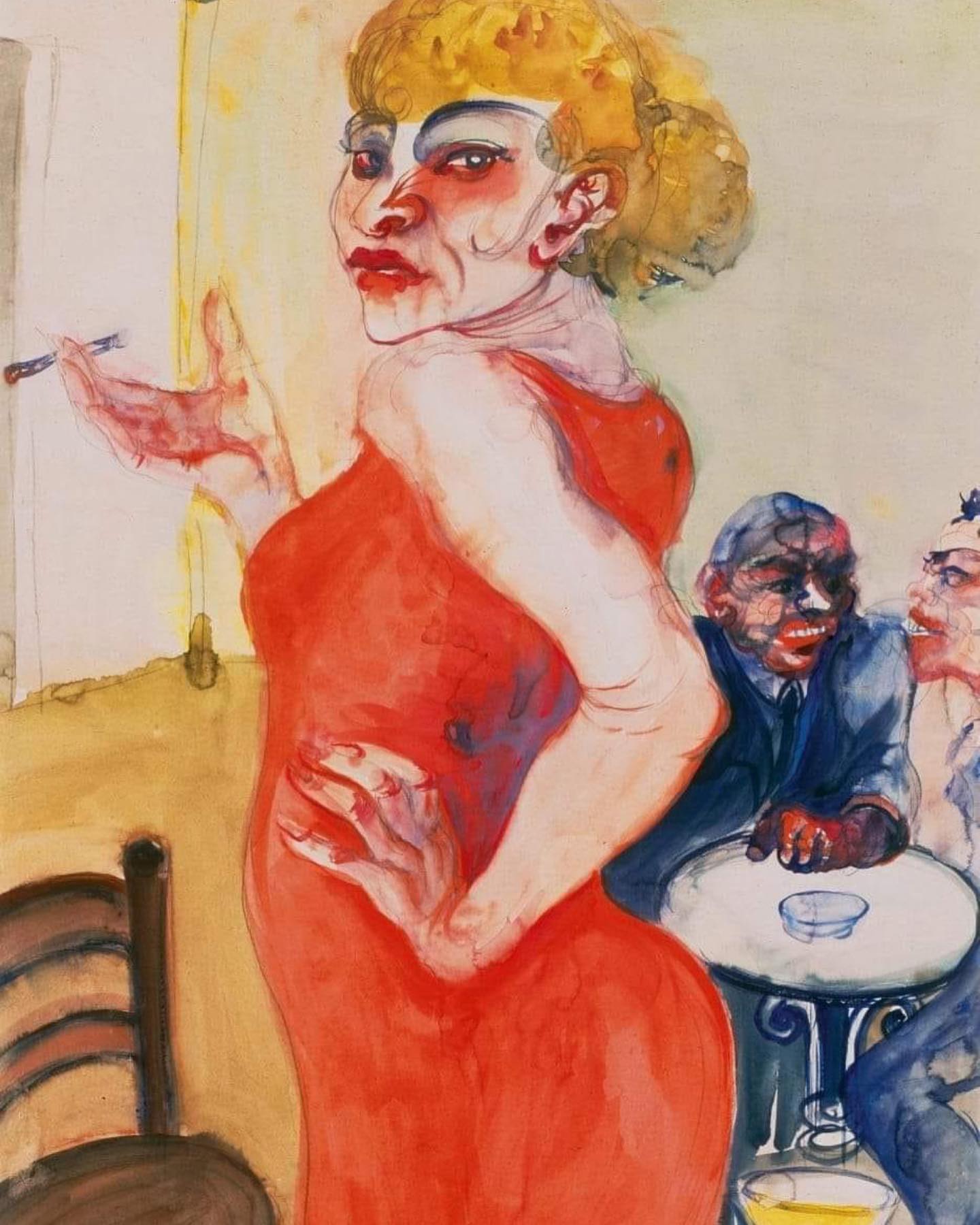
German Expressionism/Degenerate Art: Elfriede Lohse-Wächtler
Lissy, 1931
Watercolor over pencil on paper 68 × 49 cm
©Städel Museum, Frankfurt am Main (On permanent loan from a private collection)
Elfriede Lohse-Wächtler (1899–1940) was a German avant-garde painter whose career was cut short by the National Socialist regime. For readers familiar with Egon Schiele, her work offers a parallel in its sharp contouring and direct depiction of socially marginalized subjects. Her art was later categorized by the Nazi regime as “degenerate art” (Entartete Kunst), leading to the suppression of her work and her eventual death under the regime’s forced euthanasia program.
Lohse-Wächtler studied at the Dresden Royal Academy of Arts and quickly aligned herself with the expressionist movements of the time. During a productive but financially difficult period in Hamburg around 1929 to 1931, she focused on drawing people from the harbor district, including workers and prostitutes. The watercolor portrait Lissy from 1931 belongs to this body of work. Like Schiele, Lohse-Wächtler avoided idealized depictions, focusing on sharp contours and a distinct, unembellished posture.
The portrait is rendered frontally. Lissy, a blond prostitute from the Hamburg underworld, is shown facing forward with a steady gaze. She wears a tight, bright red dress that emphasizes her body, yet her posture remains guarded. Her turned shoulders and tight, claw-like hands create a sense of tension and defiance. In the background, the artist placed two sketchily drawn male clients at a table, their features distorted with predatory, protruding teeth. This contrast sets the figure apart from the surrounding bar environment. The energetic linework and loose watercolor washes give the scene a brisk, unfinished character. Art historians have occasionally interpreted Lissy as a form of self‑portraiture. Rather than a literal depiction of the artist, the work reflects Lohse-Wächtler’s own profound feelings of social isolation, financial desperation, and vulnerability during her final months in Hamburg.
By mid-1931, severe financial hardship and growing social isolation led to a decline in her mental health. She returned to her parents’ home in Dresden, and in 1932, her father admitted her to the state psychiatric institution in Arnsdorf, where she was diagnosed with schizophrenia. Despite her confinement, she remained creatively active until 1935, producing numerous portraits of fellow patients.
Her situation worsened significantly after May 1935 when her husband, Kurt Lohse, divorced her, leading to her being legally incapacitated. Under Nazi eugenicist policies, she was denied permission to leave the hospital grounds after refusing to consent to sterilization. In December 1935, she underwent a forced surgical sterilization at the Dresden-Friedrichstadt women’s hospital. Following this trauma, she stopped painting entirely.
In 1940, Lohse-Wächtler was deported to the Pirna-Sonnenstein institution, a facility that had been converted into a killing center under the secret Nazi euthanasia program known as Action T4. On July 31, 1940, she was murdered there along with thousands of other institutionalized individuals. Her story represents a tragic intersection where early modern expressionism was systematically destroyed by political ideology.


Leave a Reply