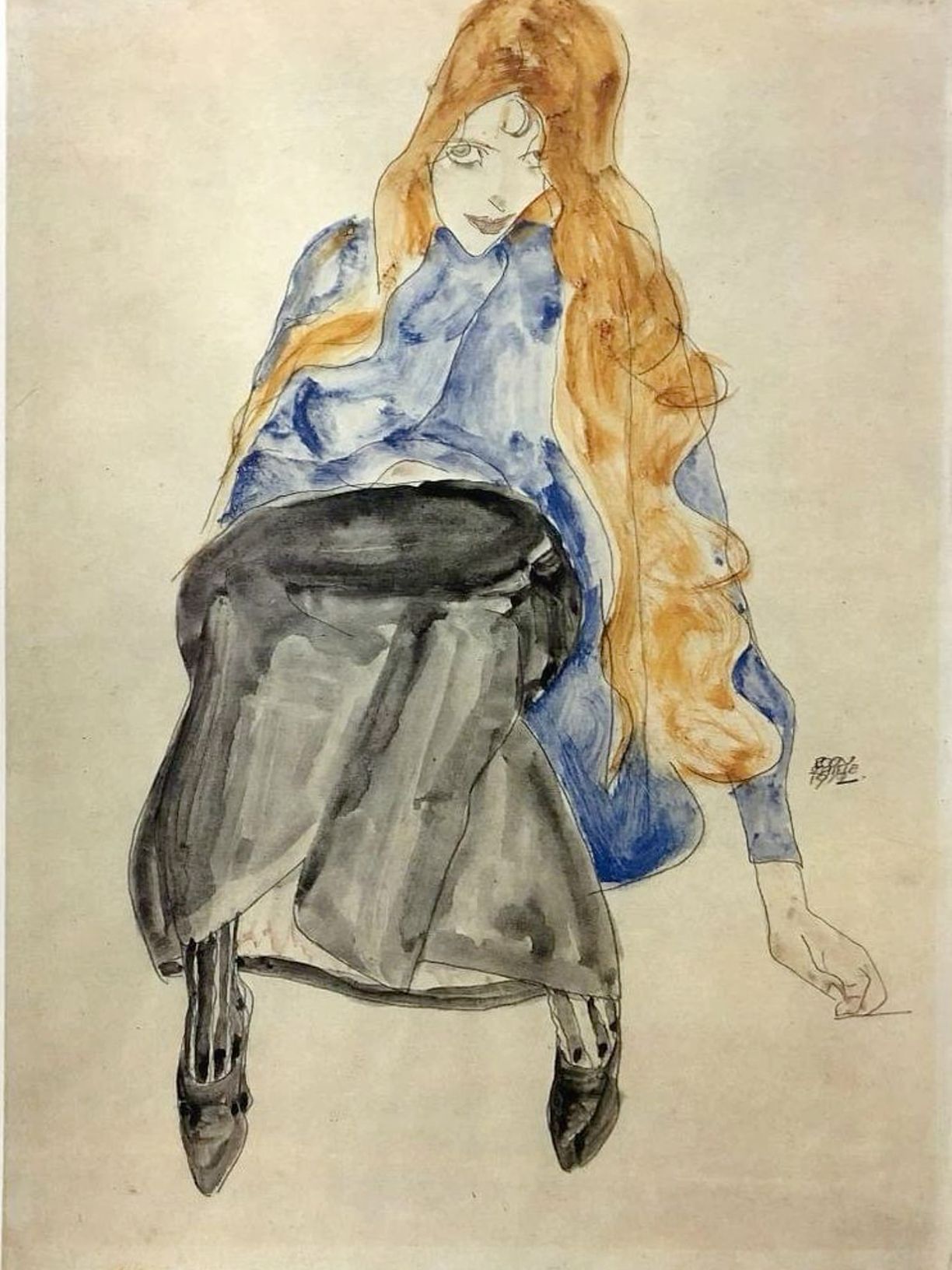
Egon Schiele:
Seated Girl with Long Blond Hair (Sitzendes Mädchen mit langem blondem Haar), 1912
Gouache, watercolor and pencil
45.1 × 31.7 cm
Private collection
(Kallir d1092)
This drawing from 1912 shows Schiele working with a restrained combination of gouache, watercolor and pencil, using each medium only where it supports the figure. The young woman sits in a slightly forward‑leaning pose, her left arm extended in a long downward line that steadies the composition. The blue jacket is applied in compact patches of color, while the dark skirt is kept simple, allowing the contour to define most of the structure. The long blond hair falls in broad, lightly brushed strokes that give the sheet its vertical movement. The face is indicated with minimal detail—just enough color to establish the eyes and mouth—so that the posture and the fall of the hair carry the drawing.
Wally Neuzil had entered Schiele’s life the previous year, first appearing in his work in the spring of 1911 and moving into his studio soon after. From that point onward she was present in his daily working rhythm, and her features recur across many drawings of 1912. The warm blond hair, the compact posture, and the slight forward inclination seen here correspond closely to the way she appears in other sheets from the same months. Although the sitter cannot be identified with certainty, the resemblance suggests that Wally may already have been involved in this study, at a moment when she was becoming central to Schiele’s work.
The drawing belongs to a group of small, intimate figure studies in which Schiele relied on a limited range of media to achieve clarity and presence. The interplay of contour, wash and color is quiet but deliberate, showing how he could create a complete figure with only a few carefully placed decisions. Within his 1912 output, this sheet stands out for its balance of simplicity and precision, and for the way it reflects the steady working partnership that was solidifying between Schiele and Wally at the time.
Leave a Reply