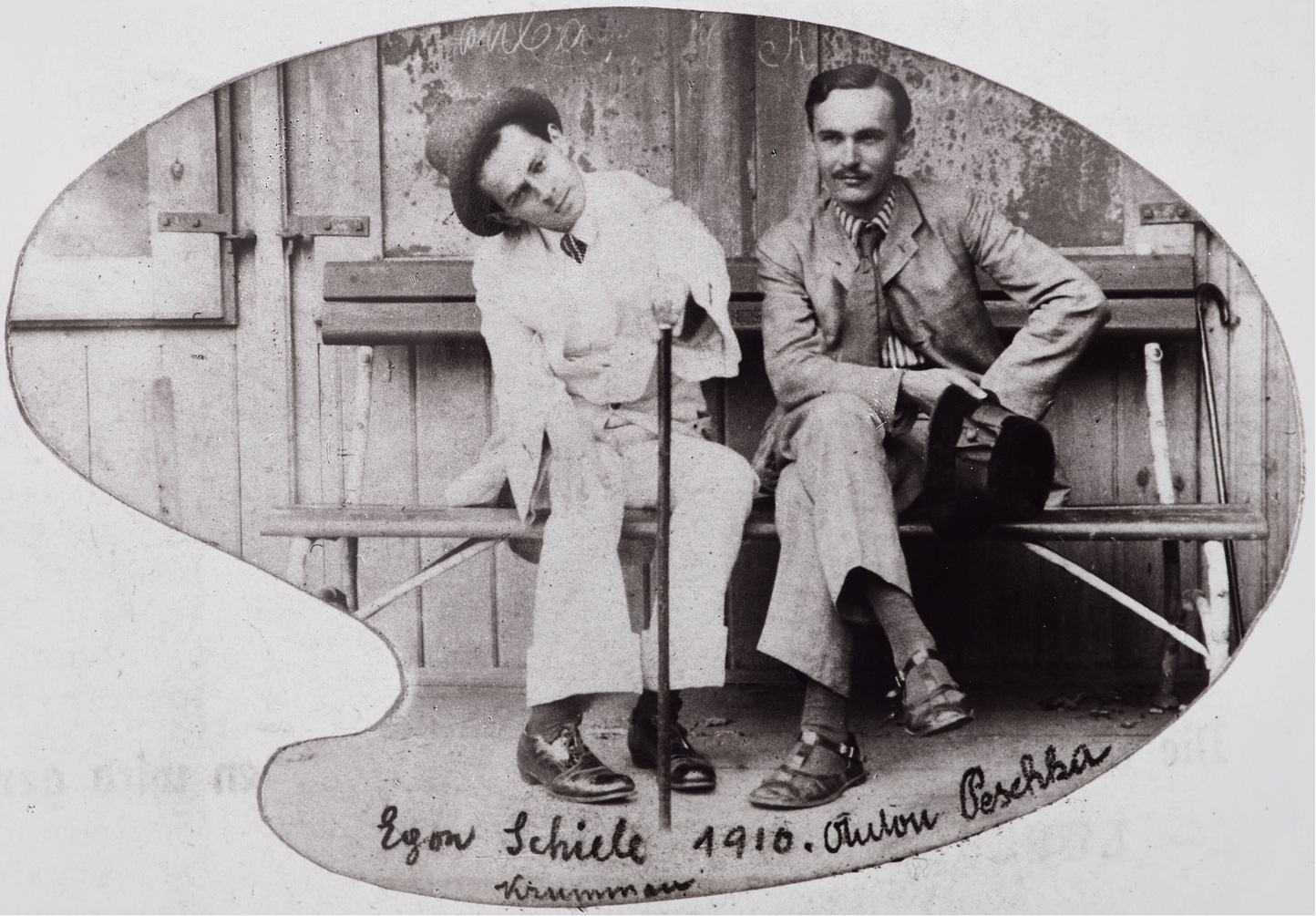
Between Stewardship and Intervention: Anton Peschka and Schiele after 1918
While Anton Peschka (1885–1940) was a founding member of the Neukunstgruppe, a Viennese avant‑garde group formed in 1909, his career is also linked to some of the controversial interventions he made in his informal role within the family in handling and occasionally selling works from Egon Schiele’s estate. In the decades following Schiele’s death in 1918, a clear pattern emerged. Evidence suggests that Peschka not only adapted his own style to mimic Schiele’s increasingly sought-after work, but that he also altered, completed unfinished work, and added color to several unfinished drawings left behind by his brother‑in‑law Egon Schiele. This mixture of artistic intention and financial pressure shows how complex Peschka’s position became. On one hand, Peschka acted as a sort of guardian of Schiele’s estate, helping to keep the Egon’s memory alive during the difficult interwar period. On the other hand, his actions blurred sometimes the lines between artistic emulation, posthumous collaboration, and approached the edge of what might be regarded as forgery. As Schiele’s market value for his art grew already throughout the 1920s, the appeal of presenting more finished and colorful works intensified, complicating the line between Peschka’s responsibilities to the family and the extent of his interventions. Because of their close personal and artistic relationship, Peschka’s role became even more difficult to navigate.
Managing the Estate: The Commercial Incentive
Following Egon Schiele’s death in 1918, Anton Peschka took charge of the artistic and financial affairs of Schiele’s surviving family, including his wife Gerti (Schiele’s sister), Schiele’s mother Marie, and Schiele’s other sister Melanie. The research was presented at the exhibition in the Wien Museum, and its findings were laid out in the accompanying catalog Schiele & Peschka: Eine Familienaufstellung. Through his marriage to Gerti, after Egon’s death, Peschka also had access to Schiele’s unfinished studio material at a time when interest in Schiele’s expressionist works was steadily increasing. Art historians emphasize that Peschka’s interventions were not intended as deliberate deception. Rather, they arose from economic necessity and practical choices during the difficult economic conditions in the 1920s. As demand for more fully developed, colored works by Schiele grew, Peschka began developing some of the unfinished material Schiele left behind.
A surviving letter to Gerti shows that he describes that he colored in at least four of Schiele’s drawings because colored pieces sold significantly better. It is therefore not unlikely that additional works were altered in a similar manner, even if only a portion of these interventions can be documented today. And further correspondence preserved in the Peschka family estate shows that Peschka — who at the time lived with Gerti and their children under severe financial strain — also completed or “restored” certain works by Schiele to make them easier to sell. The Peschka family estate — later transferred to the Wien Museum by Anton Peschka Jr. — also contains several unmistakable Schiele imitations, raising further questions for ongoing Schiele research.
In the Shadow of Genius: The Artistic Struggle
Beyond the financial pressures for Peschka, there was also a personal toll. It must have been very difficult for him to see Schiele’s reputation grow so quickly, while Peschka’s own creations received little attention from critics and collectors. This desire for recognition of his art likely contributed to the stylistic shift he made in the mid‑1920s. During this period, Peschka produced a group of works that echo Schiele’s visual language. It was an intentional effort to emulate the style of Egon Schiele, highlighting even morethe difference between his own modest success and the growing demand for Schiele’s work, which sold far more readily than his own.
A clear example is his near‑exact copy of Schiele’s drawing Alte Mühle (1916), produced around 1925, at a moment when Peschka was moving closer to Schiele’s established aesthetic.


For a struggling artist whose own creations were more difficult to sell on the market, watching Schiele’s posthumous fame accelerate confronted Peschka with the painful contrast between his own limited reach and the growing appreciation for Schiele’s work. Additional examples from Peschka’s oeuvre from the mid‑1920s show how consistently he gravitated toward Schiele’s characteristic line, compressed anatomy, and muted palette, a group of works that could be presented here as a brief slideshow.
Mid‑1920s nudes by Peschka
A small group of mid‑1920s drawings — especially several nudes — further demonstrates how consistently Peschka gravitated toward Schiele’s characteristic line and muted palette, a selection that can be shown here as a brief slideshow.
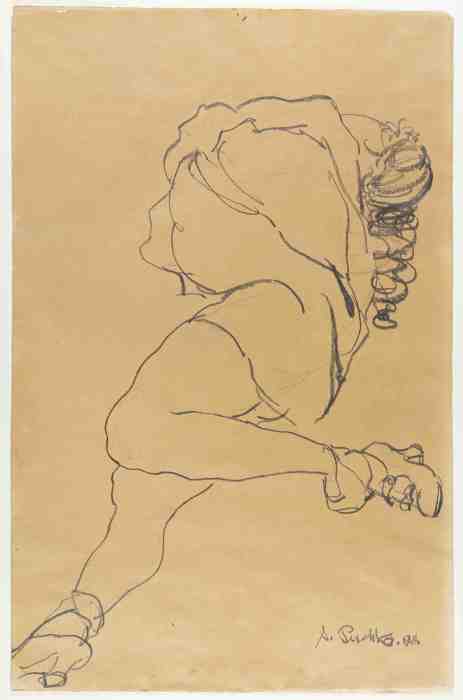
Reclining Female Nude, 1924, Anton Peschka 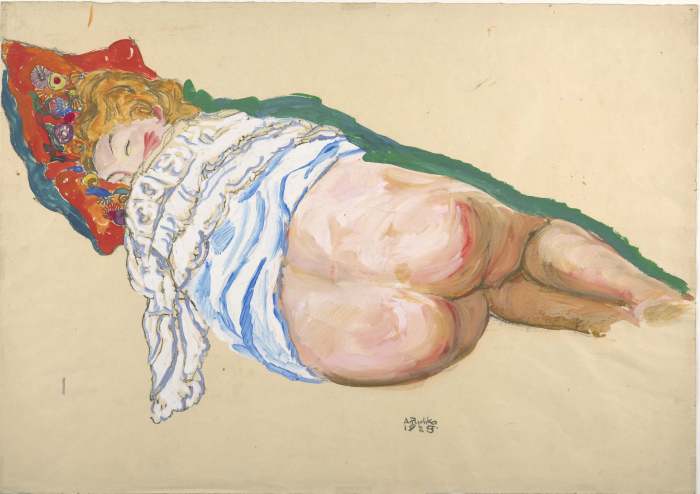
Reclining Female Semi-Nude, 1925, Anton Peschka 
Female Back Nude, 1925, Anton Peschka 
Female Nude, 1924, Anton Peschka 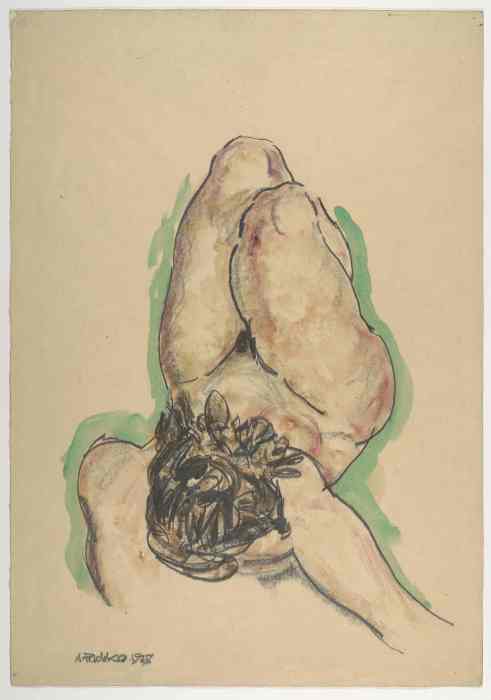
Female Nude Lying on her Back with Legs Pulled Up, 1927, Anton Peschka 
Crouching Back Nude, 1924, Anton Peschka 
Nude Lying on the Stomach, 1925, Anton Peschka
Krumau
A number of landscapes from the mid‑1920s, including views of Krumau, reveal how Peschka adapted Schiele’s angular contours and compressed spatial rhythm in his own compositions.


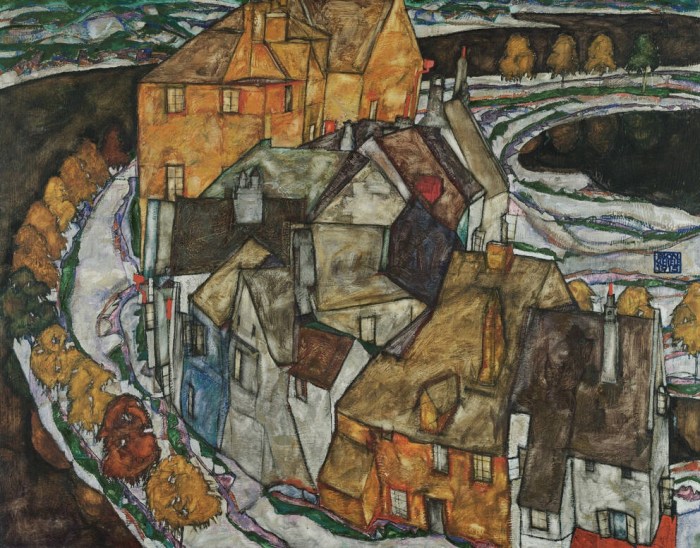

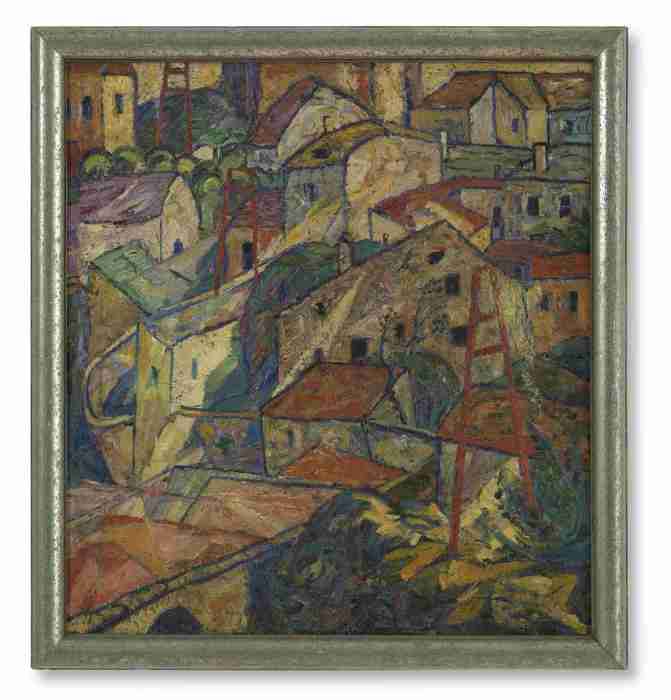
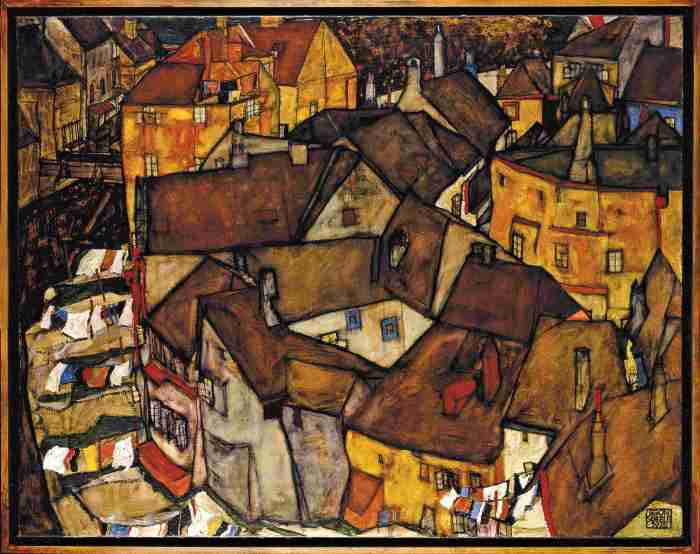
Sunflowers
Even in floral subjects, such as his studies of sunflowers, Peschka’s line and muted palette echo the restrained clarity of Schiele’s late works.


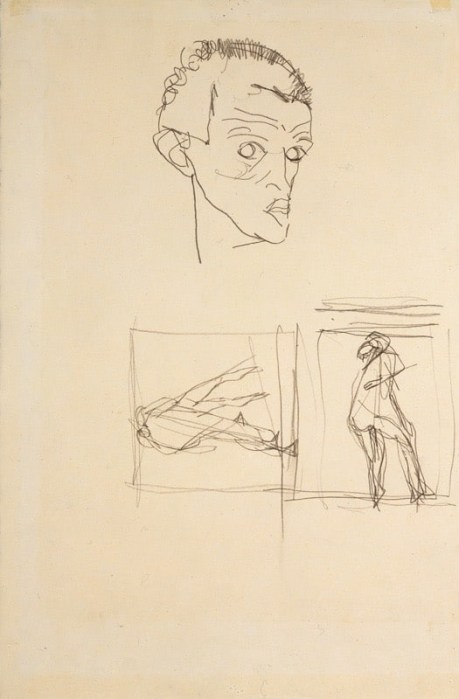
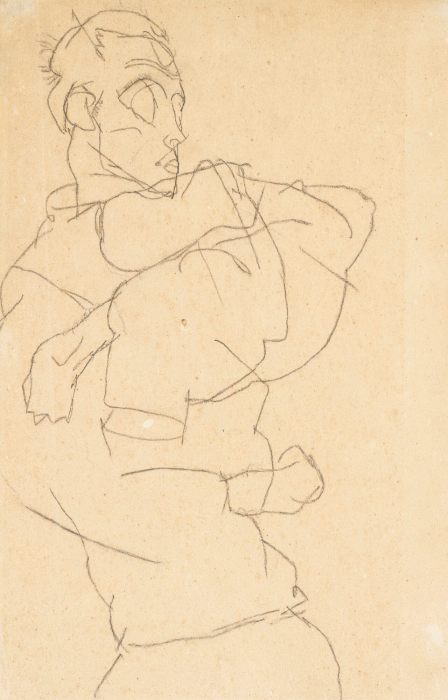
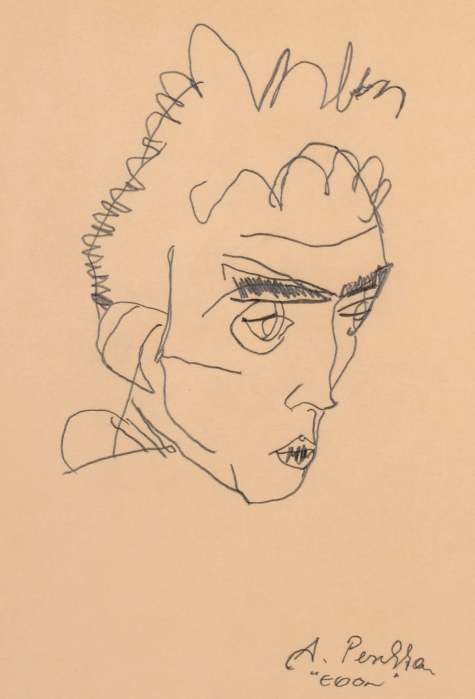
Head Schiele
To illustrate how closely Peschka studied Schiele’s line and facial structure, the following pair of head studies — three by Schiele and two by Peschka — show how he approached similar motifs in his own work.


Altering the Canvas: Mödling II and Knabenbildnis II

The interventions were not limited to adjustments on paper; Peschka also worked on some oil paintings, leading to close technical study. The Wien Museum publication discusses Mödling II (1918), a work long suspected of having been posthumously altered. Schiele expert Jane Kallir noted that the painting was likely finished by an outside hand. Recent material analysis by the museum’s restoration team did not identify definitive traces of Peschka’s brushwork, confirming that the canvas aligns with Schiele’s layered painting process, yet the work remains central to the broader discussion of paintings Peschka followed closely in an effort to understand Schiele’s late style.
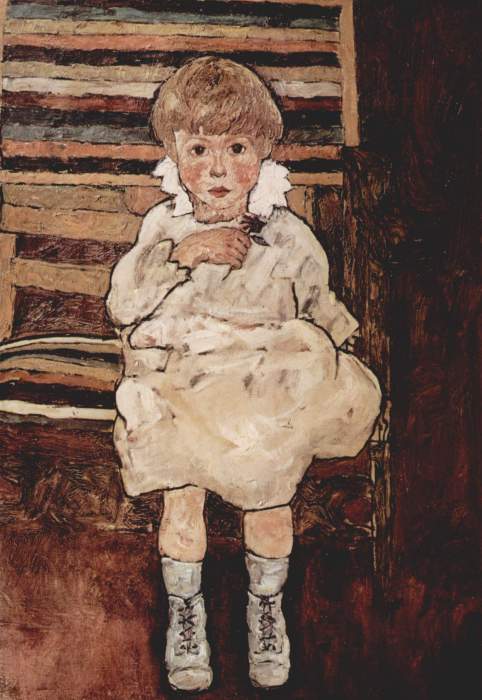
A more clearly documented case involves Knabenbildnis II (Boy’s Portrait II), 1918. Heinrich Benesch, an early supporter of Schiele, had seen the painting during Schiele’s lifetime in 1918, and remembered its unfinished state. In a later letter to Gerti, he wrote: “die Beine des Kindes waren nur bis in die halben Waden (von oben gerechnet) fertiggemalt, der übrige Teil aber kaum zeichnerisch angedeutet” (“the child’s legs were painted only halfway down the calves, and the rest was barely indicated”). When he encountered the painting again years later, after Schiele’s death, he found it fully completed — and Peschka acknowledged to him that he had finished it. Benesch could no longer recall whether the chair on the painting Knabenbildnis II had already been present in Schiele’s original version.
These findings, presented in Schiele & Peschka: Eine Familienaufstellung, shift the view of Peschka from a follower of Schiele’s style to someone whose administrative responsibilities and artistic challenges intersected with the posthumous life of Schiele’s work. Not only by emulating Schiele’s work, but also by adding color to unfinished sketches by Schiele and reworking familiar motifs, Peschka increased the marketability of the works held within the Peschka family estate during the difficult economic conditions of the 1920s. Although at least several interventions can be documented, it remains unclear whether additional works were similarly reworked; a number of sheets preserve a degree of uncertainty, and not all such adjustments can be attributed solely to Peschka. The name of Erwin Osen also appears in this context, suggesting that other hands may have contributed to the posthumous reshaping of certain drawings and paintings — a subject that belongs to a separate post. It remains regrettable that these interventions only now come more fully to light, yet they also reveal the human reality of an artist like Peschka who struggled to sustain his family and hoped, in Schiele’s shadow, to secure a modest livelihood through the work he so closely admired.


Leave a Reply