
The Imitation Game: The Klimt–Schiele Photo That Isn’t What It Seems
For more than twenty years, this photograph has circulated online as a supposed historical document: Gustav Klimt and Egon Schiele standing together in a studio, reviewing drawings side by side. It appears constantly on blogs, forums, Pinterest boards, and even on a few serious art sites that never bothered to check its origin. The image is persuasive at first glance — the bearded man on the left looks Klimt‑like, the younger figure on the right could pass for Schiele, and the table covered with sketches completes the illusion of an authentic moment between the two artists.
But no such photograph was ever taken in their lifetime. If a real image of Klimt and Schiele together existed, it would appear in every monograph, every catalogue raisonné, every exhibition publication, and every biography. It would be the most reproduced photograph in the entire Schiele literature — and, frankly, it would have been the centrepiece of my own site.
The truth is simpler: the picture does exist, but not as a historical photograph. It comes from the 1980 Austrian TV movie Egon Schiele, a German/Austrian 90‑minute production that tells the story of Schiele’s life and even incorporates some of his actual art. The film was shot in color, with Schiele played by Felix Mitterer — information traced and confirmed through the careful research of Paul Robinson, who was kind enough to share the material he had gathered about this photograph and the TV movie.
The widely circulated black‑and‑white version is most possibly a photographic movie‑still from that production. As Paul Robinson suggests, this still may have been created before the colour production images were known. It was likely posed by the actors and used for promotional purposes — possibly in a newspaper advertisement — which would explain how it detached so easily from its cinematic origin.
Paul Robinson later shared a colour still from a closely related moment in the same sequence: when mirrored, it aligns strongly with the black‑and‑white version, though it is not taken from precisely the same frame. The colour image is softer and less distinct, but the widely circulated black‑and‑white version has been given a kind of artificial age — its grain and contrast push it toward the look of a photograph from around 1910, allowing it to pass more convincingly as an “authentic” atelier moment. Working from Robinson’s colour still, I went through the same process myself: removing the on‑screen text, mirroring the image, and converting it to black‑and‑white. Below, I show how this colour still can be transformed in the same way, step by step, into the more familiar black‑and‑white “Klimt and Schiele” photograph, similar to the one that circulates online.

Screenshot klimt schiele TV Movie (1980) Courtesy Paul Robinson 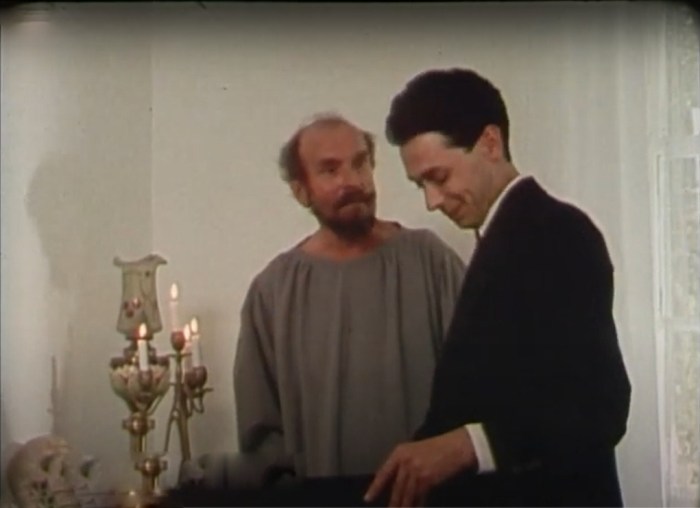
Screenshot klimt schiele TV Movie (1980) vs 2 without frame and text 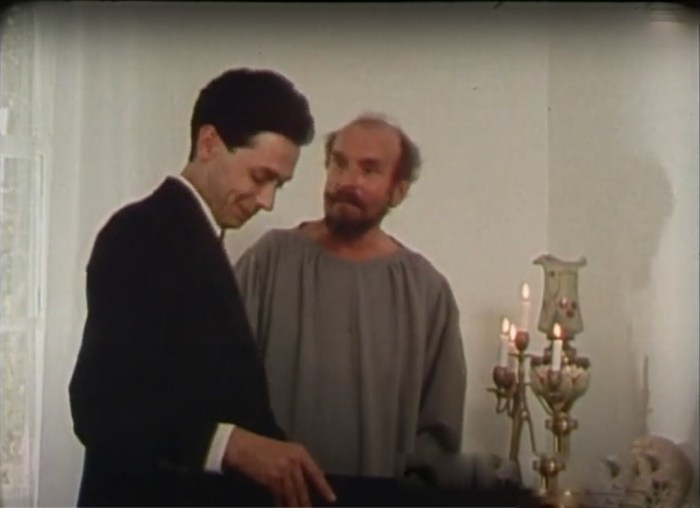
Screenshot klimt schiele TV Movie (1980) vs 2 without frame, text and mirrored 
Screenshot klimt schiele TV Movie (1980) vs 4 without frame, text, mirrored and black and white
For a time, a link to the full film circulated online, and I was able to watch it myself through that source a few times. That link has since disappeared. I am currently trying to obtain the film through other channels — a slow and difficult process — and will certainly report back here once I have it.
Before the colour version of the film was identified, it was even plausible to assume the still came from an older black‑and‑white TV production. Once stripped of context and converted to black‑and‑white, the image entered the internet as a “lost” atelier photo. A convincing pose, a few drawings on a table, and a vague resemblance were enough for a false narrative to take hold. Repetition became authority. The photograph is now part of the digital folklore surrounding Klimt and Schiele: endlessly shared, confidently misattributed, and rarely questioned.
Thanks to Paul Robinson’s persistence, the real provenance of the image is now clear — and it stands as a textbook example of how visual myths form and circulate.
Leave a Reply