The Belgian Connection: Théo van Rysselberghe
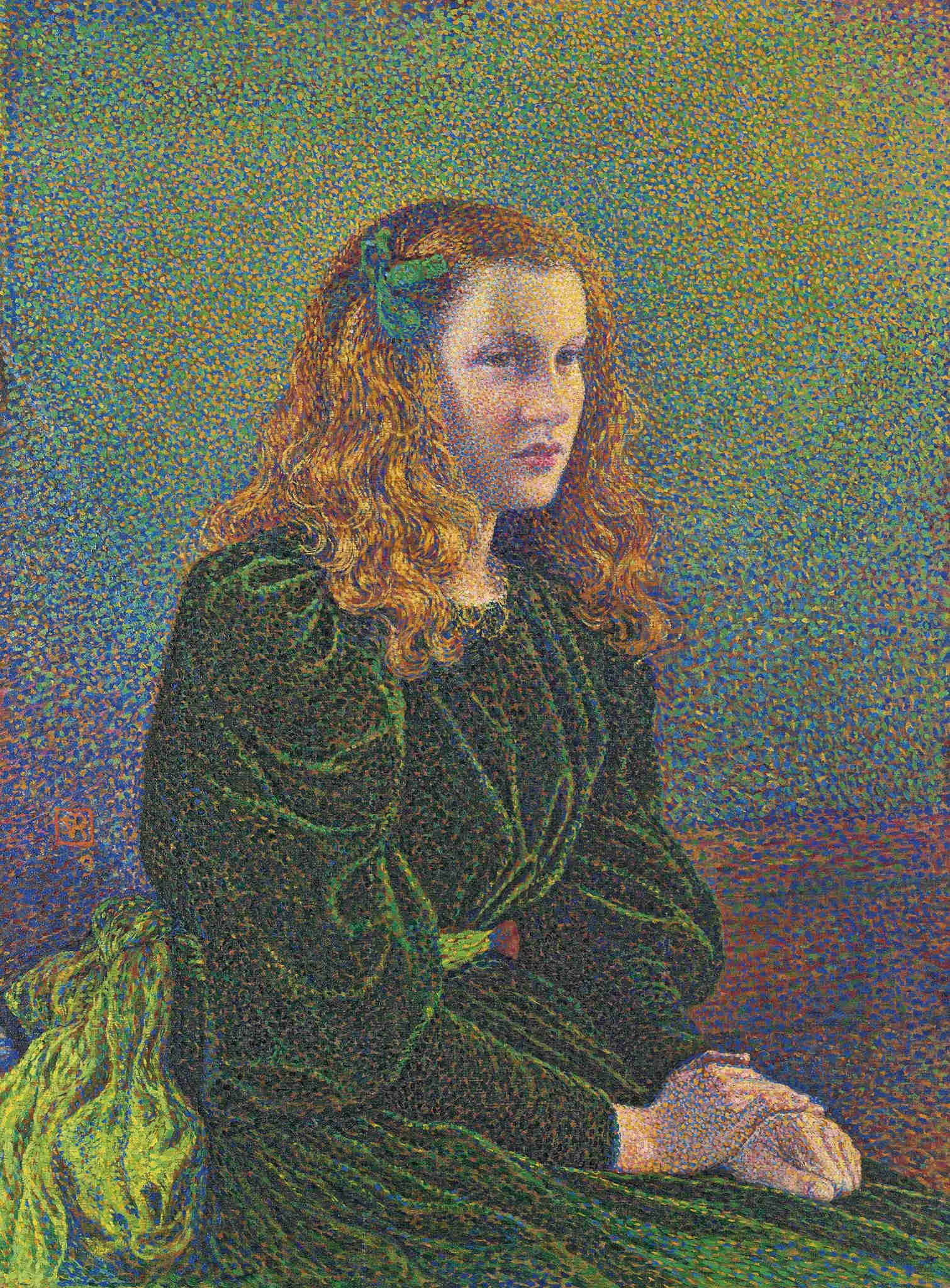
Young Woman in a Green Dress (Jeune femme en robe verte), 1893 Oil on canvas
81.7 × 60.6 cm
Auctioned at Christie’s in 2010 for GBP 769,250
Painted in 1893, Young Woman in a Green Dress belongs to the final year of Les XX, an independent Brussels exhibition society founded in 1883 that invited international artists and operated outside academic structures. By this stage Van Rysselberghe’s pointillist method had settled into a steady, measured application. He worked with a consistent touch and a controlled palette, applying colour in a way that emphasised structure rather than experiment. The sitter is identified as Germaine Maréchal, born in 1879, a niece of Maria Monnom, the artist’s wife. The Monnom family operated a printing house that produced L’Art Moderne and the catalogues for Les XX and later Libre Esthétique, placing them at the centre of the Belgian avant‑garde’s publishing infrastructure. Several members of the extended family appear in Van Rysselberghe’s portrait work from the late 1880s and early 1890s, including Germaine and her sister Denise, who was portrayed both earlier and again during this period.
The painting entered the exhibition circuit immediately after its showing at the final Les XX presentation in 1893, appearing in The Hague, Paris, Dresden and Berlin in the years that followed. These venues reflect the growing international interest in Belgian neo‑impressionism and the structured exhibition culture that surrounded it. In 1899 the work was included in the third exhibition of the Vienna Secession, where Van Rysselberghe was invited as a guest exhibitor. The invitation was part of a broader effort by the Secession to align itself with established European avant‑garde networks. Les XX had served as a structural model for the Secession’s founders, who studied its independent organisation, its international invitations and its detailed catalogues. Archival records indicate that Van Rysselberghe did not travel to Vienna for the exhibition; his works were sent, as was standard practice for foreign participants. His absence does not diminish the significance of the invitation; it simply reflects the practical realities of international exhibition culture at the time.
The painting’s appearance at auction in 2010 fits a pattern in which portraits from the early 1890s, especially those with clear documentation and direct ties to the Les XX circle, surface infrequently. Works from this period often remain in private collections for extended periods, and when they do appear, they tend to attract interest from collectors focused on Belgian neo‑impressionism and its documented connections to the European avant‑garde. The sale reflects both the rarity of such portraits on the market and the established position of Van Rysselberghe’s work within late nineteenth‑century exhibition history.

Leave a Reply