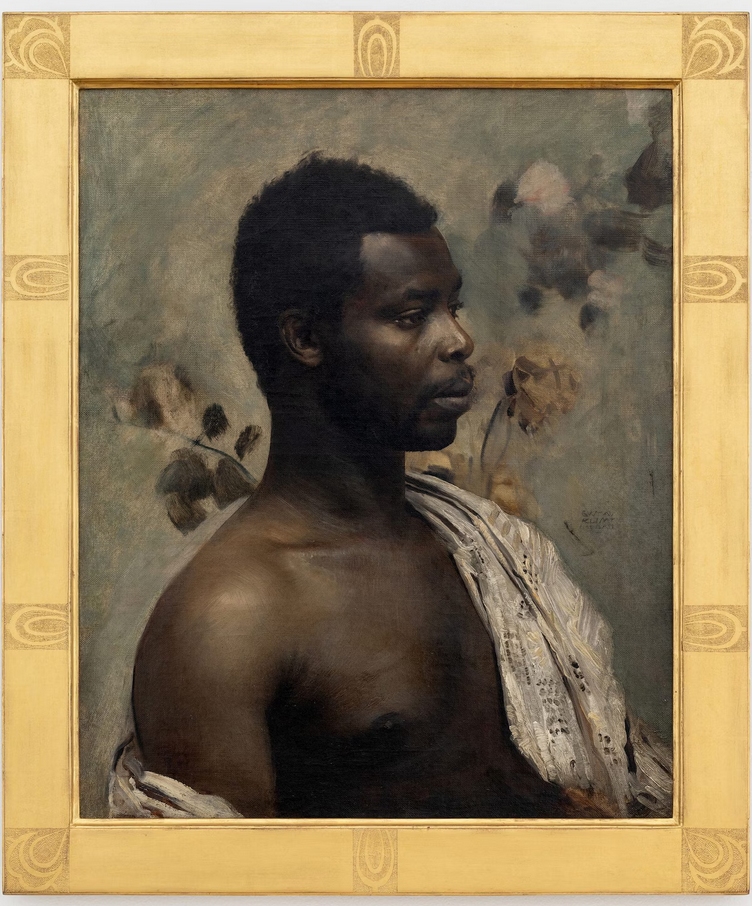
Gustav Klimt:
Portrait of Prince William Nii Nortey Dowuona (1897)
Oil on canvas
65.5 x 54 cm
Rediscovered in 2023; presented at TEFAF Maastricht 2025,
Offered privately; market approx. €15 million ($16.4 million)
(Natter 245)
Klimt is known for his golden, decorative works, but this canvas steps away from that. It feels more direct and unfinished, and it leaves certain aspects unresolved. The art world appreciates a rediscovery. This painting, missing since 1938 and known only from a photograph, suddenly comes back into view. In 2023, an anonymous collector couple arrives at W&K in Vienna with a canvas that had been stored without care. Alfred Weidinger recognizes Klimt’s estate stamp. The market responds positively, and experts confirm it. Yet the excitement leaves certain questions about the image unanswered.
The man staring out from the frame is Prince William Nii Nortey Dowuona, a leader of the Ga Osu people, a coastal state then trapped under the rule of the British Gold Coast colony. His presence is calm and authoritative. Klimt is often praised for avoiding the racist caricatures of his era. It is easy to label him a visionary who saw the prince as an equal. But the circumstances of their meeting were far less idealized. Klimt didn’t seek out Prince Dowuona out of respect. He encountered him inside a Völkerschau—a human exhibition—at the Tiergarten am Schüttel in Vienna. Austrian promoters had imported a group of West Africans, branding them as “Ashanti” entertainment to meet the public demand for exotic spectacle.
Let’s address the original title, because avoiding it is exactly how the art world distances itself from its past. When this painting was brought to Samuel Kende’s auction house in Vienna in 1923, after Klimt’s death, it did not carry the prince’s name. It appeared in the auction records simply as Head of a Negro (“Bildnis eines Negers”). The term is uncomfortable today, but it reflects how the Western art market categorized black individuals at the time. To the Viennese public and the dealers, he was not a sovereign leader from the Gold Coast; he was treated as an anonymous, exotic figure. The title was not an artistic decision—it echoed the way he was presented within the exhibition itself. It reduces a living man to a generic ethnographic type, prompting us to ask why such a label appears in the history of this painting.
Even the heavy ornate frame around the painting today plays a role in shaping how it is perceived. When the anonymous collectors brought the canvas out of storage, it sat in what experts described as an unattractive, inexpensive frame. The refined presentation we see now is a modern addition, prepared before the work entered the competitive segment of the market. At the Samuel Kende auction in 1923, it did not have this polished, golden appearance. It was shown plainly. This modern framing choice is not a neutral restoration; it is a deliberate marketing decision. By surrounding Prince Dowuona in gold, the art trade attempts to push a pre‑Secession, naturalistic study into the profitable aesthetic of Klimt’s later “Golden Phase.” It visually reframes a work rooted in a colonial context into something that appears familiar and commercially reassuring.
Around 1900, European fascination with the “exotic” was overwhelming, and this painting reflects that context as well. Artists were drawn to anything outside their own social world, searching for a sense of authenticity and raw presence. Yet that interest often turned into the stereotype of the “noble savage.” Instead of placing the prince in a pseudo‑primitive setting, Klimt presents him within the composed image of an aristocrat, shaping the Western fantasy in a more controlled and polished way. It reflects a culture that idealized the outsider while reducing him. The attention painters paid to the prince may have been progressive for its time, but it remains a perspective shaped from within the boundaries of cultural superiority.
This tension becomes more apparent when we look at the complicated history behind the canvas. For years, art historians could not agree on what—or who—they were looking at. In Tobias Natter’s 2012 catalogue raisonné, the work was listed as entry number 245. But because the painting was missing and known only through an old photograph, Natter questioned both its dating and its subject. He suggested that the canvas might not depict a living person from 1897 at all. Instead, under entry 245, he proposed that it was Klimt’s later rendering of a Central African sculpture he had seen at Brussels’ Musée du Congo around 1914. That theory effectively turns a Ghanaian ambassador who walked the streets of Vienna into an ethnographic object. It took Weidinger’s detailed research to dismantle Natter’s hypothesis, confirm that number 245 was authentic, and link the work back to the 1897 human zoo.
Klimt, after all, simply paid his admission fee. He entered the enclosure. He and his studio partner Franz von Matsch treated the exhibition as a place where they could find inexpensive, available models. Archival records even suggest that a patron commissioned both artists to paint the prince, ultimately choosing Matsch’s version—which now hangs in Luxembourg’s National Museum of Archaeology, History & Art—while Klimt’s study remained unsigned and stored in his studio. The dignity visible on the canvas does not come from Klimt; it belongs to Prince Dowuona himself, who maintained his composure under the gaze of a Viennese audience. Klimt did not elevate the prince; he worked from his presence for artistic purposes.
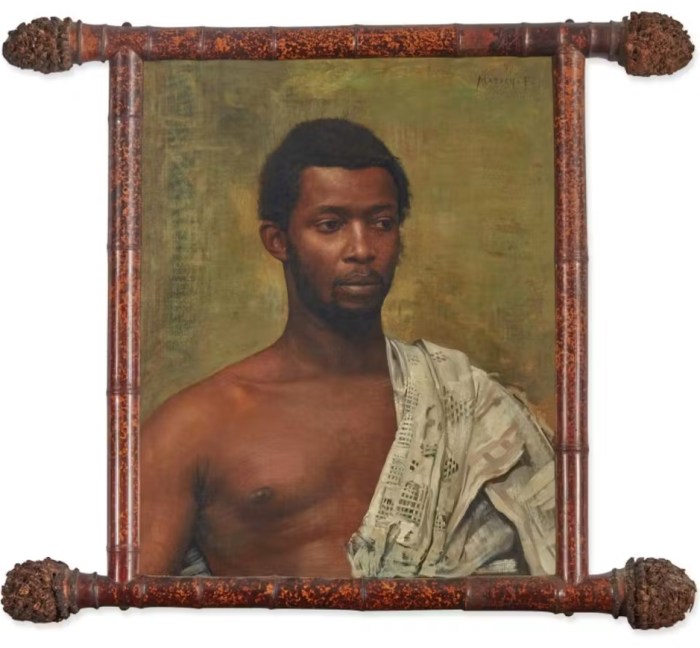
The painting reflects this complex history. There are no gold leaves or flat decorative patterns here. This is Klimt’s early, tight naturalism—a style defined by controlled, physical brushwork. The subtle tonal shifts across the prince’s face contrast with the broader, more hurried handling of the clothing and the dark, enclosing background. The object itself shows clear signs of wear. Removing the surface dirt revealed long‑term neglect. There is abrasion along the edges of the canvas, with small areas of paint loss caused by poor storage conditions. While cleaning tests confirmed Klimt’s hand beyond doubt—visible in the sharp jawline and the concentrated highlights in the eyes—the damage simply reflects the years the painting spent out of view.
The main difficulty, however, lies on the back of the painting. The art market would prefer this to be a straightforward, uncomplicated story. We are told that a successful restitution agreement was reached with the heirs of the Klein family, the Jewish collectors who lost their property to the Nazis in 1938. But what do we make of the eighty‑five years in between? Ernestine and Felix Klein are the same couple who once owned the Klimt Villa in Vienna’s Hietzing district. After purchasing the property, they hired an architect to build a two‑story villa around the modest garden house that Klimt had used as his final studio. The Kleins effectively created what we now call the Klimt Villa to preserve the artist’s legacy. When the Nazi regime targeted them in 1938, the family fled to London, leaving behind both their architectural project and this portrait.
Where was the painting between 1938 and 2023? It appears to have been kept out of sight in postwar Hungary. By whom? In whose home did it hang while the world assumed it was gone? The W&K Gallery does not provide answers. The “Austrian collectors” who supposedly retrieved it from Hungary remain unnamed. This silence is not incidental; it leaves parts of the story unaddressed.
When the portrait appeared at TEFAF Maastricht 2025, it was shown quietly in the Modern section. It sold privately for €15 million, but that moment was immediately overshadowed by a legal dispute. Austrian prosecutors seized the painting after allegations that it had been taken out of Hungary without the required state export permits. The portrait of Prince Dowuona has reappeared, but it is immediately involved in legal and commercial complications. We have found the canvas, but the circumstances behind it remain unclear.


Leave a Reply