Gustav Klimt:
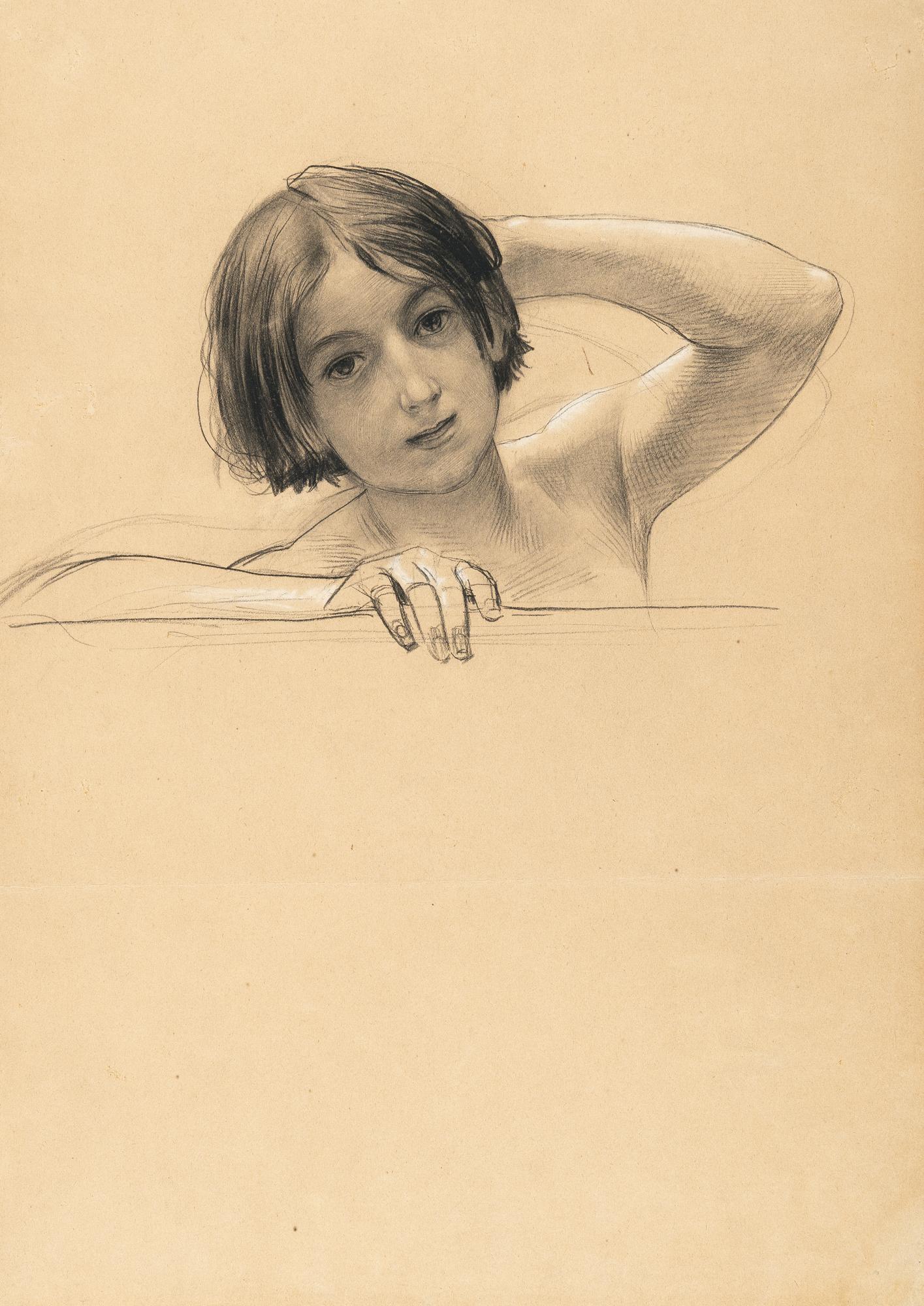
Portrait of a Boy Looking Over a Wall (Bildnis eines über eine Mauer blickenden Buben), ca. 1884–1885
Chalk highlighted in white, partially smudged, on pale brown velvety drawing paper
45 × 31.5 cm
(Not in Strobl, will be added in forthcoming volume)
This early drawing shows Gustav Klimt at a moment when his realism is still fully intact, yet already softened by the sensitivity that would later define his portraiture. The boy rises above the wall with a gentle immediacy, as though he has just lifted himself high enough to meet the viewer’s gaze. Klimt concentrates his attention on the face: the rounded cheeks, the slightly parted lips, the pageboy haircut rendered with fine, deliberate strokes, and above all the direct, unguarded look that anchors the sheet. The pale brown paper absorbs the chalk in a velvety way, allowing Klimt to move between crisp definition and subtle smudging, especially around the hair and the shadow under the chin, where the drawing breathes with a quiet softness.
The boy’s gesture is simple and telling. His right hand rests on the edge of the wall, steadying himself, while the left touches the back of his head in a small, almost absentminded movement. It gives the scene an intimate, unposed quality, as though Klimt caught him in a moment of curiosity rather than in a formal sitting. The drawing belongs to the period when Klimt, newly graduated from the Vienna School of Applied Arts, shared a studio with his brother Ernst. Within that shared practice, studies often circulated between the two, and in this case the connection is unusually clear: the boy reappears, transformed but recognisable, in Ernst Klimt’s Genius with a Trumpet (1885), where the youthful figure is woven into a more allegorical setting. The tilt of the head, the upward glance, and the gentle openness of the expression echo the drawing unmistakably, showing how Ernst adapted Gustav’s study into the decorative programme he was developing at the time.

What remains most striking is the tenderness of Gustav’s attention. Even in this early phase, before the ornamental richness of his later work, he shows how closely he observes the human face — not to idealise it, but to preserve the fleeting, searching presence of a child looking out over a wall, a presence that would quietly continue its life in his brother’s painted genius.
Leave a Reply