The Hungarian Connection: Sándor Ziffer
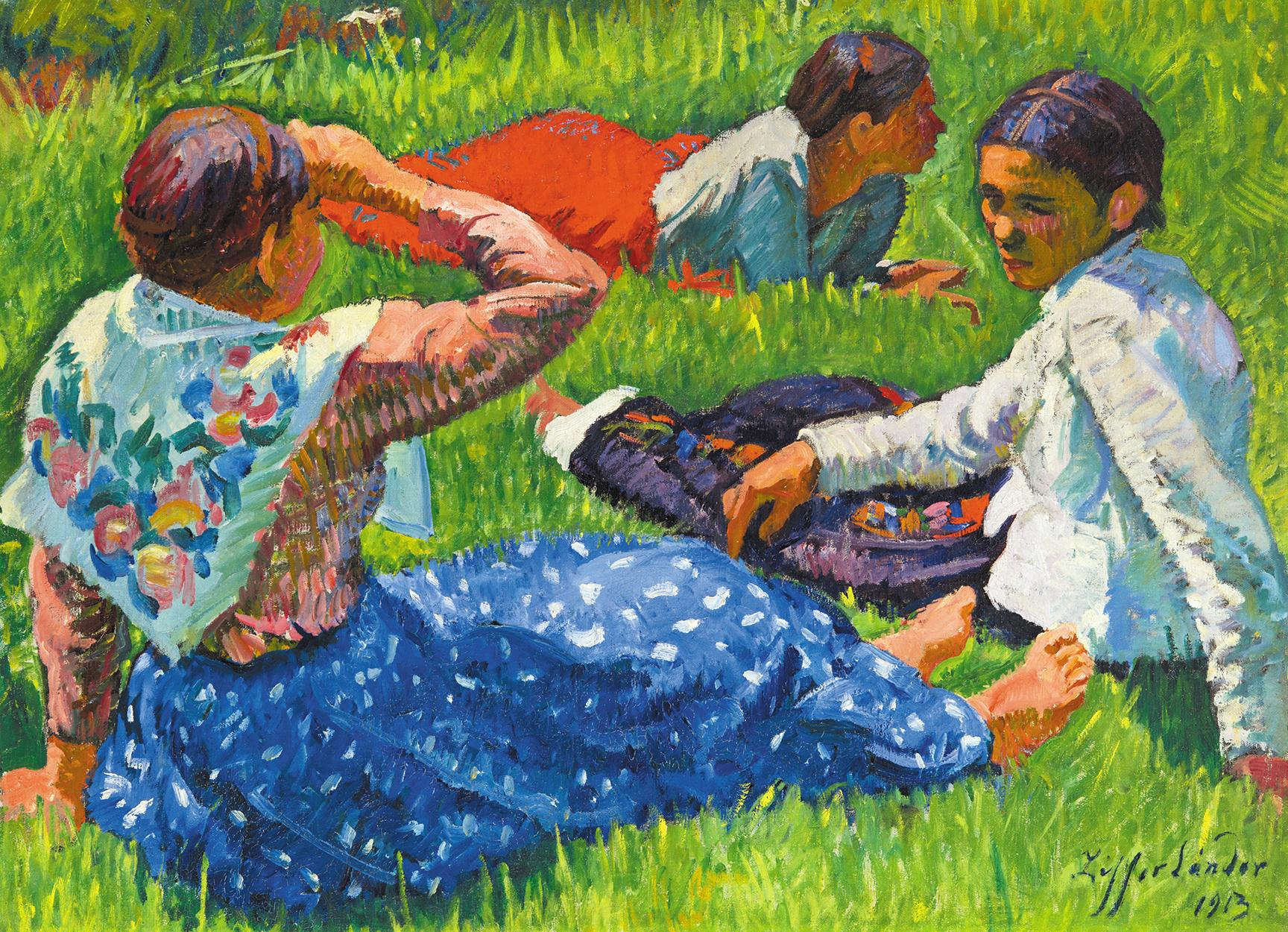
Models resting (Gipsy Girls sitting in the Grass), 1913 – Sándor Ziffer
Oil on canvas
92 × 128 cm
Auctioned at Virág Judit Galéria, Budapest in 2024 for $ 135,000
This wide, sunlit canvas shows Sándor Ziffer at his most assured, capturing three young women resting closely together in the grass, their bodies forming a gentle diagonal that draws the eye from the lower left toward the bright, open field behind them. The patterned blue skirt, painted with bold, almost mosaic‑like strokes, anchors the composition; beside it, the red skirt glows with a warm intensity that seems to radiate into the surrounding greens. The floral shawl, draped loosely over the shoulders of the woman in blue, adds a soft counter‑rhythm of pinks and whites, its delicate patterning set against the more assertive brushwork of the landscape.
The figures lean into one another with a natural intimacy: the woman in the white blouse turns slightly inward, her posture relaxed, her expression softened by the warm outdoor light; the woman in blue rests her weight on one arm, her gaze lowered, her body forming a gentle curve that echoes the slope of the grass; the woman in red sits upright yet unposed, her presence steady, her clothing catching the sun in a way that makes her the quiet fulcrum of the group. Their gestures feel unforced, as if Ziffer had stepped into a moment already unfolding, capturing not a scene arranged for the viewer but a shared pause in the day.
The greens of the grass shift constantly — cool, deep tones near the shadows of the figures, then bright, almost electric greens where the sunlight hits the blades directly. These transitions give the painting a lively decorative pulse, a sense of movement even in stillness. Ziffer’s brushwork remains expressive yet controlled: strokes overlap, break, and rejoin, shaping the forms without tightening them. Even the shadows feel intentional, woven into the tapestry‑like unity of the scene rather than simply cast by the sun.
Although Ziffer was not a member of The Eight, the group that introduced French modernism into Hungarian art, the shared modernist impulse is unmistakable here. The softened planes, the rhythmic contours, the ornamental correspondences between fabric, foliage and figure all echo that same movement — an affinity felt in the visual language rather than declared through formal affiliation. His training at Nagybánya—the seminal open-air artists’ colony that revolutionized Hungarian art by introducing plein-air naturalism and impressionist light—was sharpened by encounters with Paris and Berlin, giving the painting its perfect balance of clarity and warmth, structure and ease.
The result is a work that feels both modern and timeless, a painting that breathes with outdoor light and human closeness. It embodies the qualities that have secured Ziffer’s place in Hungarian art history, with significant representation in the Hungarian National Gallery.
Leave a Reply