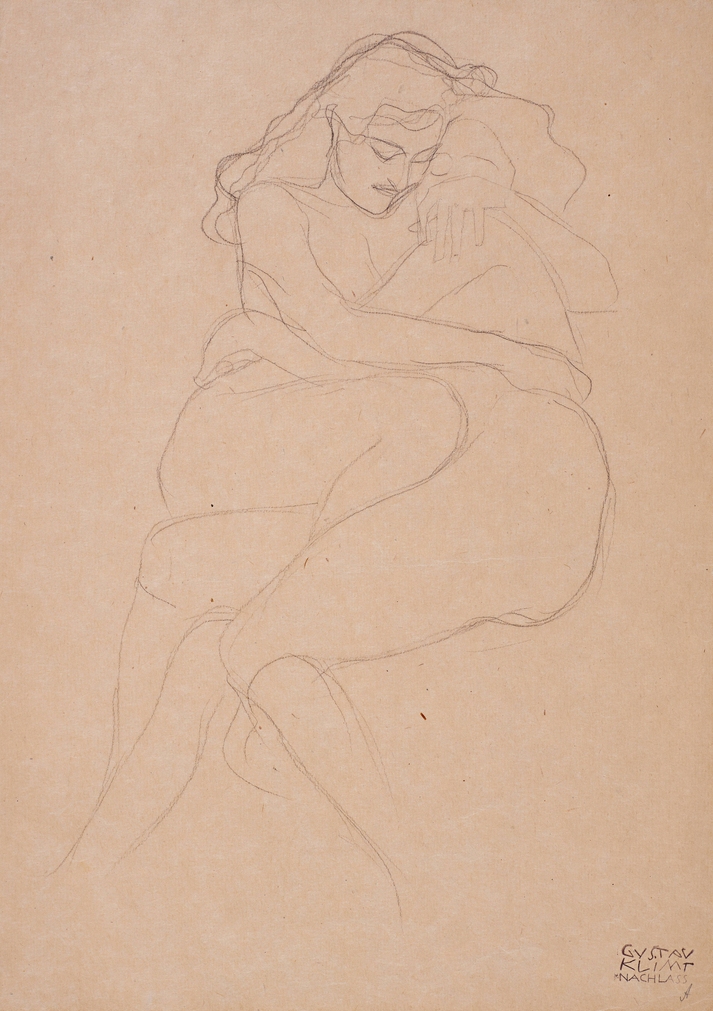
Gustav Klimt:
Two Embracing Female Nudes (Zwei sich umarmende weibliche Akte)
Black chalk on package paper
44.9 × 32 cm
© Leopold Museum, Vienna
(Strobl s1937)
The precise timing of this sketch is a subject of ongoing debate among art specialists, offering two distinct perspectives on Klimt’s stylistic development. Art historian Marian Bisanz-Prakken, the former curator of the Albertina Museum in Vienna, proposes an early date of 1903–1904. In this view, the artwork highlights a phase where Klimt relied heavily on pure, minimalist line-work to convey emotion. The simplified curves and the overlapping limbs represent an experimental study of physical interaction, showing how touch forms new collective shapes. This early dating ties the sheet to the formal language Klimt explored for monumental projects like the Stoclet Frieze.
Conversely, Alice Strobl assigns the drawing to a later phase, placing it around 1909 within the specific chapter of her catalogue raisonné dedicated to depictions of friends and lovers (Studien von Freundinnen und Liebespaaren). This timeline shifts the interpretation toward Klimt’s late allegories. A key feature of this later style is the visual blending of bodies, transforming two distinct figures into a single, fluid silhouette. By partially hiding the faces of the models, Klimt de-emphasizes individual identity, focusing instead on the shared contour of the embrace. Under Strobl’s chronological placement, this work aligns with the numerous figure studies that paved the way for his masterpiece Death and Life (Tod und Leben), where intertwined human forms similarly merge into a dense cluster.
When analyzing this sheet, it is crucial to remember its original purpose as a private studio study rather than a finished artwork. Klimt likely never intended for these raw trials on packing paper to be exhibited or sold. They functioned purely as experimental steps in his creative process; the three visible calves in the lower section show how he tested different overlapping positions on a single page, perhaps discarding one angle to immediately sketch the next. Viewing the sheet through this lens transforms it from a static image into a dynamic record of observation. The inward lean of the heads and the soft intersection of the shoulders are not final aesthetic choices, but a spontaneous capture of human tenderness frozen mid-process.
Leave a Reply