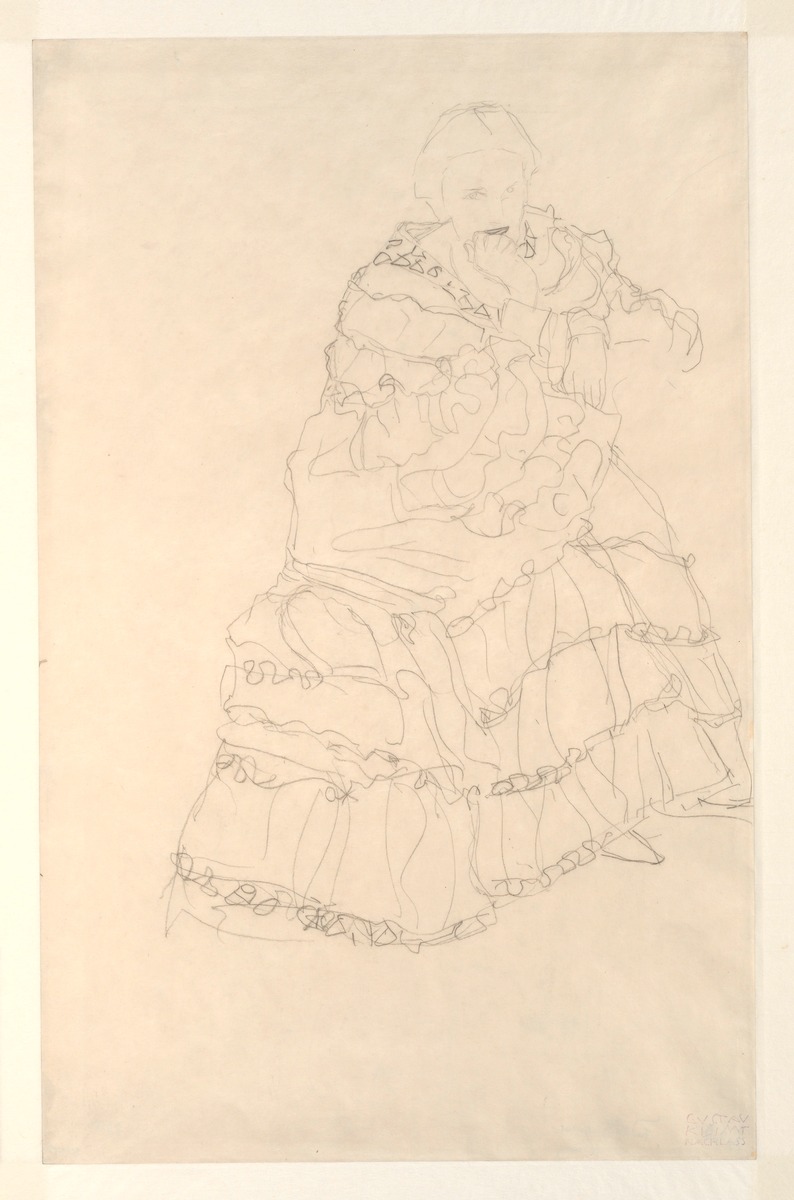
Gustav Klimt:
Study for the Portrait of Magda Mautner‑Markhof (Studie zum Bildnis von Magda Mautner‑Markhof), 1904–1905
black chalk paper
55.1 × 34.9 cm
©Akademie der bildenden Künste, Wien
(Strobl s1222)
This drawing belongs to the same period in which Klimt was working on The Three Ages of Life, and it shows the quiet, searching quality of his preparatory sheets from these years. Strobl records around ten drawings connected to the planned portrait of Magda Mautner‑Markhof, each one exploring small adjustments in posture and emphasis, as if Klimt were still deciding how to translate her presence onto the canvas. The handling is soft and unforced: the black chalk settles lightly, the contours remain open, and the figure is held with a calm, attentive clarity.

Magda Mautner‑Markhof was in her early twenties at the time. She was the daughter of Carl Mautner von Markhof, from the prominent Viennese brewing and industrial family whose patronage of the arts was enduring and generous. Klimt visited the family often, and Alfred Roller — a close friend of Klimt and a central figure of the Secession — gave Magda painting lessons. She was not only a patron’s daughter but an artist in her own right: works by her were shown at the Kunstschau, which places her firmly within the creative circle around Klimt, Moser, Roller, and their wider milieu. Her sister, Ditha, was married to Koloman Moser, which further connected her to the artistic networks of the time.
The portrait was never executed. No direct explanation survives, but the likely reason is simple: Magda left Vienna for Paris, where she studied with Maurice Denis. The shift in her artistic direction, combined with the practical distance, may have led to the abandonment of the commission. She later married and moved to Salzburg, and the project seems to have remained at the stage of preparatory drawings. What remains is this quiet sheet — a trace of an intention that never reached the canvas, held with the same gentle concentration Klimt brought to his portrait studies.
Magdalena Anna Klara was born on April 14, 1881 in Vienna. In 1904 she was portrayed by Eduard Veith in Melancholie, painted one year before Klimt made his series of drawings for her planned portrait. She aimed to compile a collection of contemporary Austrian art and owned Gustav Klimt’s Hope I (1903), originally acquired by Fritz Waerndorfer. In 1912 she purchased Egon Schiele’s Autumn Tree in Stirred Air (Winter Tree). On 5 November 1913 she married the teacher Alois Grasmayr, with whom she moved to Salzburg. Magda died there on August 22, 1944.
Leave a Reply