
Finding Gerti’s Grave
My visit to Vienna in autumn 2025 led me, almost quietly and without planning, to the grave of Gerti Schiele — a small detour that most visitors to the Friedhof Ober St. Veit never think to make. Reaching the cemetery itself is already a small journey: first by U‑Bahn from the centre of Vienna, and then either by bus or on foot up the slope toward the Friedhof Ober St. Veit, which, as its name suggests, sits on higher ground at the city’s edge. Many people come to pay their respects to Egon and Edith, whose resting place is easy to find once you pass the entrance and turn right, and often marked by a small cluster of flowers left by admirers around his grave. They both died within days of each other in the autumn of 1918, victims of the Spanish flu, and Edith was pregnant at the time — a double loss that still feels almost unbearable in its suddenness. What most people do not realise is that Edith’s sister, Adele Harms — who died much later, in 1968, and was subsequently buried in the same grave — is not mentioned on the stone at all. Nothing on the grave reveals that a third family member, who died many decades later, rests there as well. That story, though, belongs to another post — one that follows the quieter threads of the Harms sisters and the way their histories fold into the Schiele family.
Gerti’s grave lies elsewhere in the cemetery, on the left-hand side, where you have to step up onto a small rise within the Friedhof before the path levels out again. To reach it, it helps to have a map with the marked grave number. For anyone who wishes to visit: “Friedhof Ober St. Veit, Gruppe L, Reihe 16, Nr. 11.” It is the Peschka family grave, the resting place she shared with her husband, the painter Anton Peschka, who had been one of Egon Schiele’s closest friends. Peschka painted with dedication and skill, though his career never reached the same visibility as Egon’s, and the two men remained bound by friendship, family, and the shared language of their craft. To find Gerti’s grave, you have to look more deliberately, using the cemetery map and the grave number until you reach the spot.
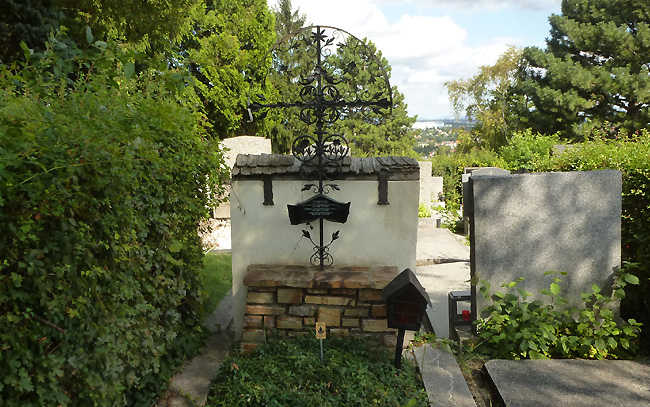
It wasn’t exactly easy to pinpoint the location, but in a cemetery you have all the time in the world; no one will mind, and no one is there to disturb the quiet. When I finally reached the spot, the silence felt different — not solemn in the way of famous graves, but tender, almost private, as if the place had been waiting for someone to remember her. The small plot no longer carries the nameplate that once identified it, leaving only the simple stone frame, the fallen leaves, and the modest iron cross with its plaque at the head. Standing there, I felt the strange intimacy of visiting someone who has been overshadowed for more than a century, someone whose presence in the world mattered deeply to the brother whose art would eclipse nearly everything around him. It was a moment of quiet recognition, a reminder that even in a cemetery filled with names, some stories still need to be sought out before they can be seen.
The grave once carried a black enamel nameplate listing the members of the Peschka family who rest here: Anton Heinrich Emanuel Peschka (21 February 1885 – 9 September 1940), his wife Gertrude Luise Marie Peschka–Schiele (13 July 1894 – 4 May 1981), and their children Gertrude Peschka (23 February 1913 – 3 January 1944) and Anton Peschka (27 December 1914 – 25 July 1997). The plaque has since disappeared, leaving the grave unmarked in its present form, but older photographs preserve the names that once stood at the head of the plot.
A closer look at the enamel plate brings the names into sharper focus, a small but telling trace of the family remembered here.

What matters especially is that their daughter Gerti rests here as well. She was the first child of Gerti Schiele and Anton Peschka, born in 1913, a year before her parents married in 1914. Her story is more complex than the sparse literature ever suggested, and she did not grow up in the household of her mother and father — a history I will return to in a separate post. Only recently, during the exhibition Changing Times. Egon Schiele’s Last Years: 1914–1918 at the Leopold Museum (28 March 2025 – 13 July 2025), more was revealed about her life and presence within the family. For decades almost nothing had been written about her; only their son, Anton Jr., was known, appearing as a young boy in several of Egon Schiele’s drawings. The renewed attention to daughter Gerti — a quiet ‘rediscovery’ — made clear that her existence had long been known to specialists, yet had never received the attention it deserved. She, too, appears in Schiele’s drawings, and her presence casts a new light on several works that had been interpreted differently for years.
What is often overlooked is that the family’s story did not end with Egon Schiele’s death in 1918. In the years that followed, Anton Peschka and Gerti Schiele had two more children: Susi, born on 4 December 1920 and who lived until 30 July 2011, and Egon, born on 18 June 1928 and who died in 1994. Their lives, largely absent from the literature, were brought to light in the recent exhibition Schiele & Peschka. A Family Affair at the Wien Museum, with further details published in the accompanying catalogue, reminding us that the Peschka–Schiele family continued far beyond the narrow frame through which art history usually views them.
For anyone wishing to visit the grave themselves: I’ve added a link to the cemetery map in the comments.

Leave a Reply