Egon Schiele
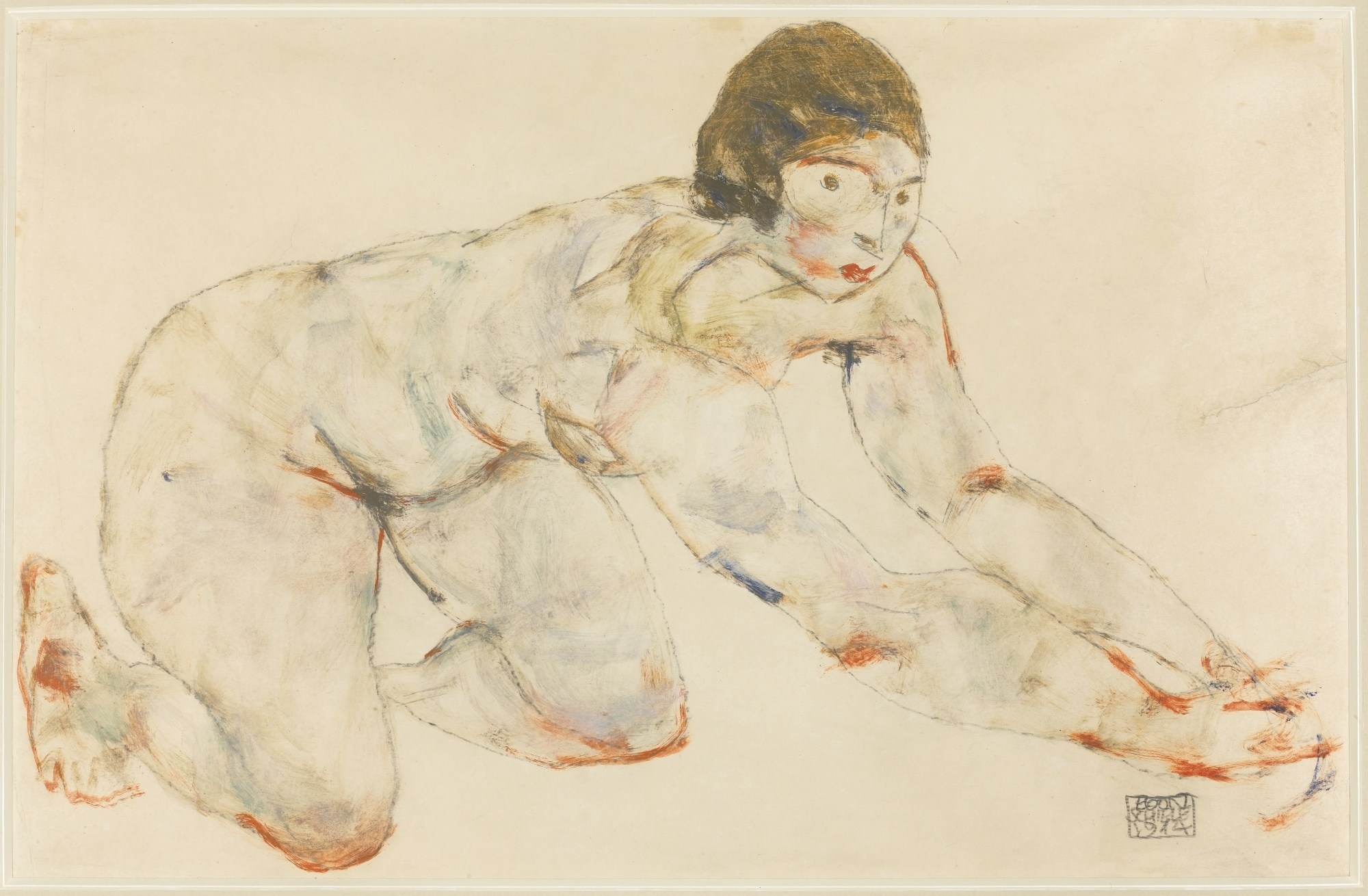
Crouching Female Nude (Kauernder weiblicher Akt), 1914
gouache, watercolour and black chalk on paper; framed
30.8 × 47.6 cm
Auctioned at im Kinsky in 2024 for € 947,500
(Kallir d1561)
This drawing stands firmly within Schiele’s sharply angular 1914 period, when his figures shift from flowing contour to a vocabulary of abrupt, tense breaks. The body contracts into articulated segments: the spine bends in a pronounced hinge, the arms thrust forward with sudden precision, and the legs fold beneath her in a way that feels constructed rather than relaxed. His line—often drawn while keeping his eyes locked onto the model rather than the paper—is quick, incisive and slightly abrasive, giving the posture a structural tautness that defines this moment in his work.
Around 1914 Schiele enters a distinctly analytical phase, a shift heavily charged by the volatile atmosphere on the eve of the First World War. The expressive elongation of earlier years gives way to a more concentrated, almost dissecting approach to the human form. He becomes increasingly interested in the mechanics of the body — the joints, the hinges, the points of strain — and this shift produces figures that feel sharper, more deliberate, and often quietly unsettling. Viewed from his characteristic high vantage point, the unease in this sheet arises from the way the body is held together by angles rather than curves, refusing any suggestion of ease or harmony.
The thin washes of gouache and watercolour do not soften the form; they merely trace its planes, functioning as autonomous pools of colour that contrast with the rigidity of the sketch. Nothing here seeks to please. Instead, the drawing confronts the viewer with a controlled awkwardness, a tension that remains suspended in the pose. It is precisely this refusal of comfort that makes the sheet so characteristic of Schiele in 1914, when he approached the body with a heightened structural focus and an unsentimental eye.
The provenance underscores its solid history, passing from the Serge Sabarsky collection in New York into private hands in the United States and Europe, appearing at Sotheby’s London in 2014, and later entering an Austrian collection.
It is a work that captures Schiele at a moment of intense clarity, where the body becomes a set of charged angles rather than a silhouette — unmistakably his, and unmistakably of this period.
Leave a Reply