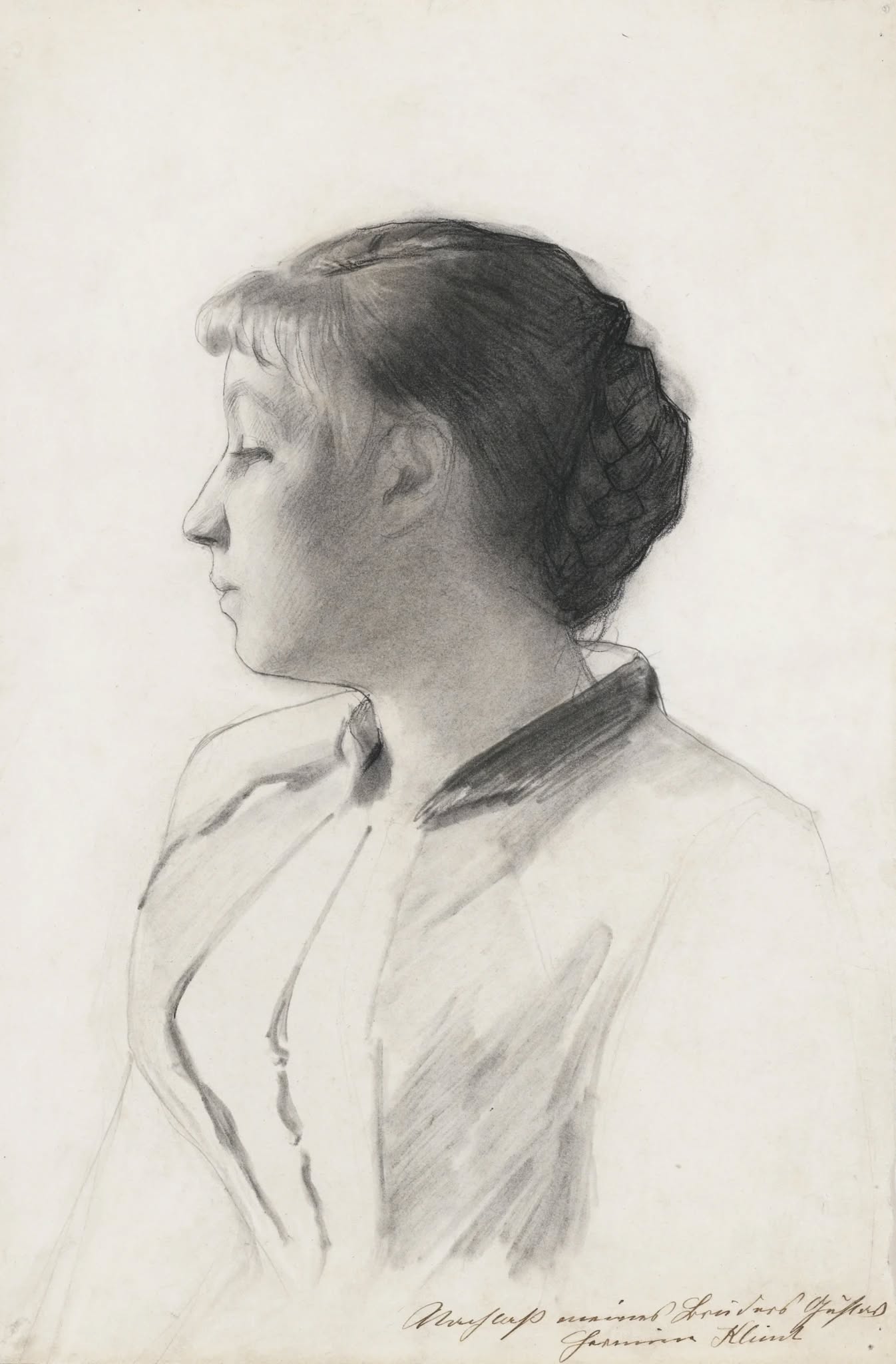
Gustav Klimt:
Girl in Profile (Mädchen im Profil)
circa 1887–1888
charcoal, black Conté crayon and pencil on paper
35.6 × 25.1 cm (14 × 9 7/8 in.)
Auctioned at Christie’s in 2008
(Not in Strobl)
This recently surfaced portrait study belongs to Klimt’s early Burgtheater years, when he was still working closely with his brother Ernst and Franz Matsch. The young girl is drawn in a calm, steady profile, her features shaped with a light, deliberate hand. Klimt uses charcoal and Conté sparingly, letting the soft modelling around the cheek and jaw carry most of the expression. The drawing has the quiet concentration typical of his theatre studies: nothing is overstated, and the lines remain close to observation rather than stylisation.
The sheet is most likely connected to Theater Shakespeares: Romeo und Juliet, one of the ceiling paintings Klimt executed for the Vienna Burgtheater between 1886 and 1888. Many of the figures in these decorative cycles were based on separate portrait studies, and this drawing fits naturally within that working method. While some observers have suggested that the model might be Klimt’s younger sister, Hermine, this identification remains unverified and speculative. Klimt often explored the tilt of a head or the fall of hair in isolation before integrating the figure into a larger narrative scene. The present study shows that process at its simplest: a young face captured with enough clarity to be recognisable, yet open enough to be adapted into a theatrical composition.
What gives the drawing its quiet interest is the balance between precision and restraint. Klimt pays attention to the contour of the profile, but he avoids tightening the line; the shading remains soft, and the expression is left understated. It reflects a moment in his career when he was still rooted in academic training, yet already developing the sensitivity to character that would later define his portrait work.
Dr. Marian Bisanz‑Prakken, the leading expert on Klimt’s graphic oeuvre and long-time curator at the Albertina Museum in Vienna, has recognised the sheet as an authentic work from this period and will include it in her forthcoming supplement to the Klimt drawings. Its emergence adds a small but meaningful piece to the visual record of Klimt’s Burgtheater years, offering a glimpse into the quiet, preparatory work behind one of his earliest major commissions.
Leave a Reply