Egon Schiele:
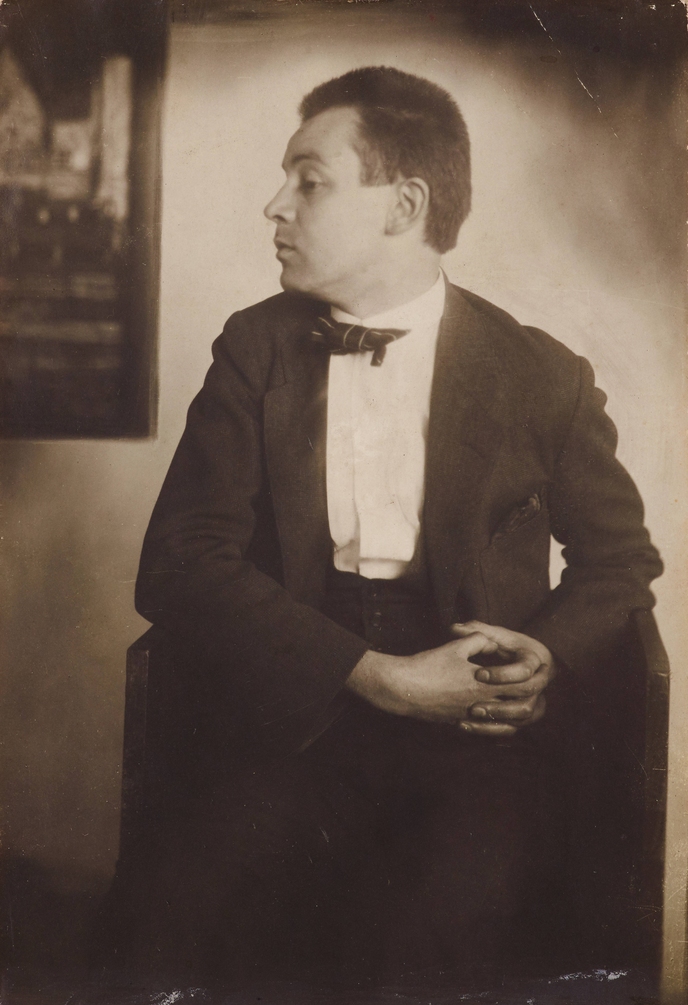
Egon Schiele in Profile, in the Background the Painting Houses by the Sea, 1914 – Anton Josef Trčka
Photograph on supporting cardboard
17.1 × 10.7 cm / 15.4 × 10.6 cm
© Leopold Museum, Vienna
This photograph by Anton Josef Trčka shows Schiele in a calm, almost private moment. Seated in profile with his hands clasped, he appears focused yet inward‑looking, as if caught between thought and observation. Trčka’s portraits of Schiele are among the most direct images we have of him, and this one stands out for its simplicity: soft light, a quiet pose, and no attempt to dramatise the artist.
In the background hangs Houses by the Sea, painted in 1914. The painting once belonged to Josef Hoffmann, who placed it in the “Austrian House” at the Werkbund exhibition in Cologne. Its presence here is a reminder of how naturally Schiele’s work could fit into the visual world of the Wiener Werkstätte, where architecture, design, and art were meant to form a single, coherent environment.
This print stems from a series of staged portraits that Trčka captured during the same photographic session in 1914. While other well‑known shots from this series emphasize Schiele’s characteristically expressive, stylized hand gestures—or show him looking directly into the camera alongside a carved wooden toy horse—the present image opts for absolute stillness. Rather than a casual snapshot, these carefully composed portraits show the artist without myth, capturing a young man engaging deliberately with his own image and the Viennese avant‑garde.
The Leopold Museum plays a crucial role in preserving photographs like this one. Their care for Schiele’s legacy — through conservation, research, and the stewardship of the world’s most extensive Schiele collection — ensures that these fragile documents remain accessible. Without the Leopold, our understanding of Schiele’s life and work would be far less complete.
Leave a Reply