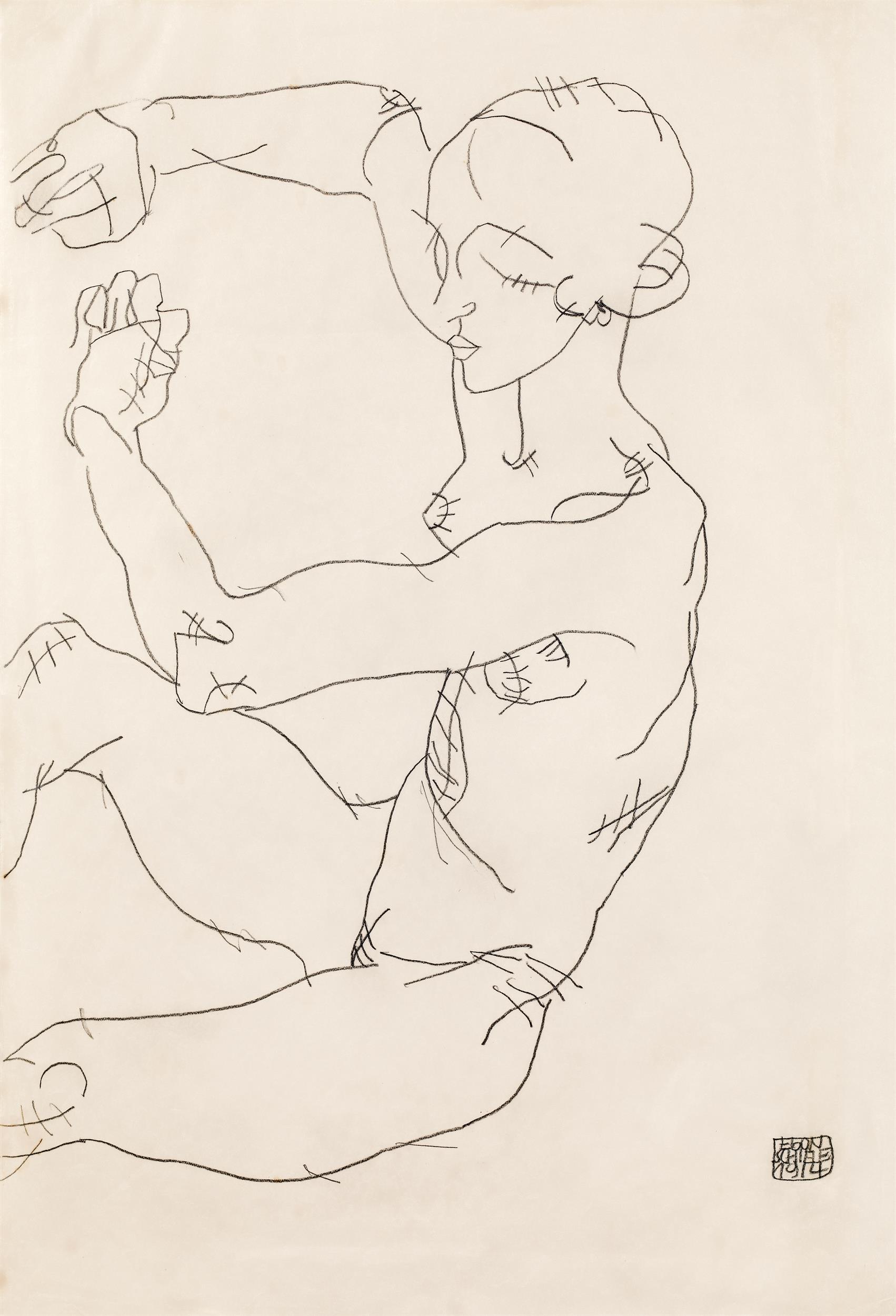
Egon Schiele:
Sitting Nude with Raised Arms (Sitzender Akt mit erhobenen Armen), 1914
Pencil on paper
47 × 32 cm
Auctioned at im Kinsky, June 2017, for €192,000 (Hammer price: €150,000)
(Kallir D 1555a)
There is a serene, profoundly moving clarity in Egon Schiele’s Sitting Nude with Raised Arms (Sitzender Akt mit erhobenen Armen), a drawing that captures a rare moment of deep emotional warmth. The sheet belongs to that taut, luminous window in 1914 when Schiele’s line became razor-fine yet intensely human. The figure sits with her arms lifted in a graceful gesture that opens the chest and elongates the torso, exposing a quiet, breathing vulnerability beneath the sharp angularity. The contours move with that unmistakable Schiele tension—quick, searching, and emotionally charged—yet the head’s slight inclination gently softens the pose, letting a tender warmth rise through the spareness of the pencil lines. The paper remains largely untouched, allowing the figure to breathe freely in the surrounding space; the modeling is wonderfully minimal, leaving the entire expressive weight to be carried by the certain, single path of his hand. It is a drawing that feels immediate, exact, and quietly radiant—a piece where Schiele’s hand seems to move faster than thought, yet lands with absolute and loving certainty.
What gives the drawing its particular resonance is the transitional chapter in which it was born. In 1914, Schiele was beautifully moving away from the raw, confrontational eroticism of his earlier years toward a far more quiet, introspective register. His figures become less defiant and more beautifully inward, their gestures charged not with public provocation but with a kind of private, suspended thought. This sheet sits precisely in that elegant transition: the raised arms recall the dramatic, expressive extremity of his 1910–12 works, but the overarching mood is calmer and deeply contemplative, as if the sitter is caught in an intimate, trusting pause rather than a staged display. You can clearly feel Schiele’s growing interest in the human body as a sacred vessel for interior life rather than a site of shock, and the drawing’s ultimate simplicity—its pure reliance on line alone—lets that heartwarming shift come through with remarkable, timeless clarity.

Leave a Reply