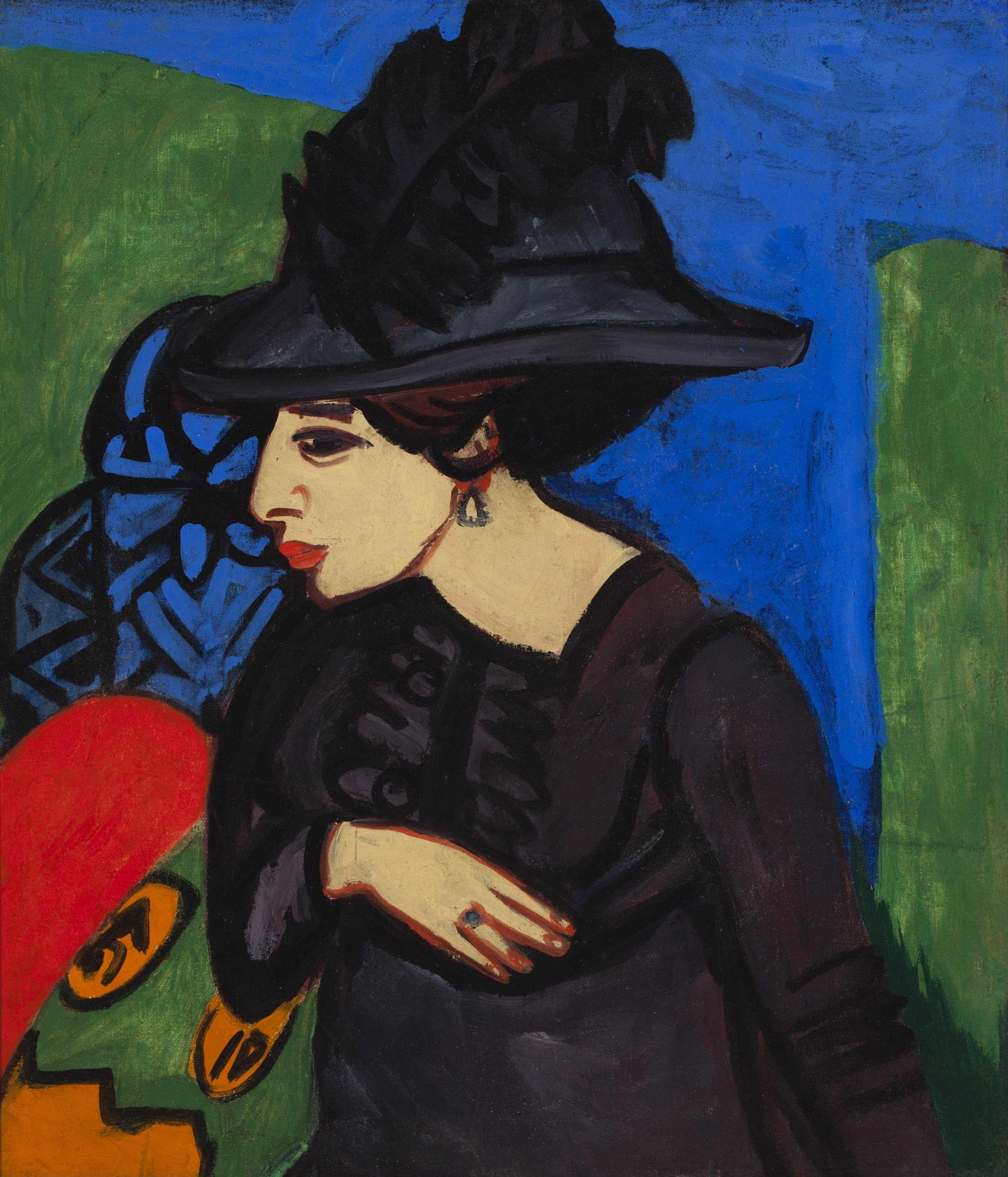
Die Brücke: Ernst Ludwig Kirchner
Dodo with a Feather Hat (Dodo mit Federhut), 1911
Oil on canvas
80.01 × 68.9 cm
©Milwaukee Art Museum, Gift of Mrs. Harry Lynde Bradley
The relationship between Kirchner (1880–1938) and Doris Große (1884–1959, known as Dodo) runs quietly through this portrait, shaping its atmosphere as much as the colour itself. Born near Dresden, she was working as a shop assistant and milliner when she met him, and from roughly 1903 to 1911 she became his partner, his live‑in companion, and the muse who carried him through those formative Dresden years of early German Expressionism. The exact date of her death remained uncertain for decades, but recent research — including work by the Buchheim Museum — confirms that Dodo died in 1959. Kirchner affectionately gave her the pet name “Dodo,” and it became the identifier for dozens of his masterpieces, a small, intimate word that now threads through the history of the movement. She actively embraced the anti‑bourgeois lifestyle of Kirchner and the Die Brücke artists, posing freely in their studios and at the Moritzburg lakes, moving with an ease and openness that matched the group’s search for a new, unguarded way of living and seeing. Kirchner equated romantic and sexual relationships directly with artistic creation, and he viewed Dodo as the ultimate embodiment of an uninhibited, natural eroticism that helped him break away from rigid academic art. Dodo’s daily life, her changing wardrobe, and her nudes became the core subject matter of Kirchner’s early career, shaping not only the themes he explored but the emotional register in which he worked. The relationship came to an abrupt end in the autumn of 1911, when Kirchner and the other members of Die Brücke decided to relocate to the fast‑paced metropolis of Berlin to further their careers, while Dodo chose to remain behind in Dresden. Once in Berlin, Kirchner quickly began a lifelong relationship with Erna Schilling, while Dodo faded from the historical record, eventually returning to her work as a milliner in Dresden directories in the mid‑1930s. Despite the split, Kirchner kept his large portraits of Dodo hanging as prominent fixtures in his new Berlin studio for several years, a quiet acknowledgement of the role she had played in shaping his early artistic world.

Seeing the rare surviving photograph of Dodo beside Kirchner only sharpens the sense of their closeness in these years — her calm presence, his restless intensity — the same tension that animates the portrait.
In this canvas, the hat doesn’t simply sit above her — it sweeps upward in a long, dark arc that pulls the eye across the surface, giving the portrait a gentle vertical tension. Her face, turned slightly away, carries that pale, almost porcelain stillness Kirchner often found in her, the red of her mouth held in a soft, unspoken line. The background is not a setting but a field of vibrating colour, the blue, green, and red laid down in broad, expressive planes that push forward rather than recede, making Dodo feel as though she is emerging from the very structure of the paint. The dark dress anchors her in the lower half of the composition, its weight balancing the feather’s lift, while the single earring catches a small glint of light — a tiny, intimate detail that keeps the portrait human amid the intensity of the palette.
That closeness — and the echo of its loss — is felt immediately here: Dodo seems to rise gently out of the bold, non‑naturalistic colours that pulse behind her, the oversized black feather lifting above her with a dramatic ease that never disturbs the calm of her expression. Kirchner’s sharp, quick brushstrokes give the scene its jagged energy, yet the tenderness with which he shapes her face keeps everything grounded in affection rather than intensity. The vivid background and the theatrical hat speak to the bohemian spirit of the avant‑garde, but it is the intimacy of their partnership that gives the painting its steady centre — a sense of someone seen not as an emblem of the movement, but as the person who shaped his early artistic world.
Leave a Reply