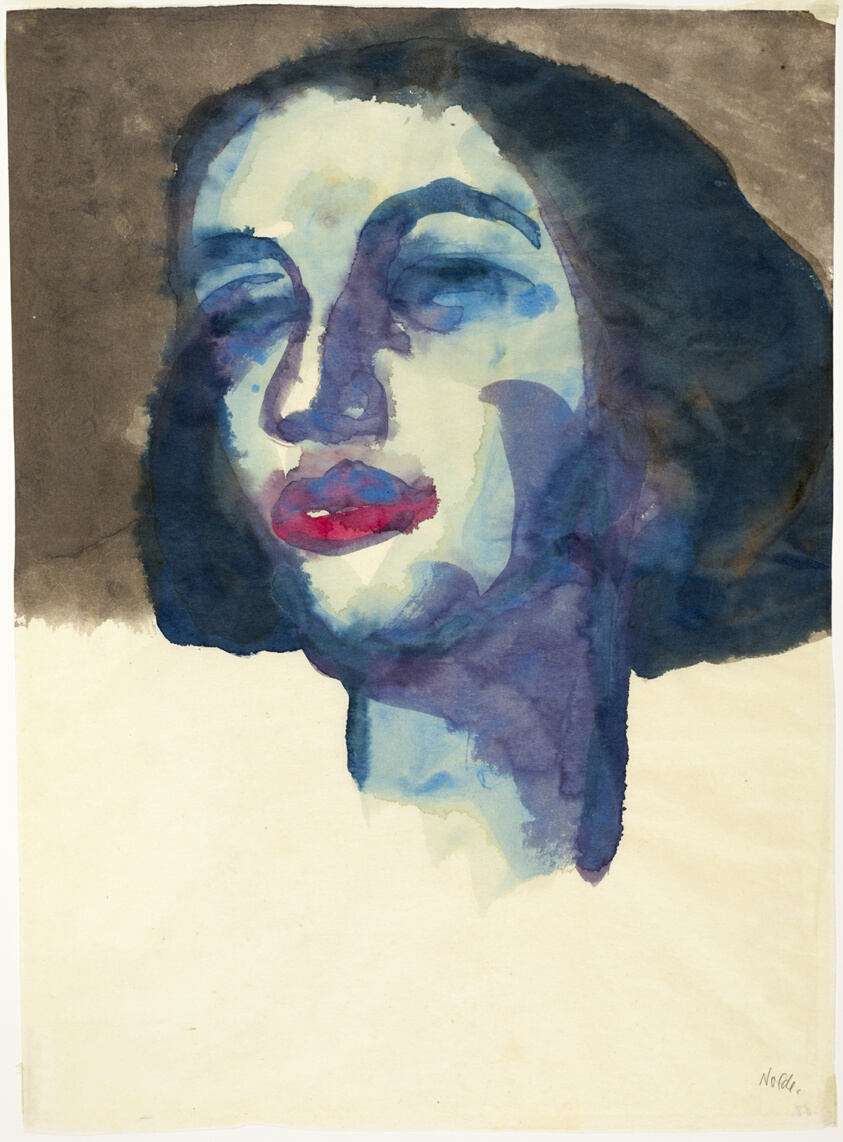
Emil Nolde:
Portrait of Mary Wigman (Porträt von Mary Wigman), c. 1920 Watercolor on cream Japanese paper
48.3 × 35.5 cm
©Art Institute of Chicago
Nolde’s portrait of Mary Wigman feels very direct, almost as if her face rises out of the paper in one slow breath. The blue and violet tones settle softly across her features, and the deep red of the mouth gives the whole sheet a quiet focus. The washes move freely, drifting into each other without sharp edges, and the cream paper keeps everything warm and open. Wigman looks straight ahead, calm and thoughtful, as if she is holding a moment to herself before stepping back into movement. Nolde doesn’t try to pin her down or describe her too closely; he lets the colour do most of the work, letting her presence appear in a simple, natural way.
Emil Nolde (1867–1956) had already travelled a long and sometimes difficult path by the time he made portraits like this. He grew up in the small village that gave him his name, trained first as a woodcarver, and only later turned fully to painting. For a short period he was connected with the Brücke painters, whose interest in raw, immediate expression encouraged him to trust bold, non‑naturalistic colour and simple, forceful forms. His later life became more complicated. He joined the National Socialist party in 1934, yet only a few years later the regime condemned his work, removed more than a thousand pieces from museums, and showed many of them in the 1937 Degenerate Art exhibition. Even after he was banned from painting in 1941, he continued to support the ideology that had turned against him. For decades after the war he was often presented as a victim of censorship, and only more recently has the fuller picture of his political sympathies come into view. His legacy is therefore a difficult one: the strength of the work is clear, but it stands beside choices and convictions that cannot be separated from his story.
It also helps to know who we are looking at. Mary Wigman was one of the defining figures of modern dance, known for her intense, expressive style and for performances that often unfolded without music. She carried a strong inner focus, and Nolde seems to have caught that here — the sense of someone who lived through movement but held a deep stillness beneath it.
The portrait feels gentle and unhurried, a small pause in the life of someone whose art was built on presence and concentration, caught by an artist who understood how much can be said with very little when the colour is allowed to breathe.
Leave a Reply