Egon Schiele:
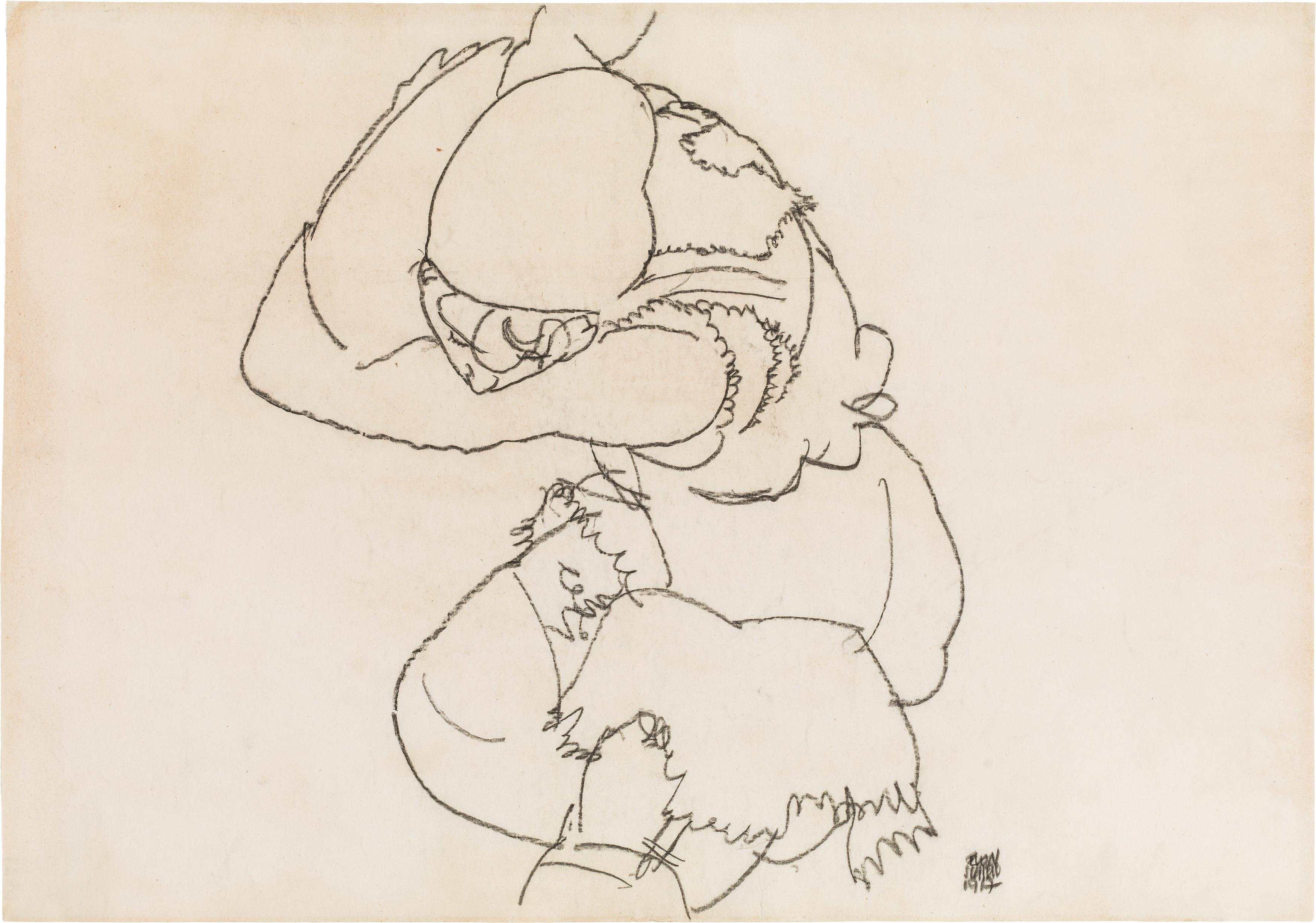
Crouching Girl (Kauerndes Mädchen), 1917
pencil on paper
29.4 × 41.9 cm
Auctioned at im Kinsky in 2018 for €147,200
(Kallir d1920)
There is a quiet, almost fragile pull to this drawing, the kind that makes you slow down before you realise it. The girl folds into herself with a softness that feels unguarded, yet there is a flicker of hesitation in the way her body curls inward, as though she is caught between wanting to disappear and wanting to be left alone. Schiele follows that inward turn with a line that feels unusually gentle for him — steady, patient, almost protective — tracing the curve of her back and the soft collapse of her shoulders as if he were trying not to disturb her.
The moment becomes even more intimate in the way her hand rises toward her face. It is not a dramatic gesture, but a small, uncertain one, the kind that happens before a thought fully forms. She might be shielding herself, or simply resting, or hiding something she does not want to reveal. We cannot tell whether this is a pose she offered him or a real moment he caught before she could pull away, and that uncertainty gives the drawing its quiet tension. The face, partly covered and turned inward, feels suspended between shyness and self‑protection, as if she is listening to something inside herself that we are not meant to hear.
Schiele allows the contours to loosen around her limbs, letting the pose breathe, and the interior modelling is reduced to the faintest suggestions, leaving the whiteness of the paper to hold the stillness around her. The whole sheet feels like a pause — a moment of retreat that he approaches with unusual restraint, stepping back just enough to let her remain in her own silence.
Its later appearance at im Kinsky in 2018, where it realised €147,200, adds a soft echo to its intimacy, a sense that the drawing has moved quietly through private hands without losing the delicate, inward moment it contains. It is one of those late pencil sheets where Schiele’s line seems to cradle the figure rather than expose her, allowing her hesitancy, her half‑hidden face, and the uncertainty of the moment to become the very heart of the work.
Leave a Reply