Egon Schiele:
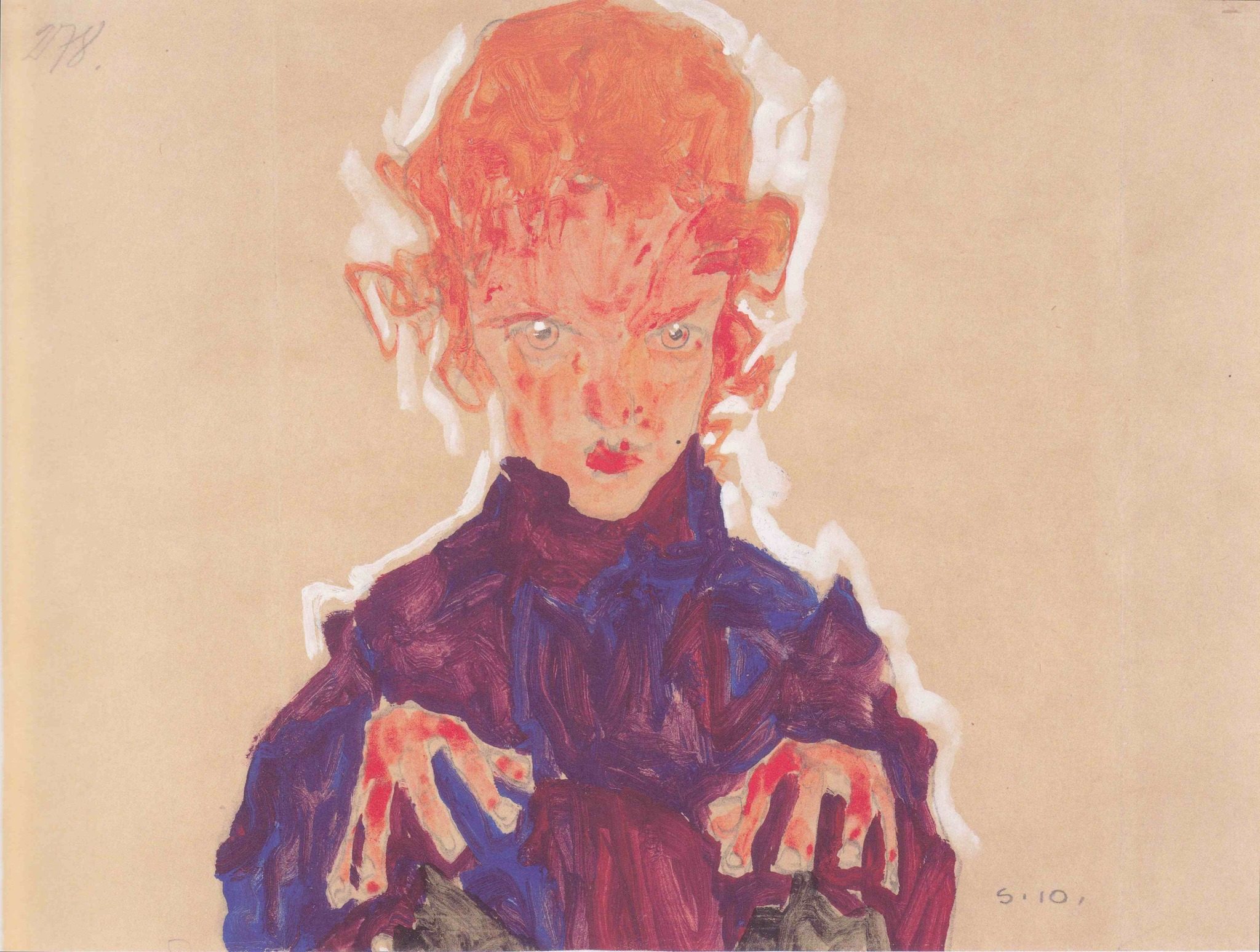
Girl Facing Front (Mädchen, frontal), 1910
Watercolor, gouache and pencil with white heightening
24 × 31.7 cm
© Albertina, Vienna
(Kallir d415)
The drawing doesn’t approach the viewer gently; it pulls you in with a sudden, almost unsettling force, as if the girl has stepped forward faster than the rest of her body can follow. Her hands come toward you first, too close and too quickly, and the whole sheet carries the strange tension of a still from a horror film — that moment when someone appears before you’ve had time to prepare for them. And then her eyes catch you: wide, unfixed, drifting past your own gaze rather than meeting it. They look through you, or beyond you, as if she is only partly present, caught between arriving and slipping away again. It is so very unsettling to say the least, and that unease becomes the first thing the viewer feels before the rest of the drawing begins to open.
Schiele follows that tension with a careful, attentive line. It is the kind of immediacy he found again and again in 1910, when he was trying to draw people as they appeared to him in the moment — unfiltered, unprepared, and strangely near.
From here the sheet quiets a little. The colour settles into the garment with a steady weight, the blue and violet washes giving her body a grounded presence after the shock of the hands and eyes. The white touches along the collar lift her slightly from the blank ground, but nothing distracts from the strange pull of her face.
The hands remain the clearest part of her, rising toward the viewer with a directness that feels almost intrusive. Their closeness is part of the drawing’s charge, and Schiele lets the tension sit there without softening it. In 1910 he was learning how much a figure could speak through its hands alone, and this sheet carries that lesson plainly.
It is very possible that this drawing belongs to the small group of sheets he made with the same girl that year. The lifted hands, the inward shoulders, the quiet, steady presence — they appear in several works from 1910, as if he kept returning to her because something in her allowed him to explore this new, frontal way of looking.
The empty background is typical of these early sheets. Schiele had just stepped out of the academy and was working with little more than paper, colour, and a few regular sitters. The emptiness gives the figure a kind of suspended immediacy, as if she has stepped forward from a space we cannot see.
It is telling that the drawing once belonged to Arthur Roessler, who recognised Schiele’s direction earlier than almost anyone and held on to these first, searching works. In this sheet, the girl sits quietly after that initial jolt, her hands lifted, her expression half‑formed, her presence both near and unreachable, and the drawing holds her with a kind of quiet respect.
Leave a Reply