Gustav Klimt:
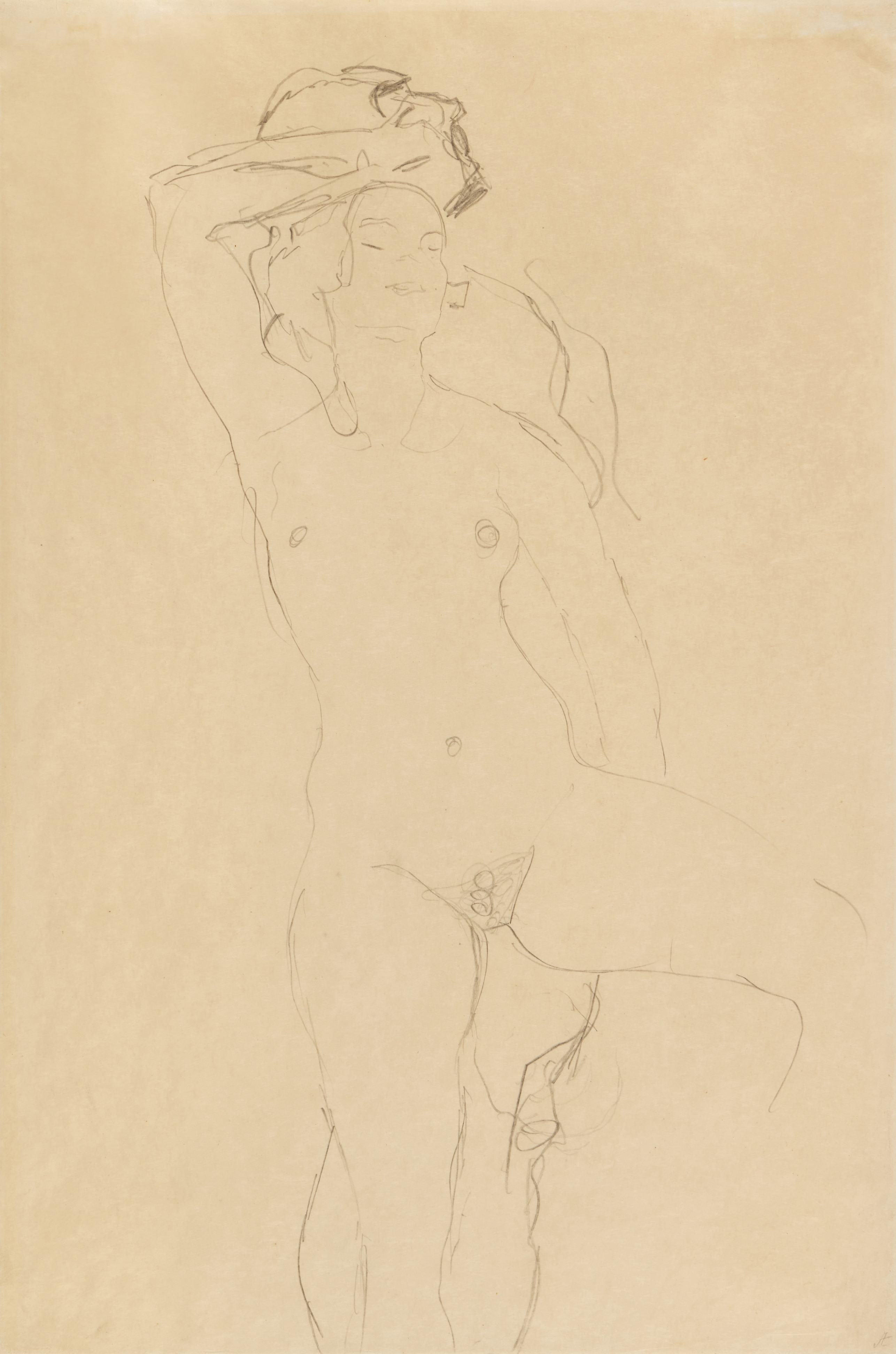
A Standing Couple, the Woman with Her Left Knee Bent and Her Right Arm Raised (Stehendes Liebespaar, die Frau mit eingebeugtem linken Knie und erhobenem rechten Arm), 1917/18 pencil on paper
54.6 × 36.2 cm (21½ × 14¼ in.)
Will be auctioned at Sotheby’s
(Strobl s2866)
The drawing belongs to Klimt’s very last years, when his line had become astonishingly light, almost weightless, yet still carried the full emotional charge of his earlier work. The couple stands close without touching, their bodies leaning subtly toward one another, as if the space between them were charged with something unspoken. The woman’s bent knee and raised arm give her a gentle, almost dancing asymmetry, a movement held in suspension, while the man’s presence is quieter, steadier, a vertical counterpoint to her soft curve. Klimt lets the figures emerge through the faintest of contours, the graphite drifting across the paper like breath, never insisting, always suggesting.
What gives the sheet its warmth is the tenderness of their proximity. Klimt no longer needs ornament or gold; the intimacy is carried entirely by the line. The woman’s body, lightly modelled, has that soft, rounded fullness characteristic of his late drawings, while her face tilts inward with a quiet, private concentration. The man’s outline is even more economical, almost dissolving at the edges, as if he were stepping forward from a dream. Together they form a single, slow gesture of closeness — not dramatic, not theatrical, but deeply human.
Although the finished painting brings the two figures together, this sheet shows Klimt working from the woman outward, letting her gesture set the emotional temperature of the composition. Her raised arm, more elongated here than in the canvas, has a floating, almost weightless grace, while the slight backward tilt of her head gives her a dreamy inwardness that feels unmistakably late. The contour of her torso is so soft it nearly dissolves, the graphite drifting across the paper with the fragility of a last thought. The absence of the male figure only heightens the sense that Klimt was building the couple from separate emotional anchors, shaping their closeness through individual studies rather than through direct interaction.
This study belongs to the preparatory group for Adam and Eve (1917/18), the large canvas left unfinished at Klimt’s death. The same gentle lean of the bodies, the same suspended tenderness, appears there in embryonic form. In this drawing you can feel him shaping the emotional architecture of the painting: the woman’s soft inward turn, the man’s quiet steadiness, the delicate balance between separation and union. It is a whisper of the final composition, distilled into the purest language of line, carrying the warmth and vulnerability that would have anchored the completed canvas.
Leave a Reply