
Gustav Klimt:
Female Semi‑Nude from the Right in Kneeling‑Cowering Position. Study for Leda (Weiblicher Halbakt von rechts in kniender‑kauender Stellung. Studie zu Leda), 1913/1914
Pencil on paper 37 × 56 cm
© Leopold Museum
(Strobl s2359)
The painting for which this drawing was made—Leda—was kept at Schloss Immendorf and was destroyed in May 1945, when retreating Nazi soldiers set the castle on fire. Its loss is complete. No colour record survives, and every tinted or “restored” version circulating today is an invention layered onto a single surviving black‑and‑white photograph. When that lone image is placed beside this drawing, the closeness becomes striking: the inward curve of the body, the protective fold, the quiet sensuality. The study and the lost 1917 painting speak to each other across time, one surviving in Klimt’s own hand, the other reduced to a fragile photographic echo.
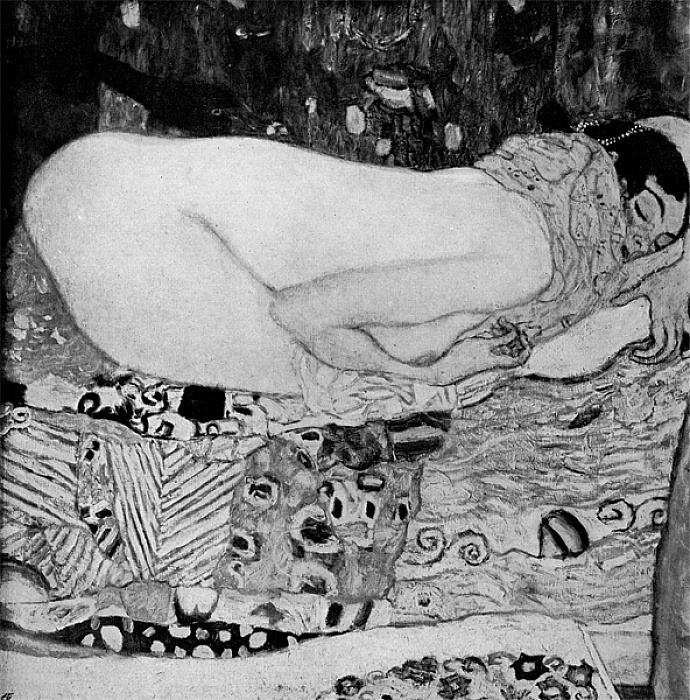
She folds inward with a quiet, instinctive grace, the body turning into itself as though she is gathering warmth from her own centre. Klimt’s pencil follows her with that soft, attentive certainty of his late drawings, letting the long, undulating line of her back rise from the sheet in a gently hatched contour. The kneeling, half‑cowering posture gives the study its emotional temperature: not fear, but a moment of inward listening, a pause before the myth enters and reshapes her into Leda. For now she remains simply a woman in a private gesture, her profile emerging delicately, the drapery at her neck lifting in a faint ornamental flutter that already anticipates the later composition.
What is striking is how much of the 1917 Leda is already present here, years before the painting took form. The curve of the spine, the tilt of the head, the decorative swirl of fabric—Klimt carries these elements almost unchanged into the final work. He seems to be exploring how sensuality can be suggested through containment rather than display, through a body that draws desire inward rather than offering it outward. Her modest, folded posture becomes its own quiet magnetism.
The later sketchbook from 1917 adds a soft echo to this sheet. There, Klimt refines the same curve of the back in miniature and, for the first time, introduces the swan—the form in which Zeus approaches Leda. Its absence here is meaningful. Without the mythic visitor, the drawing remains purely human, a study of introspection rather than seduction. The myth hovers just beyond the frame, not yet stepping into the scene. That distance gives the drawing its particular tenderness: a study poised on the threshold, suspended between a private gesture and the story that will soon envelop it.
Leave a Reply