Vienna Secession: Leopold Blauensteiner
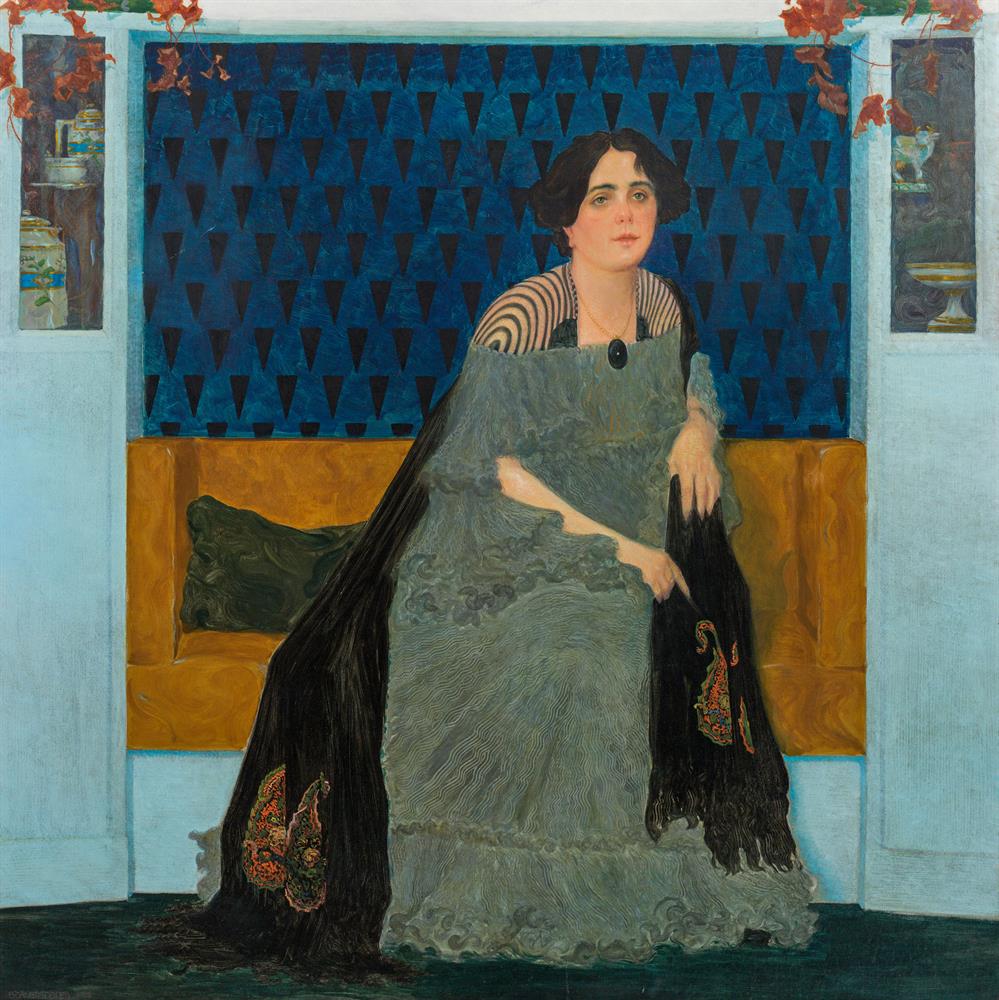
Portrait of Mrs. F. B. (Porträt der Frau F. B.), 1908
oil on canvas
160 × 160 cm
Auctioned at im Kinsky in 2020 for €140,800
The portrait has a composed, unhurried presence. The sitter rests on a mustard‑yellow couch that gives the scene its first note of warmth, while the deep blue wall behind her, patterned with downward‑pointing triangles, introduces a quiet rhythm. Blauensteiner lets these elements settle naturally around her; nothing feels forced or overly arranged. The geometry holds the figure gently in place, giving the composition a sense of order without stiffness.
Her grey‑green dress falls in long, soft folds, catching the light in a way that feels understated but attentive. The black shawl across her lap, with its touches of red and gold embroidery, adds a small accent of richness, and the striped detailing at her shoulders leads the eye upward to her face. Her expression is steady and thoughtful, shaped with a light hand that avoids drama. The modelling is soft, allowing the mood to emerge quietly from the way the light rests on her features.
The sitter is almost certainly Friderika Berger, whom Blauensteiner married in 1904. The scale of the canvas, the calm domestic setting, and the intimate, unforced tone all support this identification. It feels like a portrait made within the rhythm of a shared household, shaped by familiarity rather than formality.
Leopold Blauensteiner (1880–1947) studied at the Academy of Fine Arts in Vienna under Christian Griepenkerl and complemented his training with several terms of art history. He also took private lessons with Alfred Roller, whose influence is visible in Blauensteiner’s sense for pattern and controlled decoration. Roller published several of Blauensteiner’s coloured woodcuts in Ver Sacrum in 1903 and 1904 — his first public appearance and an early sign of how naturally he moved within the Secession’s circle. By 1909 he was a committee member of the Klimt‑Gruppe, and he took part in the Internationale Kunstschau that same year, placing him directly within the artistic conversations that shaped Vienna’s modern identity.
What he carried from the Secession into his own work was a preference for balance, clarity, and a gentle integration of decorative elements. In this portrait, the patterned wall, the paired alcoves with their vases, and the touches of red foliage at the upper corners all contribute to a quiet sense of structure. They frame the sitter without overwhelming her, and the palette — deep blues, muted greens, warm ochres — is handled with a steady, thoughtful restraint.
The painting’s strength lies in its calmness. It doesn’t reach for effect; it simply holds the viewer in a balanced field of colour, pattern, and presence. The sitter’s dignity comes through in small, measured ways — the way she sits, the softness of her expression, the gentle order of the space around her. It is a portrait that reflects Secessionist ideas in a quieter register, translated into a language that feels personal to Blauensteiner: clear, composed, and quietly attentive.
Leave a Reply