Gustav Klimt:
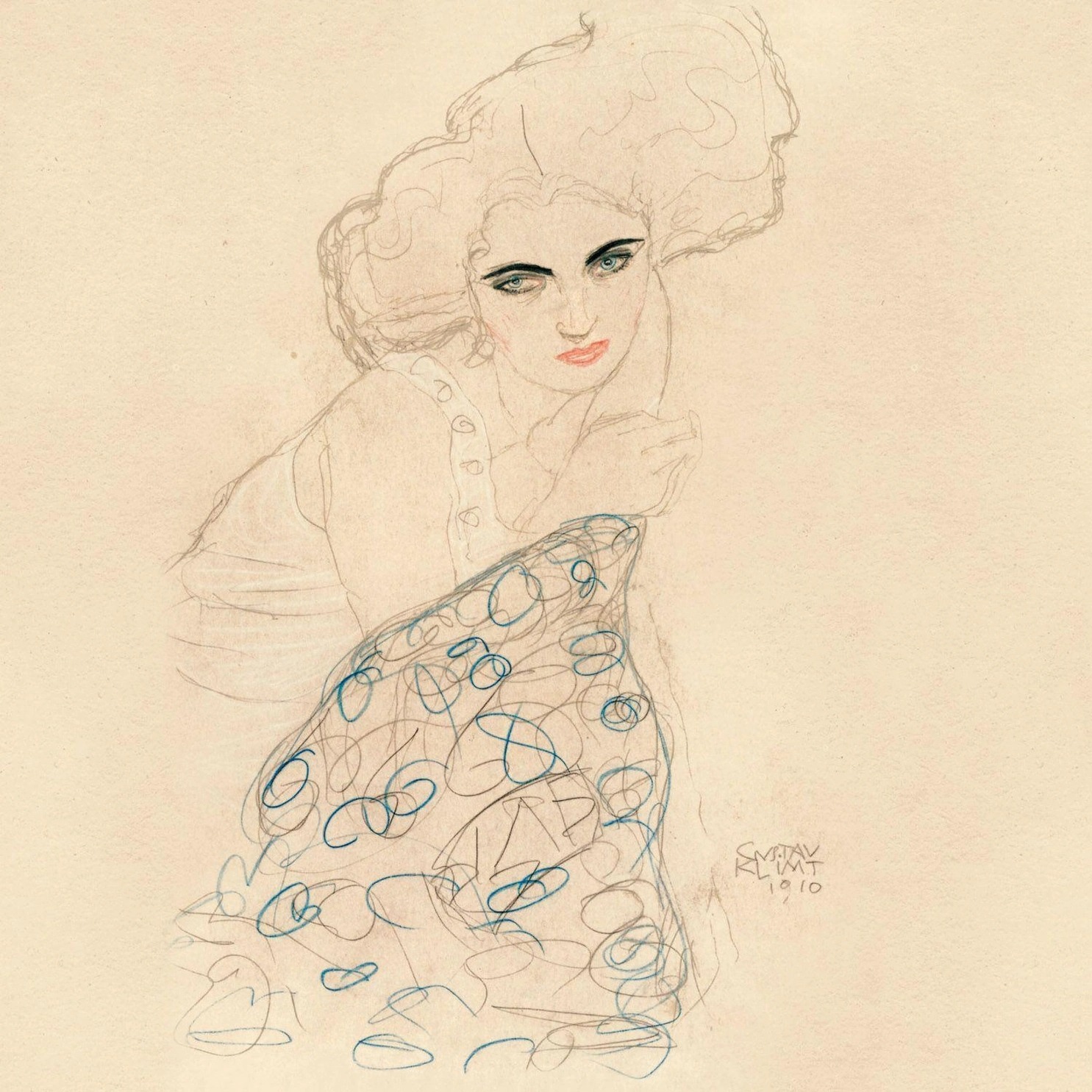
Portrait of a Girl (Mädchenporträt), 1910
Pencil, red and blue coloured pencil, heightened with white
56 × 37.3 cm
Private collection
(Strobl s1983)
Klimt approached this portrait with a kind of attentive ease, letting the girl’s features emerge gradually from the interplay of pencil and soft colour. The girl’s face is rendered with particular attention: the blue‑green eyes, the softly modelled lips touched with red, and the voluminous hair built from fine, rhythmic pencil strokes. Klimt lets the contour carry the form, but the coloured accents give the head a gentle luminosity, enough to suggest presence without pushing toward full characterisation. The upper body is only lightly indicated, with the circular blue pencil marks suggesting the patterned garment without fixing it in detail. The vivid eyes and softly heightened lips are characteristic of Klimt’s portrait studies from this moment, where small touches of colour help him test how expression might translate into paint.
This sheet is connected to a painting that no longer survives in its original form. Klimt later overpainted the earlier portrait, and the work now known as Portrait of a Young Woman (1916) lies above it. The drawing therefore serves as one of the few remaining witnesses to the earlier composition. It does not function as a strict preparatory study, but it belongs to the group of drawings Klimt made while exploring the sitter’s pose and expression, testing how much could be conveyed with the slightest shifts in line and colour.
What gives the sheet its quiet interest is precisely this sense of exploration. Klimt was not yet working toward the decorative richness of his later portraits; instead, he was concentrating on the structure of the head, the tilt of the neck, the subtle asymmetry that gives the figure life. The drawing remains modest, but it contributes to the fuller understanding of his portrait practice around 1910, when he relied on these studies to anchor the paintings that followed.
As with many of Klimt’s portrait drawings, its value lies in the way it completes the record: a small, attentive sheet that preserves an earlier idea now hidden beneath paint, and a reminder of how central drawing remained to his working process. I will post later about the painting itself — and about the image of the earlier portrait that survives beneath it, an unusually revealing story in Klimt’s oeuvre.
Leave a Reply