Egon Schiele:
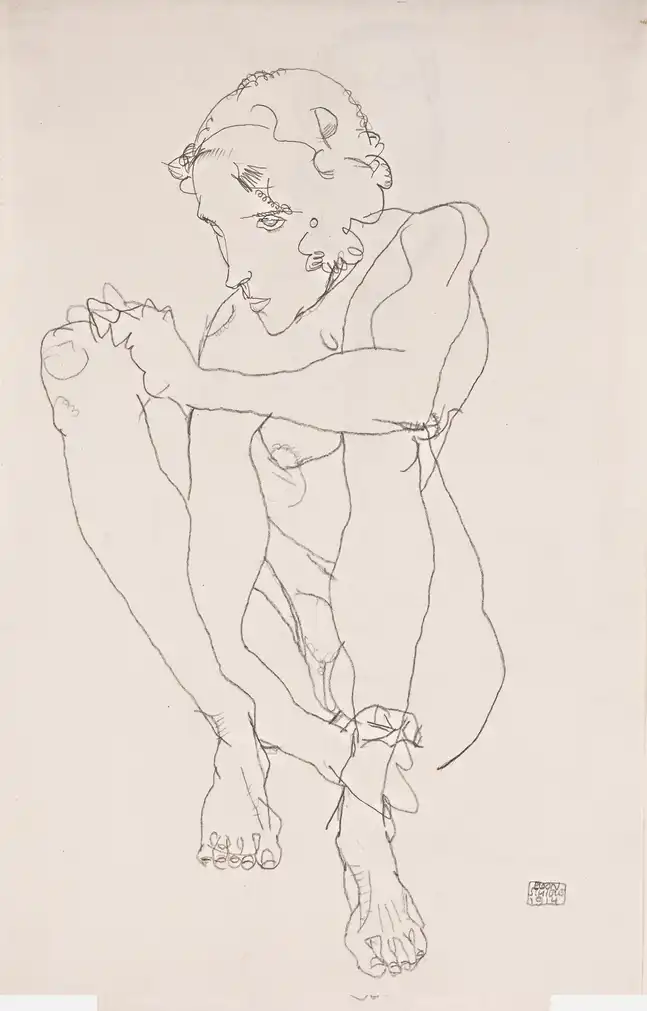
Squatting Woman (Hockende Frau), 1914, Study for Blind Mother Pencil
46.2 × 28.5 cm
©Leopold Museum
(Kallir d1511)
There is a soft, almost sheltering quality to this drawing, as though Schiele approached the figure with the same quiet inwardness that later shapes the mood of the painting Blind Mother, letting the pencil settle into the contours rather than seize them. The young woman is folded into a low squat, her weight balanced delicately, her arms resting between her knees in a gesture that feels protective and inward. Schiele’s line moves with a gentleness that is rare in his work of these years: the curve of her back is traced with a steady, breathing rhythm, the head inclines in a quiet arc, and the whole figure seems to hover in a moment of private concentration. Nothing is forced; the drawing feels as if it were made in the hush between movements.
This is one of those sheets where Schiele’s tenderness becomes unmistakable. The pose already carries the emotional seed of Blind Mother: a woman who gathers her strength from within, whose vulnerability is not exposed but held. The triangular stability of her legs anchors the composition, yet the mood remains soft, almost weightless. Schiele avoids any heavy modelling, allowing the whiteness of the paper to illuminate the figure from inside. The interior lines are minimal — just enough to suggest the gentle rounding of the shoulders, the slight shift of weight in the hips, the quiet tension in the ankles. The drawing feels as though it were made in a single, attentive breath, a moment of stillness preserved with extraordinary sensitivity.
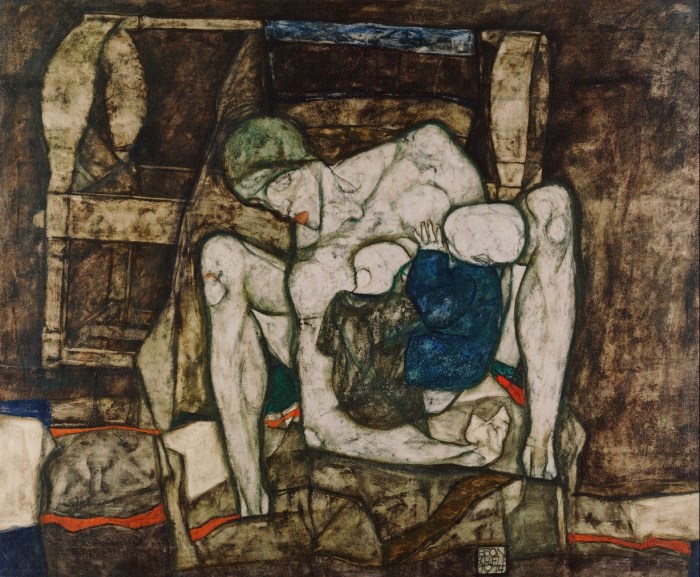
Seen alongside the painting, the study becomes even more poignant. The emotional architecture is already here, but the painting gathers it into a fuller, more urgent tenderness: the two children pressed against her body transform the inward pose into a protective embrace, and the soft, breathing lines of the drawing sharpen into the angular limbs that give the composition its quiet tension. The confined, geometric background closes around the group, intensifying the sense of closeness, while the muted ochres and blues deepen the emotional temperature. In the drawing, she rests within herself; in the painting, she holds an entire world against her chest. The sheet preserves the first, searching impulse behind one of Schiele’s most moving compositions, and seeing the two together reveals how much of the painting’s gravity was already present in this early, unguarded gesture.
The provenance reinforces this intimacy. From the Nachlass Egon Schiele in 1919, the drawing passed to Gertrude Peschka (née Schiele), the artist’s sister, keeping it within the closest circle of those who understood his life and his tenderness. It then entered the collection of Dr. Rudolf Leopold before 1972, remaining with him until 1994, when it became part of the Leopold Museum Privatstiftung. This quiet chain — estate, family, Leopold — mirrors the care embodied in the drawing itself, a small, delicate sheet carried forward across generations, preserving the first, luminous steps toward one of Schiele’s most intimate works.
Leave a Reply