Modernism in France: Sonia Delaunay
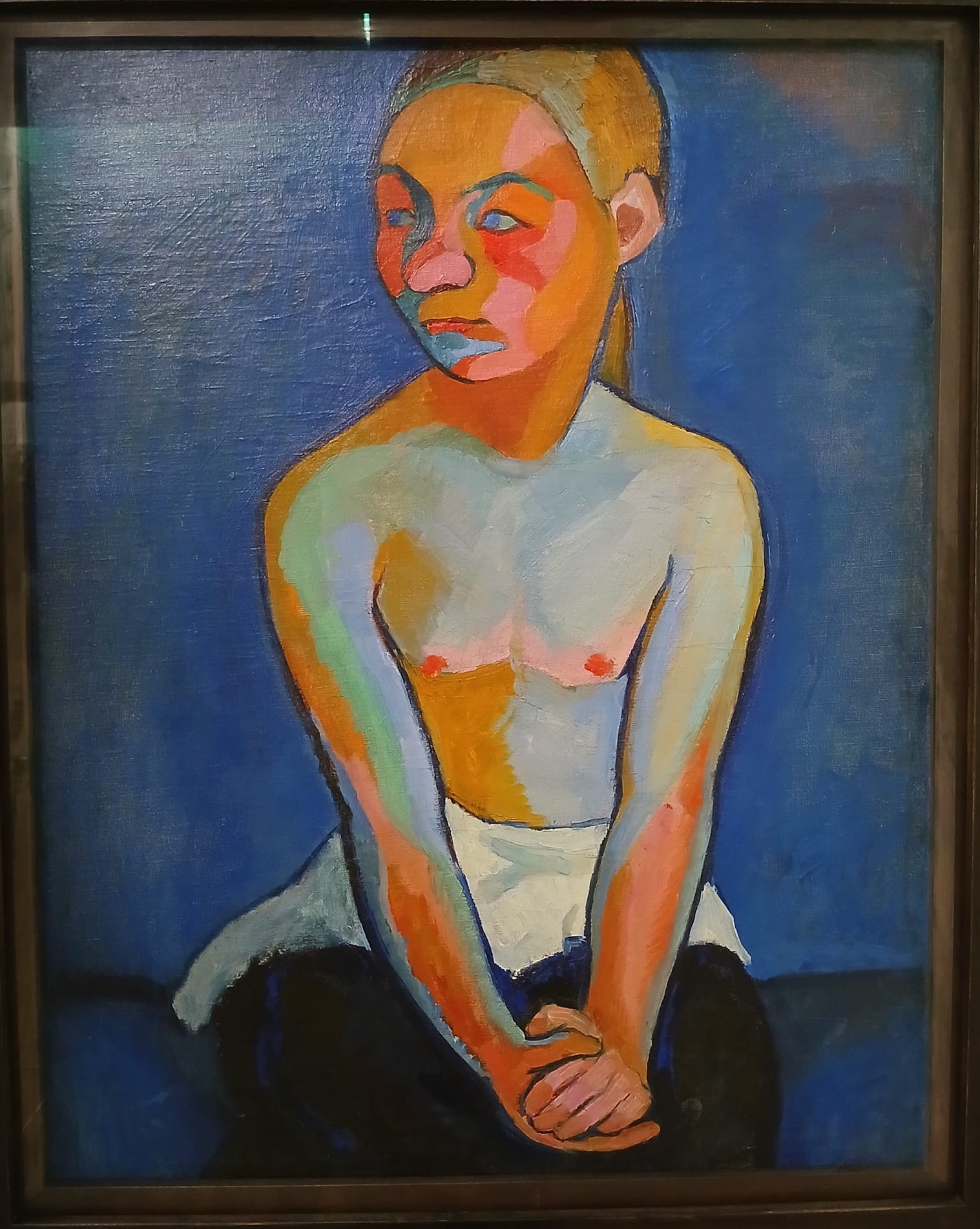
Young Finnish Woman (Jeune Finlandaise), 1907
Oil on canvas
80 × 64 cm
© Centre Pompidou, Paris, France
Painted in 1907, Young Finnish Woman belongs to the moment when Sonia Delaunay was still discovering the full reach of her own chromatic language, before abstraction opened itself to her with such inevitability. Paris had only recently become her home, and she absorbed its artistic currents with a kind of luminous hunger: Van Gogh’s emotional charge, Gauguin’s bold simplifications, Matisse’s serene orchestration of figure and ground. These influences are present, but already softened and re‑shaped by her own temperament — a temperament that sought harmony rather than shock, clarity rather than provocation.
The sitter appears with a calm, sculptural stillness, her arms folded across her chest in a gesture that feels both protective and quietly assured. Her body is built from broad, unexpected planes of color — reds, greens, deep blues — that flatten the form while giving it a strange, glowing intensity. The deep blue background gathers around her like a field of concentrated quiet, pushing the warmth of the torso forward until it seems to breathe. Delaunay is not chasing likeness; she is letting color carry the emotional truth of the figure. The face, modeled in soft greens and violets, holds a gentle inwardness, as if the sitter is listening to something within herself rather than posing for the viewer.
The painting carries traces of the artists who shaped her early Paris years. Van Gogh’s influence lingers in the emotional vibration of the palette, the sense that color can reveal an inner life. Gauguin’s presence is felt in the simplified forms and the refusal of descriptive detail. From Matisse comes the idea that figure and background can share a single chromatic rhythm. Yet the work is unmistakably hers: the color fields settle into a decorative unity that anticipates the visual language she would later develop with Robert Delaunay, where color becomes both structure and meaning.
Placed within the broader landscape of European modernism, Young Finnish Woman feels deeply connected to the explorations happening in Germany with Die Brücke and, soon after, Der Blaue Reiter. Those artists were also searching for a new emotional register through color, pushing away from naturalism toward something more direct and resonant. Delaunay’s approach, however, is gentler, more attuned to balance and luminosity. She is not reaching for drama but for a kind of chromatic calm — a harmony built from bold contrasts and softened edges.
Seen today, Young Finnish Woman reveals the beginnings of the artist who would soon transform color into a language of pure movement. It is a portrait, but also a quiet declaration: a young painter trusting her eye, stepping away from tradition, and finding the first clear notes of the voice that would define her life’s work.
Leave a Reply