Egon Schiele:
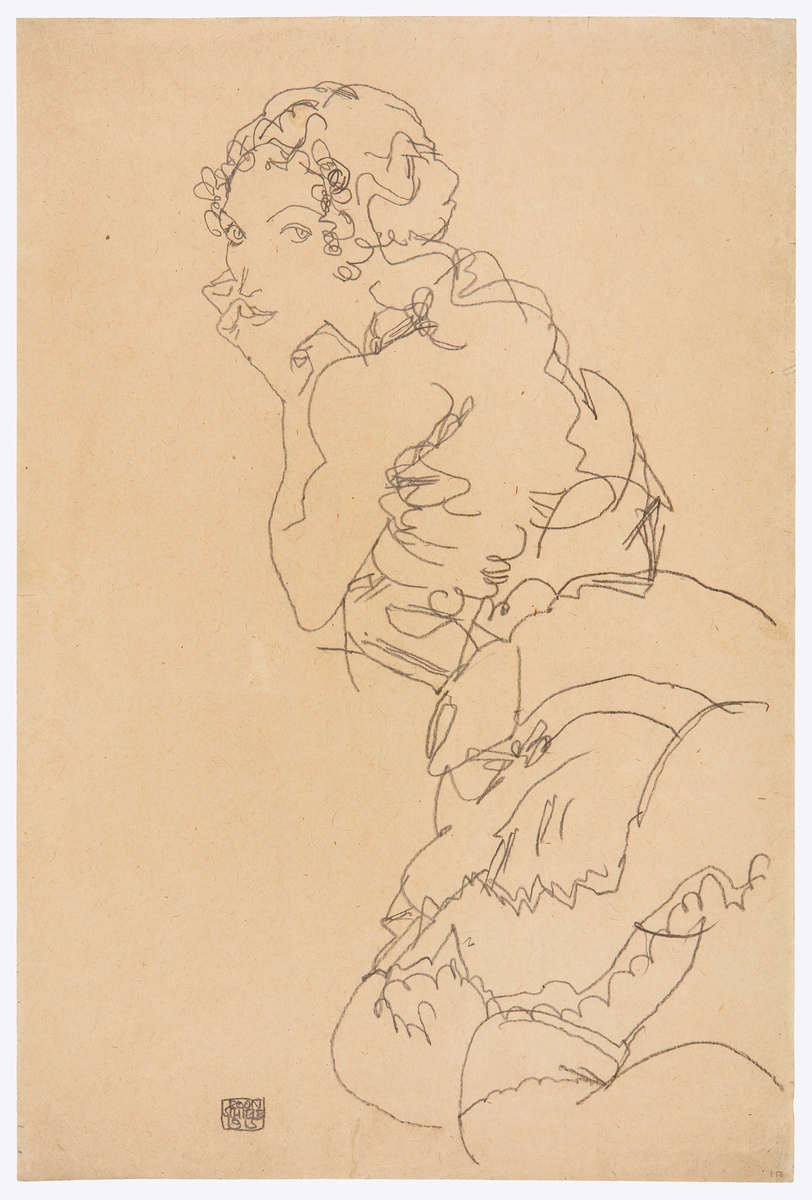
Girl Leaning on Her Elbow (Mädchen, auf den Ellbogen gestützt), 1915
charcoal
50 × 33.4 cm
Private collection
Auctioned by Wienerroither & Kohlbacher, likely around 2018, when the gallery handled several comparable Schiele drawings from private sources
(Kallir d1745)
In a sheet like this, the year alone already tells us where Schiele was emotionally: 1915, when his line quieted into something more attentive and inward, as if he were listening to the smallest shifts in a person’s posture. A girl leaning on her elbow is an unassuming subject, yet he turns it into a moment that feels gently suspended — a pause in which the body reveals more than it intends. His charcoal from this period carries a softened sharpness, still unmistakably his, but gentler in its pressure, as though he were tracing the weight of a thought rather than the outline of a figure. The drawing itself shows how lightly he could hold a body in place: the soft turn of the torso, the hand rising toward the face with a gesture that feels both shy and quietly assured, the whole pose resting on that single supporting elbow.
The figure seems caught between settling and stirring, the elbow acting as a hinge between stillness and movement. Schiele often used this half‑reclining posture to explore a kind of unguarded presence — not staged, not dramatic, simply a person drifting into their own thoughts. In 1915, with the world tightening around him, these quieter sheets carry a clarity that feels almost tender. Here, the girl’s head tilts with a questioning grace, her elbow anchoring her while the rest of the body seems to unfold from that point. The small flowers tucked into her hair introduce a fleeting softness, a decorative whisper he allows to slip into the drawing as if to temper the introspection.
Charcoal heightens this intimacy. With no colour to lean on, the line must do all the emotional work — shaping the atmosphere, holding the tension, suggesting the weight of the moment. Schiele’s drawings from this year often show a remarkable restraint: contours that are sure but never harsh, shading that barely grazes the paper, a focus on the psychological temperature rather than the surface. You can almost feel her weight settling into her arm, her gaze drifting sideways, her thoughts wandering just out of reach. Here the charcoal moves with a loose, breathing rhythm. The ruffled garment is evoked with only a few confident sweeps, enough to give it presence without heaviness, while the arm and shoulder remain open, as if she might shift at any moment. The stamped signature in the corner fixes the sheet firmly in 1915, yet the drawing feels immediate, almost freshly lifted from the page.
Seen this way, the drawing becomes less a study of a pose and more a quiet moment shared — Schiele watching the girl settle into herself with a softness he rarely allowed to surface so openly.
Leave a Reply