Der Blaue Reiter: August Macke
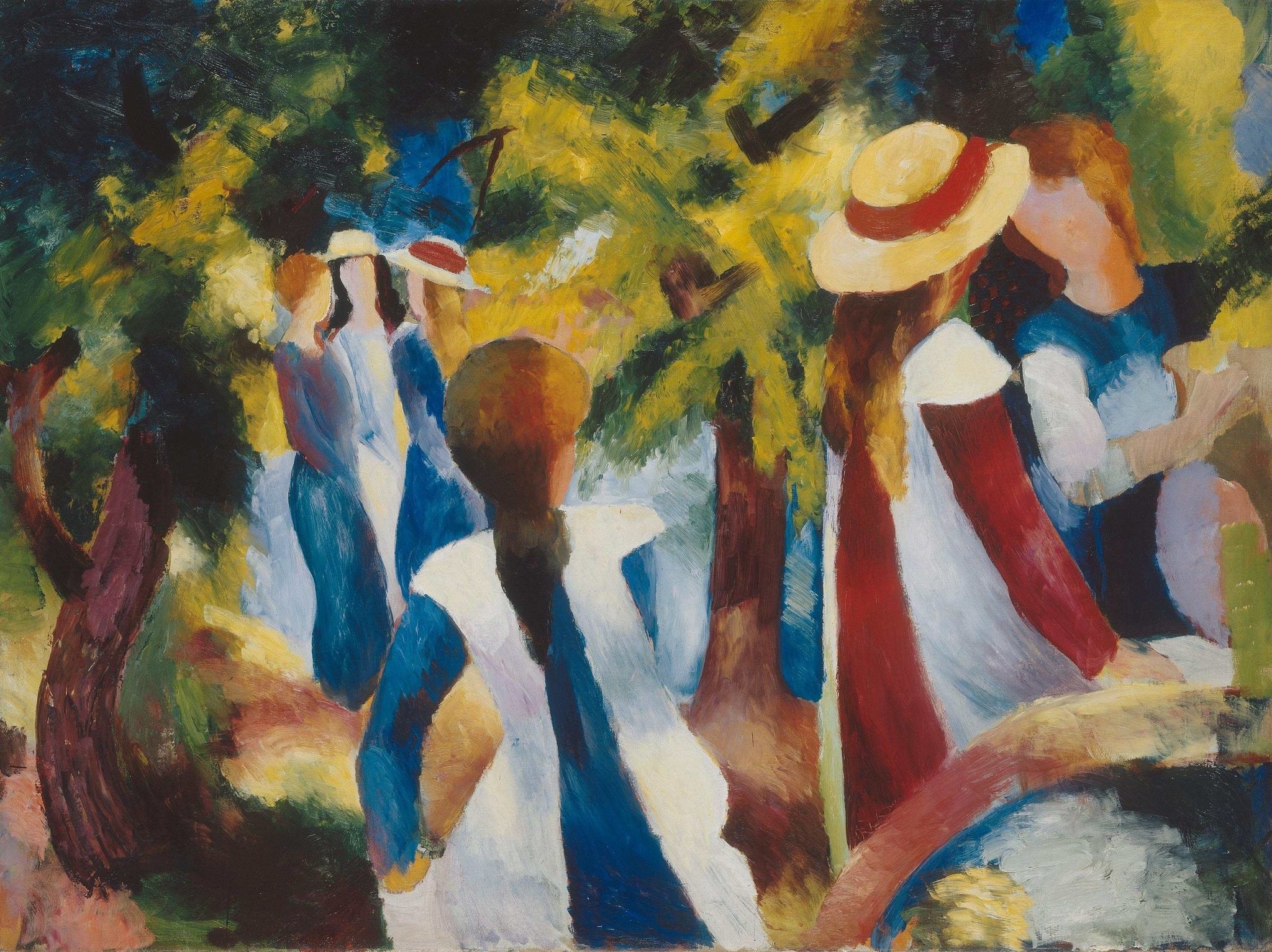
Girls under Trees (Mädchen unter Bäumen), 1914
Oil on canvas
119,5 × 159 cm
© Bayerische Staatsgemäldesammlungen – Sammlung Moderne Kunst in der Pinakothek der Moderne München, Germany
The painting unfolds like a warm, open afternoon in a park, where six girls gather in two gentle clusters beneath the trees. Nothing in the scene reaches for myth or symbolism; Macke keeps the moment grounded in the everyday, yet his color lifts it into something quietly festive. The bright dresses, the soft greens of the foliage, and the warm patches of sunlight create a sense of ease, as if the world has briefly arranged itself into harmony. His brushwork stays light and unforced, letting the colors shimmer against one another in a way that feels almost musical, and the dresses and wide-brimmed hats seem to drift into the surrounding greens, their edges dissolving softly so the figures feel carried by the light rather than outlined against it.
What gives the work its particular glow is Macke’s ability to turn an ordinary encounter into a small celebration of the present. The girls are absorbed in their own gestures and conversations, unaware of being observed, and this unselfconsciousness allows the scene to breathe. Above them, the trees form a loose, sheltering canopy, their vertical trunks giving the moment a quiet structure, like a natural pavilion holding the girls in a blooming space. The influence of Robert Delaunay is unmistakable in the way the colors vibrate, especially in the jug at the right edge of the fountain, where the contrasting disks of color echo Delaunay’s ideas about simultaneous contrasts. The quick, bright strokes move through dresses, hats, and leaves like a soft visual breeze, giving the whole scene its gentle sense of movement, yet Macke softens the theory into something lived and human. His color is not a system; it is a way of making the world feel more alive, more immediate.
In 1913 he had written to Franz Marc about this difference, admiring Delaunay’s “living color” and distancing himself from Kandinsky’s increasingly abstract compositions. That distinction is visible here. Macke was skeptical of the spiritual ambitions that animated much of the Blue Rider circle, preferring instead the beauty of the here and now. His parks, zoos, and city scenes reshape the modern world into a blooming garden, a place where color harmonizes rather than agitates. Even the movement of the girls—unhurried, absorbed—feels like part of this gentle transformation, as if the world were briefly held in balance, their slight turns toward one another deepening the painting’s calm sociability and making the moment feel quietly shared.
Painted in 1914, in those last bright months before the war, the work carries a quiet poignancy. It captures a world still intact, still full of light, before the rupture that would follow. The calm sociability, the soft radiance, and the trust in the everyday make this one of the clearest expressions of Macke’s vision: a moment of simple human presence, held tenderly in color.
Leave a Reply