Egon Schiele:
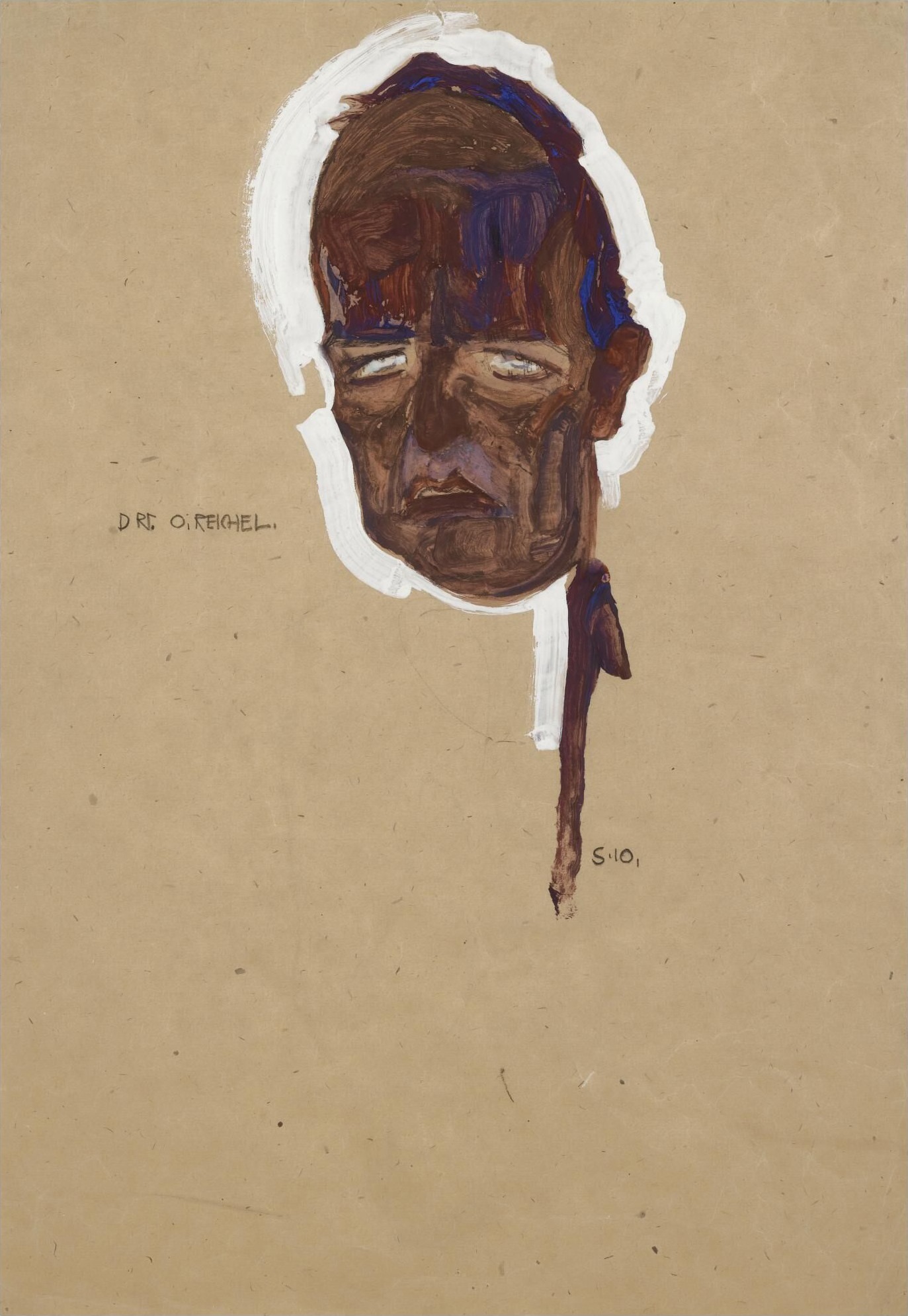
Portrait of Dr. Oskar Reichel, Head Study (Bildnis Dr. Oskar Reichel, Maske), 1910
Gouache, watercolour and pencil heightened with white on paper
44.5 × 31.1 cm
Auctioned at Sotheby’s in 2006 for 825,600 GBP
(Kallir d641)
This head study of Dr. Oskar Reichel confronts the viewer with a stark, almost abrasive directness. Schiele gives us a face that seems to hover between likeness and apparition, the features pushed into a narrow, mask‑like frame that feels both intimate and unsettling. Reichel himself was a prominent Viennese physician and collector, a man of sharp intellect and considerable cultural curiosity, and Schiele responds to that presence with a gaze that feels too direct to be comfortable. Many viewers may recoil from this intensity, but that reaction is part of the drawing’s charge: Schiele is not offering charm, he is offering the truth of a moment in which sitter and artist meet without disguise.
The handling reinforces this tension. The gouache and watercolour sit in thin, uneven layers, allowing the pencil structure to flicker beneath like exposed nerves. White heightening flashes across the brow and cheek, giving the head a pallor that feels almost electric, as though the face were lit from within. The surrounding paper is left bare, so the head floats in a void that sharpens its strangeness. The expression is difficult to pin down — alert, wary, perhaps even slightly defensive — and it is precisely this ambiguity that gives the sheet its unsettling pull. Schiele is not smoothing Reichel into a reassuring patron; he is studying a man whose intelligence and self‑possession resist easy interpretation.
And yet this is exactly where Schiele’s art lives in 1910. Reichel had only recently entered his circle, introduced by Arthur Roessler, and quickly became one of his most important supporters, collecting both Schiele and Kokoschka with a discerning eye. Instead of flattering him, Schiele looked with a kind of fearless scrutiny that could unsettle both sitter and viewer. The drawing belongs to the uncompromising core of his early portrait practice: works that strip away social polish and leave the psychological surface exposed. Some may dislike it, some may find it too sharp or too strange, but it is unmistakably Schiele — a portrait that insists on being seen on its own terms, without dilution or apology.
Leave a Reply