Egon Schiele:
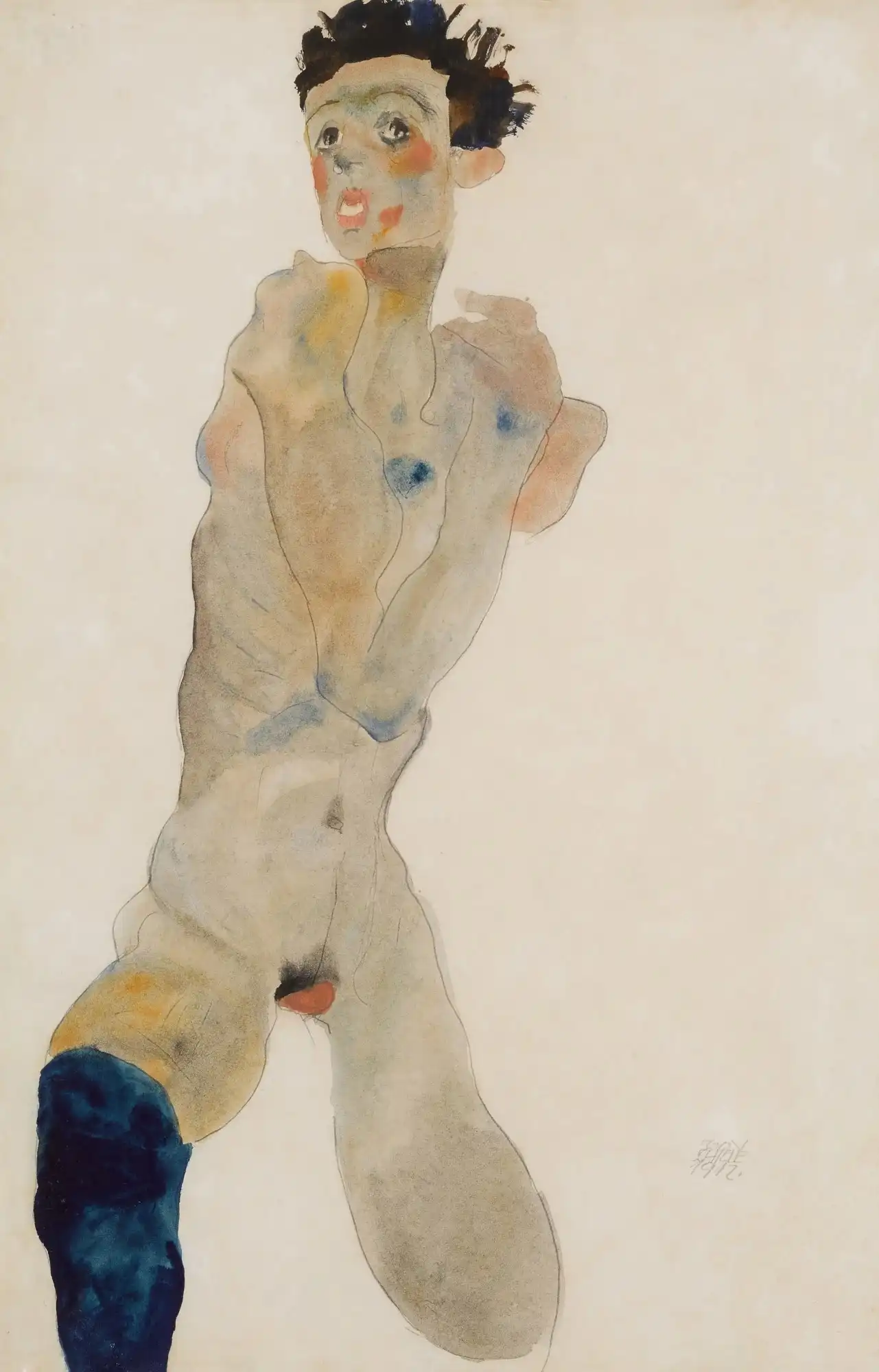
Standing Male Nude with Crossed Arms (Self‑Portrait) (Stehender männlicher Akt mit verschränkten Armen (Selbstbildnis)), 1912 Gouache, watercolour and pencil on paper
46.4 × 29.5 cm
Auctioned at Sotheby’s in 2024 for 1,016,000 GBP
(Kallir d1163)
Schiele returned again and again to the self‑portrait as a way of testing both his technique and his own sense of identity, and this sheet from 1912 shows him working with a clarity that feels unusually calm for such an exposed pose. By this moment he had moved away from the sharp angularity and fierce contrasts of 1910, letting the line soften into something finer and more deliberate. The washes settle in pale, translucent pools across the body, leaving small untouched passages of paper that give the skin a fragile brightness. The tones shift gently between yellows, greys, faint blues and pinks, with only a few stronger notes—the flushed cheeks, the dark, wide eyes, and the quick electric blue of the stocking—giving the figure its quiet charge.
He stands alone in an empty field of paper, as he so often placed himself and his models, with no setting to distract from the body’s language. The crossed arms and slight tilt of the head create a tension that feels both defensive and strangely open, as if he is caught between stepping forward and pulling back. The hands, though partially hidden, are drawn with a nervous precision that adds to the inward pressure of the pose. That mixture of vulnerability and assertion is characteristic of his self‑portraits of these years, where the body becomes a site of conflict as much as revelation. The gaze, deep and almost ink‑dark, gives the figure its emotional centre, while the soft modelling of the torso keeps the drawing anchored in the physical world.
This posture recurs in several works from 1912, including the oil now in the Leopold Museum, and it captures something essential about Schiele’s self‑image at this moment: a young artist testing the limits of his own presence, aware of his power yet unsettled by it, moving between confidence and hesitation. In this sheet, that duality is expressed with unusual economy. The figure seems to confront the viewer and withdraw at the same time, the body exposed yet held close, the whole drawing shaped by the delicate balance between bravado and doubt that runs through Schiele’s most searching self‑portraits.
Leave a Reply