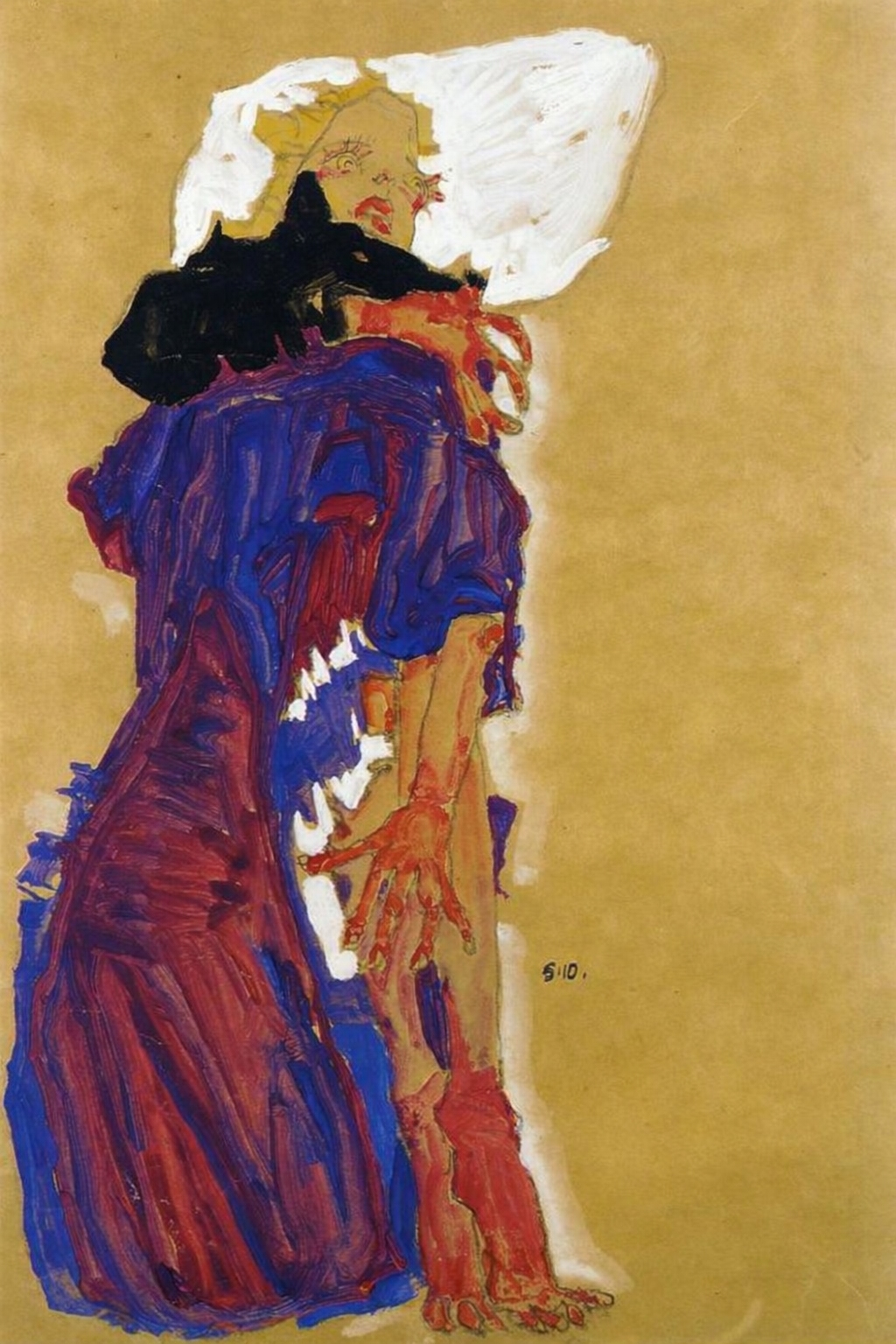
Egon Schiele:
Reclining Girl on Pillow (Liegendes Mädchen auf Kissen), 1910 Gouache, watercolor and pencil with white heightening
45.9 × 30 cm
Private collection
(Kallir d416)
This drawing carries a quiet unease that settles in the moment you look at it. The girl lies on her side, but there is nothing fully relaxed about her. The red of her blouse is strong and almost restless, pushing forward against the pale ground, and the blue beneath it adds a sharp note that keeps the whole figure slightly on edge. Her body is turned in a way that feels caught between comfort and tension, as if she is trying to settle but can’t quite let go. Schiele follows that feeling with his line: the contours are sure, but they hold a faint tremor, a sense that the pose might shift at any second. The white heightening touches her skin lightly, but even that small brightness feels alert rather than calm.
Her hands and feet carry that familiar Schiele red, not decorative but charged, giving the figure a kind of inner heat that doesn’t sit easily. The tilt of her head, the slight lift of her shoulders, the way her arm folds in — all of it adds to the sense that she is present but not at ease. The pillow beneath her supports her, yet it doesn’t soften the mood; it simply holds her in place while the rest of her seems to resist settling. Schiele doesn’t hide this discomfort. He lets it stay on the page, open and unfiltered.
The background is plain and dry, offering no distraction, no setting to soften the figure. It makes her stand out more sharply, as if she were placed in a space with nothing to lean on but herself. A small studio note in the corner reminds you how immediate the sheet is, how quickly it must have been made, and how closely Schiele was watching her. He wasn’t looking for charm or ease; he was looking for truth, even when that truth sits awkwardly.
This is Schiele early on, already drawn to the tension inside a simple pose, already willing to show a body that doesn’t quite rest. Some may find the unease unsettling, but it is exactly this honesty that makes the drawing feel alive. The girl is not idealised, not softened, not arranged to please. She is simply there, caught in a moment that wavers between rest and discomfort, and Schiele meets her with the same directness. The result is a sheet that stays with you, not because it is gentle, but because it refuses to pretend.
Leave a Reply